Personal & Family

Separation Agreement HK: Cap. 192 s.14 Deed Template

Separation deed drafted to section 14 of the Matrimonial Proceedings and Property Ordinance (Cap. 192) and the Cap. 179 separation periods. Word and PDF.
4.6/519 reviews50 000+ downloadsInstant download
Share

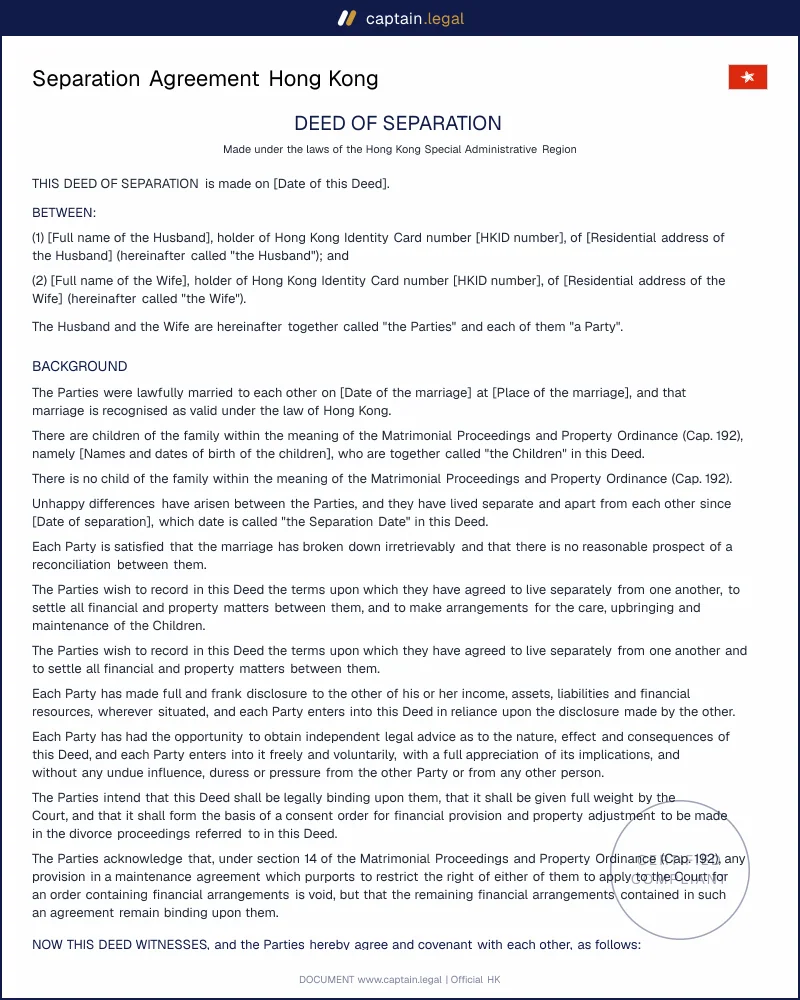
A separation agreement is the written contract a married couple signs when they decide to live apart, recording maintenance, the arrangements for the children, occupation of the matrimonial home and the division of assets, without ending the marriage. In Hong Kong it is a maintenance agreement under section 14 of the Matrimonial Proceedings and Property Ordinance (Cap. 192), normally executed as a deed so the promises bind even where nothing of value passes between the spouses. Couples reach for one when the marriage has broken down but a divorce petition is premature or unwanted, either because the separation period has not yet run or because the family wants settled terms before going near the Family Court.

Compliant

2026 Legislation

50,000+ clients

trust us

Affordable

From $4.90 / doc

Secure payment

Instant download

Separation Agreement HK: Cap. 192 s.14 Deed Template

Secure payment

Fill in the template

What is a separation agreement between spouses in Hong Kong?

A separation agreement is a contract between two people who remain legally married. It changes nothing about their status: they cannot remarry, and each remains the other's next of kin until a decree absolute. What it does is fix the terms on which they will live apart, which is what section 14 of Cap. 192 contemplates when it speaks of a written agreement between parties to a marriage containing financial arrangements. The Court of Appeal in L v C confirmed that such agreements carry real weight and should be held to unless a party shows compelling, unforeseen circumstances.

Three neighbouring documents get confused with it. A judicial separation is a court decree obtained through matrimonial proceedings, not a private contract. A consent summons in ancillary relief is an agreement turned into a court order and enforceable as one. A pre-separation postnuptial agreement, signed while the couple still live together, falls outside section 14 and is judged by the Radmacher principles adopted in SPH v SA. Our template is a private deed made on or after the actual separation, drafted so it can later be lifted into a consent summons. Related documents sit in the Hong Kong personal and family templates collection.

2

When do you need this document?

The most common trigger is the decision to stop sharing a home while the separation period runs. A couple intending to file a joint application under section 11B of Cap. 179 must prove the separation date, and a dated deed signed on the day one spouse moves out beats messages reconstructed two years later. The second scenario is financial: one spouse earns, the other has been at home with the children, and the household cannot wait for a maintenance pending suit hearing. Religious and family objections to divorce account for a third group, who separate permanently and never petition. A fourth is expatriate: one spouse is posted out of Hong Kong and the terms need recording first.

Two edge cases deserve attention. Where one spouse holds shares in a family company, the deed should record how that interest is treated and be read alongside the governance terms in our Hong Kong shareholders agreement template, because valuation disputes are the commonest reason separation deals collapse later. Where a parent will travel abroad with a child, a standalone child travel consent letter for Hong Kong is still needed, since immigration officers do not read separation deeds.

3

Key clauses included in our template

  • The recital of separation fixes the date the spouses ceased to live in the same household and states that they intend to live apart permanently. That date is the one relied on under section 11A(2)(c) or 11A(2)(d) of Cap. 179, so the wording is drafted to survive cross examination.
  • The maintenance provisions separate spousal from child maintenance and state each figure, its due date, the payment method and the review mechanism. Keeping the streams apart matters because the court's power over child provision under Cap. 192 is wider and cannot be traded away.
  • The arrangements for the children cover custody, care and control, and access, with term time and holiday schedules, handover points and a communication protocol, all recorded as subject to section 3 of the Guardianship of Minors Ordinance (Cap. 13).
  • The matrimonial home clause sets out who occupies the property, who services the mortgage, rates and management fees, and what happens on sale. Where a transfer is agreed, it provides for an assignment stamped under the Stamp Duty Ordinance (Cap. 117).
  • The full and frank disclosure schedule lists the assets, liabilities, MPF accrued benefits and income each spouse has declared. Without it the deed is open to attack on the basis that one party signed without appreciating what was given up.
  • The releases and undertakings cover non-molestation, claims against each other's estates and the taking of independent legal advice, closing the gaps that resurface in probate or under the Domestic and Cohabitation Relationships Violence Ordinance (Cap. 189).
4

Cross-border and practical considerations in Hong Kong

Hong Kong is a single jurisdiction, so there are no regional variants, but the practical position shifts with where the assets sit. Mainland property is the frequent complication: a Hong Kong deed can record what the parties agree about a flat in Shenzhen, yet giving effect to it usually needs a separate instrument attested by a China-Appointed Attesting Officer before any Mainland registry will act.

Public housing changes the calculation. Where the family occupies a Housing Authority flat or a subsidised sale flat, occupation rights follow tenancy policy and alienation restrictions rather than the couple's private bargain, so a clause promising one spouse exclusive occupation may be unenforceable against the landlord. Couples in that position often need a private letting for the departing spouse, drafted with our tenancy agreement template for Hong Kong landlords and tenants.

Retirement money is the third area where expectations run ahead of the law. Hong Kong has no pension sharing mechanism, so MPF accrued benefits under the Mandatory Provident Fund Schemes Ordinance (Cap. 485) cannot be split by private agreement. They are disclosed, valued, then offset against other assets.

5

How to fill out this separation agreement

You begin with the identity details of both spouses and the date and place of the marriage, taken from the certificate rather than from memory, because a discrepancy causes requisitions later. The form asks for the separation date and whether the spouses already live in different households, and adjusts the recitals to match. Next come the children: names, dates of birth, the custody arrangement and the access schedule, with sole and joint custody wording generated from your answer.

The financial section takes disclosure first and promises second. You list assets, liabilities, MPF balances and monthly income for each spouse, then set the maintenance figures, payment dates and review terms. If the matrimonial home is to be transferred or sold, the form produces the matching undertakings and timetable. The deed then prints with attestation blocks for a witness to each signature, in Word and PDF.

6

Common mistakes to avoid

The mistake that causes the most damage is signing without disclosure. A spouse who later discovers an undeclared property or an unmentioned bonus has a straightforward route to reopening the financial terms, and section 15 of Cap. 192 gives the court the machinery. Almost as common is the couple who sign a deed and then carry on sharing the flat for cost reasons. Section 11C of Cap. 179 asks whether they live with each other in the same household, and a shared kitchen with shared meals will usually defeat a claim of two years' separation.

Three drafting errors recur. The first is a clause purporting to prevent either spouse from ever applying to court, which is void and sometimes taints the negotiating history. The second is treating the children's arrangements as a bargaining chip against maintenance, since the court will not enforce a trade that leaves a child short. The third is failing to execute as a deed, losing the twelve year limitation period. Separation does not revoke a will or sever a joint tenancy, so review the estate documents at the same time with our Hong Kong will template drafted to the Wills Ordinance.

Key takeaways

STATUS

You stay married, but set terms

A separation agreement is a private contract between spouses who remain legally married. It does not end the marriage, so you cannot remarry and you may still be treated as each other’s next of kin until a decree absolute. What it does do is record agreed arrangements for maintenance, children, the matrimonial home and asset division under section 14 of the Matrimonial Proceedings and Property Ordinance (Cap. 192).
COURT POWERS

You cannot contract out of court

No clause can block either spouse from applying to the Family Court for ancillary relief: the Hyman v Hyman rule still applies in Hong Kong, so a bar on court applications is void even if the rest of the deed stands. The District Court can also vary financial arrangements under section 15 of Cap. 192 if circumstances change or the deed does not provide properly for a child.

TIMETABLE

Separation length affects when you can petition

The Matrimonial Causes Ordinance (Cap. 179) sets the divorce timetable: section 12 stops any petition within the first year of marriage (save for exceptional hardship or depravity). After that, a petition can be based on living apart for one continuous year with the other spouse’s consent (section 11A(2)(c)), or two years without consent (section 11A(2)(d)). Section 11C warns that “living apart” requires not sharing the same household.

Frequently Asked Questions

Yes. It is a valid contract between spouses and, executed as a deed under section 19 of the Conveyancing and Property Ordinance (Cap. 219), it can be sued on for twelve years under the Limitation Ordinance (Cap. 347). The Court of Appeal in L v C held that separation agreements should be upheld unless there is a compelling case of unforeseen circumstances. What it cannot do is bind the Family Court absolutely: section 15 of Cap. 192 lets the court alter the financial terms where circumstances have changed or a child is not properly provided for.

One continuous year if your spouse consents, under section 11A(2)(c) of the Matrimonial Causes Ordinance (Cap. 179), and two years without consent, under section 11A(2)(d). A joint application under section 11B needs one year of living apart or a signed notice of intention filed a year earlier. No petition may be presented within the first year of the marriage at all, under section 12, other than for exceptional hardship or exceptional depravity. The date in your deed starts that clock.

It must be witnessed. A deed requires each signature to be attested, and in practice the couple sign before an independent adult who is not a party and, ideally, not a family member. Notarisation is not required for use in Hong Kong. To rely on it in the Mainland, arrange attestation by a China-Appointed Attesting Officer; for a civil law country, a notary and legalisation are usually needed.

Yes, by a written deed of variation signed with the same formalities as the original. A posting outside Hong Kong, a child moving school or a serious illness are all reasons couples revisit the numbers. Do not rely on an informal understanding: if one spouse quietly pays less for two years, the other may still claim the arrears. Failing agreement, section 15 of Cap. 192 lets either spouse ask the court to alter the terms.

You receive it in both Word and PDF. The Word file lets you or your solicitor adjust a clause, add a schedule of assets or change a handover time before signing; the PDF is the clean version for printing and execution. Both carry the attestation blocks and the disclosure schedule. Print two originals so each spouse holds a signed set. Related paperwork sits in the Hong Kong document catalogue.

Unpaid instalments accrue as a contractual debt you can pursue in the District Court, so nothing disappears. A contract claim is slower than enforcing an order, though. If payments become unreliable, the route is an application under the Separation and Maintenance Orders Ordinance (Cap. 16), which allows a maintenance order without a divorce, or a petition followed by a consent summons turning the agreed figures into an order.

4.6/5

19 verified reviews · 50 000+ downloads

Separation Agreement HK: Cap. 192 s.14 Deed Template
  • Immediate access to the document
  • PDF + Word download
  • Compliant with 2026 legislation
  • Reviewed by lawyers
Fill in the template
Secure payment
Updated on September 2, 2026

You might also like

Prenuptial Agreement Hong Kong
Letter of Authorisation Hong Kong