Personal & Family

Child Travel Consent HK: Cap. 13 Consent Letter

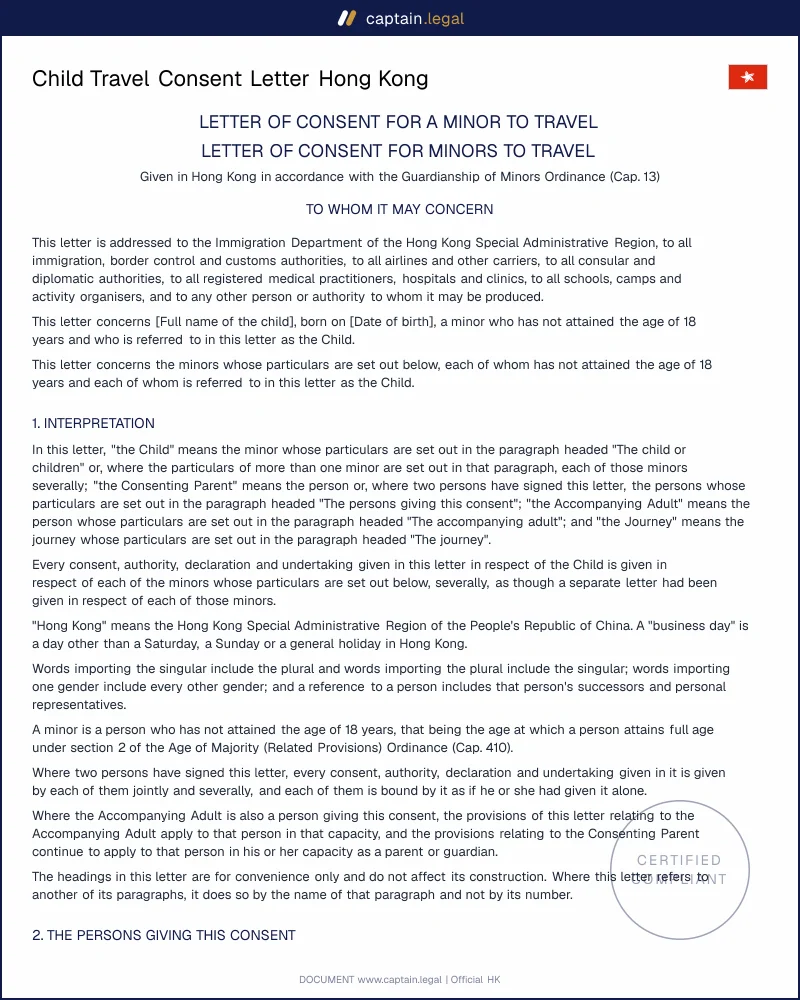
Consent letter drafted to section 3(1)(b) of the Guardianship of Minors Ordinance (Cap. 13), with itinerary and emergency medical consent. Word and PDF.
4.8/517 reviews50 000+ downloadsInstant download
Share

A child travel consent letter is the written authorisation a parent or legal guardian signs so that a minor can leave Hong Kong with one parent only, a grandparent, a school group or a domestic helper. It identifies the child, the accompanying adult, the destinations and the travel dates, and normally carries an emergency medical consent so the adult in charge can authorise treatment abroad. Immigration officers, airline check in staff and foreign border control all want the same thing: written proof that the adult presenting a child at the counter has the right to do so. Separated parents, cross boundary families and expatriate households are the heaviest users of this parental travel authorisation.

Compliant

2026 Legislation

50,000+ clients

trust us

Affordable

From $4.90 / doc

Secure payment

Instant download

Child Travel Consent HK: Cap. 13 Consent Letter

Secure payment

Fill in the template
2

When do you need this document?

The commonest trigger is a school holiday split across two households. One parent takes the children to Bangkok for a week, the other stays in Hong Kong, and the airline asks at the gate why the adult's identity card surname does not match the child's passport. Grandparents flying a child to the Mainland or Kuala Lumpur face the same question with less support, since a birth certificate proves parentage but says nothing about permission. School trips and sports tours follow: most schools now collect a signed consent per pupil, because the tour leader needs authority for each child.

A domestic helper travelling with a child is a Hong Kong specific case overseas templates handle badly. The helper is an employee under the Employment Ordinance (Cap. 57), not a relative, and officers treat her differently, so the letter must name her, give her passport number and record that she is engaged under a Hong Kong employment contract. Two edge cases repay planning. A child holding a second nationality may face the entry rules attached to the passport used at the destination rather than the HKSAR one. Where one parent has died, the survivor is the guardian under Cap. 13 but will still be asked for the death certificate at some borders, so the letter should refer to it.

3

Key clauses included in our template

  • The identification of the child reproduces the name exactly as it appears on the HKSAR passport, with the birth certificate number, the date of birth and the passport number. Any variation between letter and passport invites a question at the counter.
  • The basis of the signatory's authority states whether the signatory is the mother, the father or a guardian appointed under Cap. 13, and confirms those rights have not been limited by court order. This is the clause an immigration officer reads first, and it is why the template is drafted differently for a sole custodian and for an enduring power of attorney, which concerns property.
  • The details of the accompanying adult cover full name, identity document number, relationship to the child and a contact number abroad. Where that adult is a foreign domestic helper, the clause records the employment relationship and pre-empts the question at the control point.
  • The itinerary and validity period name each country, the travel dates and the flight or ferry details where known. Open ended wording such as "for any travel" is routinely rejected, so the template forces a defined window.
  • The emergency medical consent authorises the accompanying adult to consent to treatment and hospitalisation, and records allergies and insurance particulars. Hong Kong has no equivalent of the English rule letting a sixteen year old consent alone, so the clause matters for teenagers too.
  • The execution block provides for signature, date, a witness and, where required, attestation before a Commissioner for Oaths or notary public. Space is reserved for the apostille issued by the High Court.
4

Regional considerations for departures from Hong Kong

Mainland China is the busiest crossing and the least forgiving on paperwork. A child travelling on a Home Return Permit is inspected on both sides, and cross boundary pupils are checked daily, so those families keep a standing letter with the escort. Where the child holds a foreign passport, the visa rules apply in full and the letter is best prepared in English and Chinese.

Macao applies lighter formalities, yet ferry operators and crossing staff still ask an adult who is not the parent for written authority. Airlines are the other gatekeeper: carriers at Hong Kong International Airport apply their own accompanied minor policies, and a letter that fails to name the accompanying adult can stop a family at check in.

Commonwealth destinations are the strictest. South Africa requires evidence of parental consent for minors and has turned travellers away over an unsigned or undated letter. Canada publishes a recommended consent form, while Australia and the United Kingdom leave it to officer discretion, which means the letter is requested whenever surnames differ.

The Schengen Area treats the letter as evidence for the visa application as much as for the border. Consulates in Hong Kong ask for the consent of both parents where a minor applies for a short stay visa, and several want the signature certified.

6

Common mistakes to avoid

Undated letters cause more trouble than any other defect. An officer looking at a signature with no date cannot know whether the consent predates a custody dispute, and the letter is then worth very little. The second recurring failure is the surname mismatch left unexplained: where a child carries the father's surname and travels with the mother, the letter should say so and the birth certificate should travel with it. Third, parents copy an American template reciting state law and notarisation requirements that mean nothing to a Hong Kong or Mainland officer.

Two further mistakes carry real legal risk. Signing a consent letter while custody or access proceedings are pending, without the agreement of every party, does not cure the restriction in Cap. 512, and a parent who relies on the letter alone may still be in breach. Families also forget to revoke. A letter left in circulation after a separation still looks valid to whoever reads it, so the safe practice is a short validity window and retrieval of the original on return.

Key takeaways

Purpose

It is evidence for airlines and border officers

Hong Kong has no statutory form for a child travel consent letter, and there is no ordinance saying a child cannot fly without one. Its value is evidential: it links the child, the accompanying adult, the destinations and the travel dates, so check-in staff or immigration can clear doubts quickly (for example, where surnames differ on an HKSAR passport).

Legal position

One parent may travel, unless restrictions apply

Section 3(1)(b) of the Guardianship of Minors Ordinance (Cap. 13) puts mother and father on an equal footing and, read literally, allows either parent to exercise parental authority alone. The position can change where the child was born outside marriage (section 3(1)(c)) or where a court has made custody or access orders that restrict removal from Hong Kong.

Risk

A consent letter cannot override court orders

A travel consent letter is not a court order. If custody or access proceedings are on foot, the Child Abduction and Custody Ordinance (Cap. 512) can bar removal of a child from Hong Kong without the consent of every party, and many orders repeat that restriction. A sealed prohibition order sent to the Immigration Department can place the child on a stop list, and an officer suspecting a breach may detain the child.

Frequently Asked Questions

The letter is a private evidential document, not a statutory instrument. What it does is record, in a form an immigration officer can act on, that the holder of parental rights under section 3(1)(b) of the Guardianship of Minors Ordinance (Cap. 13) authorised the journey. Signed, dated and witnessed, it is treated as reliable evidence of consent. It cannot displace a court order restricting removal, nor create parental rights the signatory does not hold.

Where the parents were married, either may consent alone under section 3(1)(b), so one signature is legally sufficient in Hong Kong. Two signatures are far stronger in practice. Several consulates here require both parents' consent for a minor's visa, and South Africa looks for evidence from each. Where the child was born outside marriage and the father has not obtained a section 3 declaration, the mother's signature alone is the correct one.

Both come from the same completed form. The PDF is the version to print, sign and carry, since it holds the layout officers expect. The Word file exists for the edits that always come up: a flight moved by a day, an accompanying adult added at short notice. Keep a signed scan on a phone as well as the original: check in staff often accept a photograph, a border officer wants paper.

Sign it close to departure, ideally within the month before travel, and never leave it undated. A letter signed a year ahead invites the question whether circumstances have changed. Where a consulate requires it for a visa, work backwards from the appointment rather than the flight. For repeated crossings to the Mainland or Macao, a defined term is usually accepted if the accompanying adult and the purpose are stated.

For most journeys, no. A signature and a witness are enough for the Mainland, Macao and most leisure destinations. Certification becomes worthwhile in two situations: a consulate has asked for it in writing, or the destination scrutinises minors closely. A Commissioner for Oaths at a Public Enquiry Service Centre, a solicitor or a notary public can attest the signature, and the High Court issues the apostille where legalisation is required.

Refusal does not always block the trip: either parent may consent alone under Cap. 13 where no court order says otherwise. Where an order or pending proceedings restrict removal, you need the leave of the court, rarely refused for an ordinary holiday with a clear return date. Where the worry runs the other way, a prohibition order notified to the Immigration Department is the tool. If a guardian is to take over on your death, deal with that in a Hong Kong will, not in a travel letter.

4.8/5

17 verified reviews · 50 000+ downloads

Child Travel Consent HK: Cap. 13 Consent Letter
  • Immediate access to the document
  • PDF + Word download
  • Compliant with 2026 legislation
  • Reviewed by lawyers
Fill in the template
Secure payment
Updated on August 19, 2026

You might also like

Last Will and Testament Hong Kong
Small Claims Tribunal Claim Pack HK