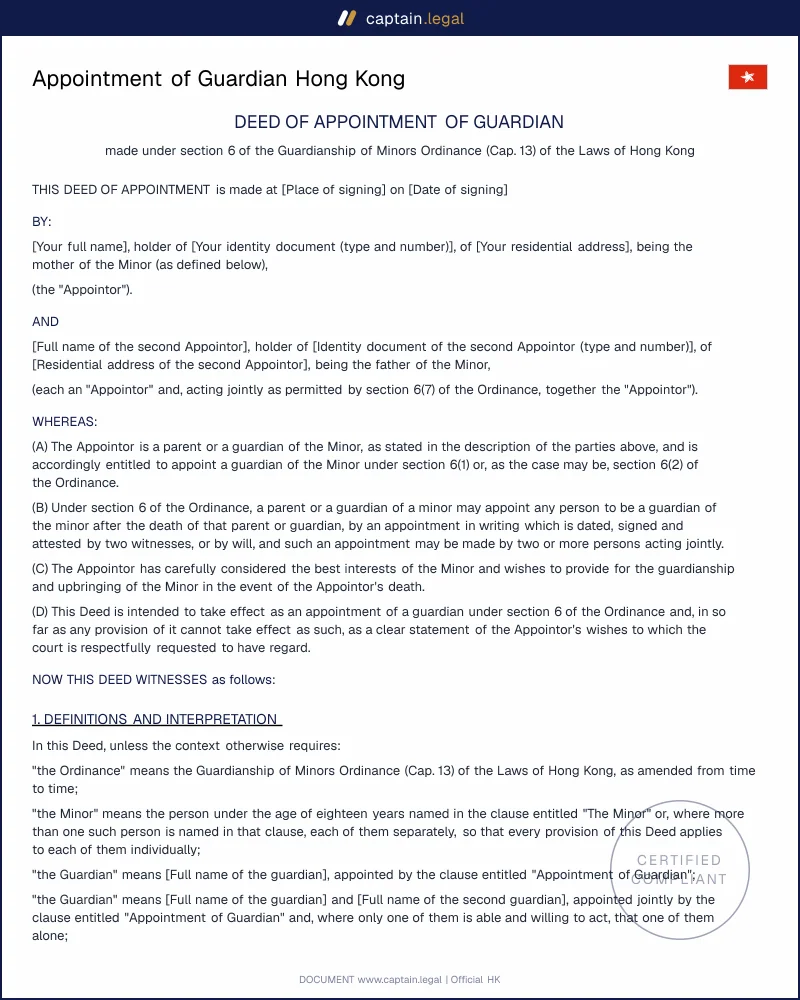
Separated and divorced parents should read the appointment together with their custody arrangements. A parent holding a custody order under the Matrimonial Proceedings and Property Ordinance (Cap. 192) or under Cap. 13 itself triggers the automatic route in section 7, so the guardian steps in at once even though the other parent is alive. The surviving parent keeps the right to ask the court to vary that outcome. Where the appointing parent had no custody order, the guardian has no authority until the court makes an order. If you are negotiating a separation deed with custody and access terms, settle guardians on death in the same discussion. The other parent's written agreement removes most of the litigation risk.
Families with Mainland China ties should know that the Hong Kong appointment governs guardianship in Hong Kong. Parents can designate a guardian by will under article 29 of the Civil Code of the People's Republic of China, and where children live or hold property across the boundary, a parallel Mainland designation naming the same person avoids two systems reaching different answers. A Hong Kong document meant for use in the Mainland normally has to be attested by a China-Appointed Attesting Officer.
Expatriate families face the reverse question. Parents domiciled in England and Wales may already hold an appointment under section 5 of the Children Act 1989, and Australians and Americans often have a guardianship clause in a home country will. Name the same guardian in Hong Kong, and state that the deed is an additional appointment if you do not want it to revoke the foreign one. Guardianship gives the guardian no immigration status, so a guardian living abroad may need to relocate the children. Households employing a foreign domestic helper should remember that the helper's visa is tied to the employer; the domestic helper hiring and termination pack covers the paperwork the surviving household will face.
Children who will inherit assets need more than a guardian. A guardian has authority over the child, but money left to a minor is best held by trustees under a will trust governed by the Trustee Ordinance (Cap. 29). Many parents give the two roles to different people, one to raise the children and another, often a financially experienced relative, to manage the funds.