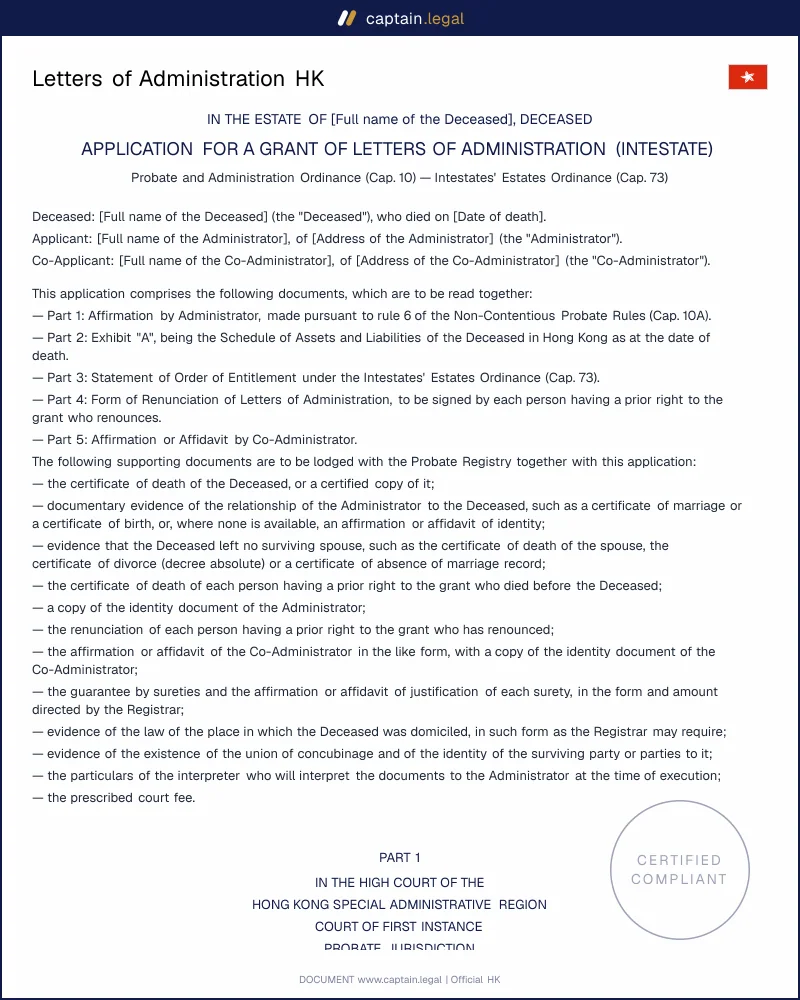
The Probate and Administration Ordinance (Cap. 10) vests the power to grant representation in the Court of First Instance. Section 25 requires at least two administrators, or a trust corporation, whenever a minority or life interest arises under the intestacy, so an estate passing partly to a child under 18 cannot be granted to the surviving parent alone. Section 60J makes it a criminal offence to take possession of or deal with the property of a person who died on or after 11 February 2006 without lawful authority or reasonable excuse.
Procedure sits in the Non-Contentious Probate Rules (Cap. 10A). Rule 2A lets the Registrar specify the forms applicants must use, rule 21 fixes the order of priority (spouse, children, parents, then siblings and more remote kin) and rule 38 lists the situations in which the Registrar will call for sureties. The Judiciary's Probate Registry guide to grants and personal applications summarises these steps for lay applicants.
Distribution follows section 4 of the Intestates' Estates Ordinance (Cap. 73). A surviving spouse takes everything when the deceased left no issue, parent, full sibling or issue of a full sibling. A spouse with issue takes the personal chattels, a fixed statutory legacy and half the residue, the other half going to the issue on statutory trusts. With no issue but a surviving parent or full sibling, the legacy is larger. Without a spouse, the estate passes in turn to issue, parents, full siblings, half siblings, grandparents, then uncles and aunts, and only after them to the Government as bona vacantia. Under section 6 of the Inheritance (Provision for Family and Dependants) Ordinance (Cap. 481), dependants may seek reasonable provision within six months of the grant, later only with the court's leave. In Li Yik Ho v Secretary for Justice (FACV 4/2024), the Court of Final Appeal upheld the finding that excluding same-sex couples lawfully married overseas from Cap. 73 and Cap. 481 was unconstitutional.