Employment & HR

GEP Visa Sponsorship HK: Cap. 115 and ImmD ID(E) 991

Employer pack drafted to ImmD guidebook ID(E) 991 and the Immigration Ordinance (Cap. 115): local recruitment letter, visa clause, ID 990B checklist.
4.7/5— 18 reviews50 000+ downloadsInstant download
Share

An employment visa sponsorship pack is the set of employer documents a Hong Kong company files with the Immigration Department (ImmD) when it hires an overseas professional under the General Employment Policy (GEP). It is drafted for HR managers, founders and in-house counsel who need the file to meet the standard of a Hong Kong law firm. The pack contains a support letter showing why the role cannot readily be filled locally, a schedule of key contract terms matching what ImmD checks, and a Form ID 990B checklist mapped to the online submission. A complete and consistent file is what allows ImmD's standard four-week processing time to apply in practice.

Compliant

2026 Legislation

50,000+ clients

trust us

Affordable

From $4.90 / doc

Secure payment

Instant download

GEP Visa Sponsorship HK: Cap. 115 and ImmD ID(E) 991

Secure payment

Fill in the template

What is a Hong Kong employment visa sponsorship pack?

The visa is granted by the immigration authorities, never by the employer. What the employer supplies is evidence: that the company is a genuine business, that the vacancy is real, that the candidate's skills match the post and that the remuneration package, including income, accommodation, medical and other benefits, sits at market level. The support letter is the centrepiece. It sets out the business need, the recruitment exercise run in Hong Kong and the reasons local applicants did not fit, which is the test in paragraph 8(d) of the ImmD guidebook ID(E) 991. The terms schedule then records the post, salary, fringe benefits and employment period, the four items ImmD expects to find in the employment contract or letter of appointment.

A sponsorship pack is not an offer letter, which rarely says a word about local recruitment. Nor is it the short employer confirmation letter used for an extension of stay with the same employer, which only states the position, total monthly remuneration and period of employment. Some foreign hires need no sponsor at all. Holders of a Top Talent Pass Scheme visa, or of a visa under the Immigration Arrangements for Non-local Graduates (IANG), stay on time limitation only, and dependants of a GEP professional are not prohibited from taking employment. Hiring any of them means checking their status, not sponsoring it.

When do you need this document?

The standard case for employment visa sponsorship is a Hong Kong company hiring a specialist from overseas after a local search came up short: a quantitative analyst, a cybersecurity engineer, a compliance lead. The pack also covers a change of employment. A GEP professional already in Hong Kong cannot simply resign and join you; the new employer files a fresh application and waits for approval before day one. Groups moving staff between offices use it for intra-company transfers. ImmD waives proof of local recruitment where the post is managerial or professional, the transferee has worked for the company for at least a year, the package is at market level and the number of transferees stays reasonable for the size of the business.

Eligibility has limits worth checking first. Nationals of Afghanistan, Cuba and North Korea are excluded from the GEP, and Chinese residents of the Mainland apply under the Admission Scheme for Mainland Talents and Professionals, where the employer documents are identical. Overseas Chinese holding PRC passports can use the GEP only with permanent residence overseas, or after living overseas for at least a year and applying from there. If the role appears on the government's Talent List, or the package reaches the high salary threshold in ImmD's facilitation measures, you no longer need to prove recruitment difficulty, but the letter must still explain the business need. Relocating staff also need a flat, and a residential tenancy agreement for Hong Kong flats is usually the next document.

Key clauses included in our template

  • The statement of business need opens the support letter. It describes what the company does in Hong Kong and why the post exists now, because ImmD reads the vacancy against the company's real operations and may run a field visit to check.
  • The local recruitment record lists where the role was advertised, for how long, how many applications came in and why each shortlisted local candidate missed a stated requirement. Specific reasons such as "no CFA charter" persuade; a bare "not suitable" invites a request for more documents.
  • The candidate fit paragraph ties the applicant's degree, technical qualifications and experience to each duty of the post. It answers paragraphs 8(b) and 8(d) of the guidebook in one place.
  • The remuneration package clause sets out salary, bonus, housing, medical cover and other benefits, with the same figures as the contract. These terms slot straight into our employment contract drafted to Cap. 57 and the 468 rule, so the two documents never contradict each other.
  • The visa condition clause makes the start of employment conditional on the grant of the visa and the employee's admission on employment condition with your company. If ImmD refuses, the offer lapses, and the employee confirms they will take no other work in Hong Kong without approval. For hires handling client data or code, pair it with a confidentiality and IP assignment deed for Hong Kong employees.
  • The ID 990B checklist maps every employer upload, from the Business Registration Certificate to the business plan required of companies under 12 months old, and flags which items fall away under the facilitation measures. It also lists papers ImmD may request on top, such as a staff list.

Sector-specific considerations

Financial services. A GEP visa lets the professional work for the sponsor; it does not license them. Carrying on a regulated activity for a licensed corporation requires a licence from the Securities and Futures Commission (SFC) under the Securities and Futures Ordinance (Cap. 571), and bank staff doing the same work need entry on the register kept by the Hong Kong Monetary Authority under the Banking Ordinance (Cap. 155). The regulated part of the role cannot start before that, so the letter should state the licensing plan and its timing, and the contract should make continued employment conditional on the licence.

Healthcare and registered professions. Doctors, lawyers and teachers face a second gatekeeper. A doctor trained abroad needs full, limited or special registration under the Medical Registration Ordinance (Cap. 161) before treating patients. A foreign lawyer must register with the Law Society under the Legal Practitioners Ordinance (Cap. 159) before advising on foreign law, and a school teacher must be a registered or permitted teacher under the Education Ordinance (Cap. 279). ImmD will not treat a job as viable if the candidate cannot lawfully perform it. The pack records the registration route and its expected timing.

Start-ups and new companies. A company set up within the last 12 months must upload a detailed business plan covering source of funds, capital injection, projected turnover and the local jobs it expects to create. Where the candidate is a founder or significant shareholder rather than a hire, the employment route may be the wrong one: the GEP has a separate stream for investment as entrepreneurs, which this pack does not cover. When a director signs for the company, a short board resolution authorising the sponsorship and the signatory removes doubt about who binds it.

Skilled trades and non-degree hires. A candidate without a degree can qualify under the standard GEP only in special circumstances, with good technical qualifications or proven professional ability backed by documents. Trades on the Technical Professional List now have a dedicated Technical Professionals Stream for applicants aged 18 to 40, with a quota allocated first come, first served and a minimum contract duration per trade. Under that stream, employer and employee must both notify ImmD within seven days if the contract ends early. Hires under that stream need the trade evidence on top of this pack.

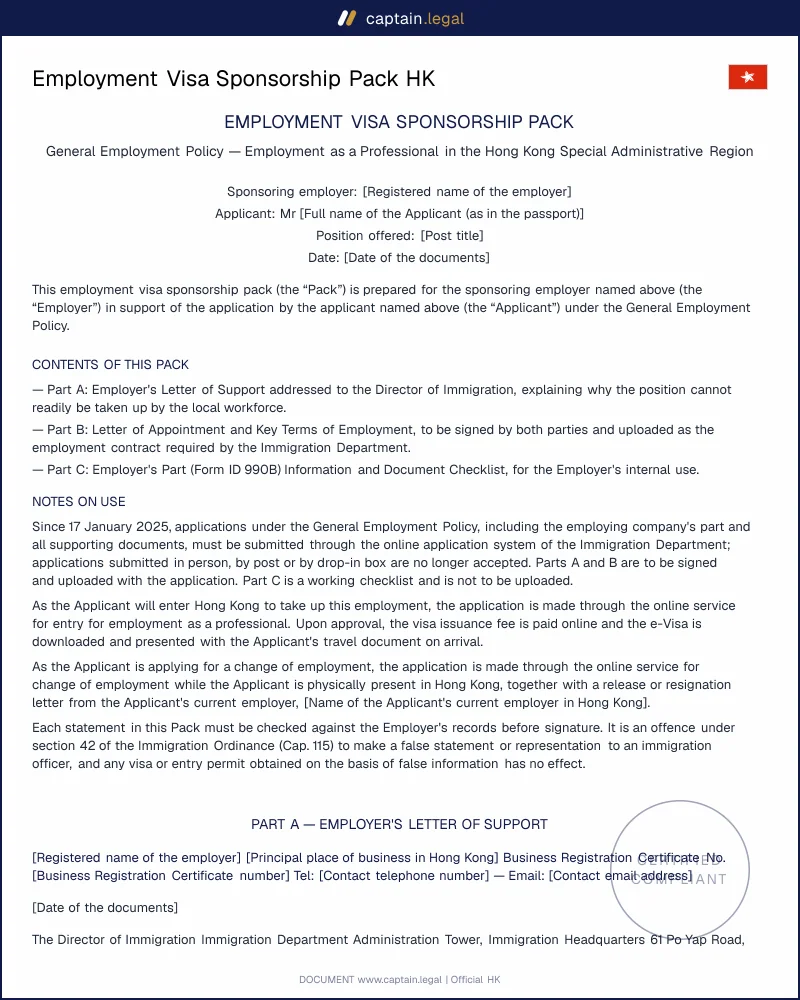
How to fill out this employment visa sponsorship pack

You start with the company: legal name, Business Registration number, date of incorporation, and whether it is listed in Hong Kong or has obtained an employment visa for non-local staff in the past 24 months. Those answers decide which corporate documents appear on your checklist, and a company set up within the last 12 months is also asked for the business plan figures ImmD expects. Next comes the role, described by duties rather than title, followed by the candidate's nationality, qualifications and work history so the letter can draw the link ImmD looks for. The recruitment section asks where and when you advertised, how many people applied and why the shortlisted local candidates fell short. If a facilitation measure applies, such as an intra-company transfer or a Talent List profession, the questionnaire adapts and the letter cites the measure instead. You then enter the remuneration package and contract terms, which feed the letter and the terms schedule with identical figures. Finally, you name the authorised signatory who will sign the online declaration. The finished pack downloads in Word and PDF, ready for letterhead and upload.

Common mistakes to avoid

The most expensive mistake in employment visa sponsorship is letting the candidate start work on a visitor stay while the application is pending. Visitors may attend meetings and sign contracts, but they may not take employment, paid or unpaid, and the company then becomes the employer of a person not lawfully employable under section 17I. Nothing that looks like productive work should happen in Hong Kong until the e-Visa is issued and the employee has entered on it. The second classic is a support letter that says "no suitable local candidate was found" and stops there. ImmD reads that as no evidence at all and asks for the advertisements and reasons, which costs weeks.

Inconsistency sinks more files than weak candidates do. A salary in the letter that differs from the contract, or a job title in the online form that matches neither, signals a problem even when the explanation is innocent. Inflating seniority to fit a degree is worse, because it moves the file into section 42 territory. Groups also forget that moving the professional to a sister company is a change of employment needing prior approval. Finally, diarise the limit of stay, normally 36 months or the contract term if shorter, and file the extension at least six weeks before expiry. A pending extension does not allow the employee to stay past the expiry date.

Key takeaways

EVIDENCE

The support letter carries the file

For a GEP hire, the employer is not granting the visa; it is proving the case to ImmD. The support letter should show the business need, the Hong Kong recruitment steps taken and why local applicants were not suitable, matching paragraph 8(d) of guidebook ID(E) 991. Salary and benefits also need to look market-level.

CONDITIONS

Approval is tied to one job

Under the Immigration Ordinance (Cap. 115), section 11, a GEP professional is admitted subject to conditions of stay. They may work only in the approved employment, and a change of employer needs prior approval. Breach can trigger section 41, while section 17I exposes employers, and sometimes directors, to prosecution for employing someone not lawfully employable.

E-FILING

File online, with consistent documents

Since 17 January 2025, GEP applications can only be filed electronically. The employer's part, formerly paper Form ID 990B, is completed and signed online by an authorised company signatory. The contract terms, checklist and support letter should align on post, pay, benefits and employment period; any document outside English or Chinese needs a certified translation.

Frequently Asked Questions

The documents follow the criteria and checklist in guidebook ID(E) 991, and the contract terms bind both parties under Hong Kong law once signed. No template can guarantee approval, because the Director of Immigration keeps absolute discretion even where every criterion is met. What the pack controls is the evidence: a specific recruitment record, a coherent package and figures that match across every document. Those are the points where most files stall.

ImmD normally takes four weeks, counted from receipt of all required documents and the application fee. The clock does not start on an incomplete file, so a missing translation or an unsigned employer declaration delays everything, and each request for further documents adds time. Extension applications take two to three weeks once complete. They should be filed within three months before the limit of stay expires, and at least six weeks before it.

Yes. Every document downloads in Word and PDF. Use the Word version to put the support letter on company letterhead and in your house style, then save the signed version as PDF for the online upload. Keep the Word file: the business description and recruitment record will serve again for later hires. For anything else the relocation requires, the full catalogue of Hong Kong legal templates covers corporate, property and personal documents.

No statute fixes an advertising period, but you must show the job cannot readily be filled locally, and advertising is the usual proof. ImmD waives proof of a local recruitment exercise for qualifying intra-company transferees, for candidates holding a relevant master's or doctorate and for graduates of top-ranked universities. Talent List professions are excused from proving recruitment difficulty. ImmD may still ask for supporting papers in a given case, so keep the advertisements and applicant log on file.

Usually, yes. Schedule 1 to the Mandatory Provident Fund Schemes Ordinance (Cap. 485) exempts people who enter Hong Kong for employment for not more than 13 months, or who remain members of a retirement scheme outside Hong Kong. With an initial GEP stay normally set at 36 months, the 13-month exemption rarely applies unless the contract is shorter. Where neither exemption applies, the employer must enrol them in a scheme within 60 days of employment starting, as for local staff.

Permission to work is tied to the approved job, so a new employer needs approval before the professional can start elsewhere. Notify ImmD through its online service for termination of GEP employment. If the employee is leaving Hong Kong, file IR56G, the notice of departure, at least one month before departure under section 52(6) of the Inland Revenue Ordinance (Cap. 112); section 52(7) then bars payments to them for one month without the Commissioner's written consent.

4.7/5

18 verified reviews · 50 000+ downloads

GEP Visa Sponsorship HK: Cap. 115 and ImmD ID(E) 991
  • Immediate access to the document
  • PDF + Word download
  • Compliant with 2026 legislation
  • Reviewed by lawyers
Fill in the template
Secure payment
Updated on October 2, 2026

You might also like

Independent Contractor Agreement HK
Severance & Long Service Payment HK