Employment & HR

Employee Handbook HK: Cap. 57, 468 Rule and PDPO

Staff handbook drafted to the Employment Ordinance (Cap. 57), the four anti-discrimination ordinances and the PDPO (Cap. 486). Ready in Word and PDF.
4.8/5— 25 reviews50 000+ downloadsInstant download
Share

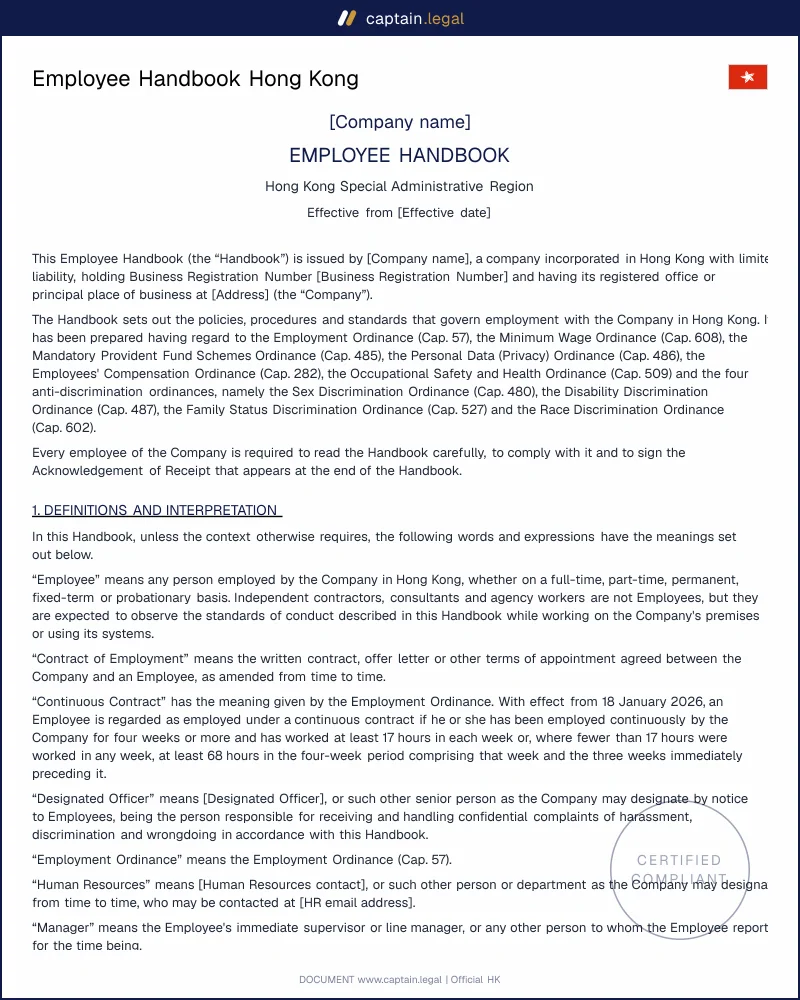
An employee handbook sets out the rules your staff work under and the commitments your business makes in return: working hours, leave, pay and MPF, conduct, equal opportunities, IT use and personal data. This Hong Kong template is drafted to the Employment Ordinance (Cap. 57), the four anti-discrimination ordinances and the Personal Data (Privacy) Ordinance (Cap. 486), so every policy sits on top of the statutory minimum. It suits SMEs growing past their first hires, regional offices formalising local practice and NGOs running paid teams. You receive an editable staff handbook in Word and PDF.

Compliant

2026 Legislation

50,000+ clients

trust us

Affordable

From $4.90 / doc

Secure payment

Instant download

Employee Handbook HK: Cap. 57, 468 Rule and PDPO

Secure payment

Fill in the template

What is an employee handbook in Hong Kong?

In Hong Kong, an employee handbook is a set of written workplace policies issued by the employer and incorporated, wholly or partly, into each contract of employment. Section 44 of the Employment Ordinance only obliges the employer to inform the employee, before work begins, of the wages, the wage period, the notice needed to terminate and any end of year payment. Everything else (how leave is requested, who hears a grievance) is left to the parties. The Labour Tribunal reads these documents closely: a published policy is evidence of what the employer promised, and an ignored one is evidence against it.

An employee handbook also differs from a Hong Kong employment contract template in legal weight. The contract fixes the individual bargain, while the handbook sets collective rules that change more often. A well drafted handbook therefore states which chapters are contractual and which are policy only, so the employer can update the second category without fresh consent. Under section 70, no clause can reduce a right conferred by the Ordinance. Once an employee has 24 months' continuous service, a variation of contractual terms imposed without consent and not permitted by the contract can also found a claim under Part VIA.

When do you need this document?

The usual trigger is headcount. Somewhere between ten and twenty staff, informal practice stops working: two managers apply different rules and the first dispute exposes the gap. A second trigger is a harassment complaint. The employer's defence under section 46(3) of the SDO turns on steps taken before the incident, so a policy written after the complaint cannot save that case. The third is legislative change: the 468 rule and the end of MPF offsetting have outdated many existing handbooks.

Regional offices are the fourth scenario. A global employee handbook drafted for the United States often assumes termination without notice and a single pool of paid time off. Neither fits Cap. 57, which requires notice or payment in lieu under sections 6 and 7 and gives annual leave, statutory holidays and sickness days separate pay rules. One edge case: a household employing a foreign domestic helper should not reach for a company handbook, because the Standard Employment Contract (ID 407) governs that relationship. Most employers pair it with the contracts and letters in our employment and HR templates for Hong Kong.

Key clauses included in our template

  • The status clause states which chapters are contractual, which are policy only, and that the employment contract prevails in a conflict. It also reserves your right to update non-contractual policies on notice, the sentence that keeps the employee handbook maintainable.
  • The working time and leave chapter applies the rest day, statutory holiday and annual leave rules, then covers sickness allowance at four fifths of average daily wages, maternity and paternity leave. Every rate uses the 12 month average wage rule, where homemade handbooks most often fail.
  • The pay and MPF chapter fixes the wage period, payment within seven days under section 23 and MPF enrolment. It separates pre-transition and post-transition service for offsetting.
  • The anti-harassment and equal opportunities policy covers all four ordinances, names a complaints officer and offers informal and formal routes with protection against victimisation. It extends to interns, volunteers and contractors.
  • The IT and generative AI policy sets acceptable use, device and password rules and the tasks for which approved AI tools may be used. It works alongside our confidentiality and IP assignment deed for employees, which protects what staff create.
  • The personal data policy includes the collection statement required by Data Protection Principle 1, retention periods consistent with Data Protection Principle 2 and a monitoring notice.
  • The discipline and termination chapter separates warnings from summary dismissal under section 9 and adds an appeal step. It flags the statutory bars on dismissal, including pregnancy under section 15, a paid sickness day under section 33(4B) and a pending work injury claim under section 48 of the ECO, and times final payments under section 25.

Sector-specific considerations in Hong Kong

Financial services firms licensed by the SFC or authorised by the HKMA need a handbook that dovetails with their compliance manuals. Paragraph 12.2 of the SFC Code of Conduct requires policies on employee dealing, and the conduct chapter should cross-refer to them so that a breach is also a disciplinary matter. Banks also operate the HKMA's Mandatory Reference Checking Scheme, under which authorised institutions request and give conduct references for staff in specified roles. Such references are only defensible if the handbook defines misconduct precisely.

Construction and outdoor work splits between two statutes: sites fall under the Factories and Industrial Undertakings Ordinance (Cap. 59), other workplaces under the general duties of the Occupational Safety and Health Ordinance (Cap. 509). The Guidance Notes on Prevention of Heat Stroke at Work are not statutory, but the Labour Department expects risk assessments and scheduled rest breaks whenever an amber, red or black Heat Stress at Work Warning is in force. The handbook should say who sets the site schedule, and typhoon arrangements should follow the Code of Practice in Times of Typhoons and Rainstorms.

Retail, food and beverage and hospitality employers roster many part-time staff, which is where the 468 rule changes most outcomes: one short week no longer breaks continuity if the four week total reaches 68. The hours records required under section 49A for staff covered by the Minimum Wage Ordinance (Cap. 608) need a clear owner. The SDO also protects front of house staff from sexual harassment by customers.

Charities and NGOs often pair a small paid team with many volunteers. Since the Discrimination Legislation (Miscellaneous Amendments) Ordinance 2020, interns and volunteers count as workplace participants, so the handbook should state which policies bind them. These organisations also hold sensitive beneficiary data, and a PDPO data protection policy built for Hong Kong non-profits works best when the handbook's data chapter points to it.

How to fill out this employee handbook

You start by entering the employer's legal name, business registration details and working patterns: fixed office hours, shifts or rostered part-time work. That answer sets the 468 rule eligibility wording for part-time staff. The questionnaire then asks where you go beyond the statute (extra annual leave, paid general holidays, medical cover, voluntary MPF contributions) and marks each choice as contractual or policy only. Next you name the complaints, data and appeals officers. The IT section asks whether staff use company devices or their own and which AI tools you allow, in line with the PCPD's Checklist on Guidelines for the Use of Generative AI by Employees.

Your employee handbook is generated in Word and PDF. Many companies adopt it by a short directors' resolution, which the board and written resolutions pack under Cap. 622 provides ready to sign. Circulate it with the acknowledgment form and arrange a Chinese translation for staff who do not read English comfortably.

Common mistakes to avoid

The most expensive mistake is adopting a foreign handbook with the place names changed, complete with a probation clause that ignores the notice rules in section 6. The second is hard coding numbers the legislature keeps changing: "12 statutory holidays" or "18 hours per week" was accurate once and is wrong now. Third, some employers declare the whole employee handbook contractual, then need every employee's consent to change a password rule. Fourth, never describe MPF offsetting without the transition rules, because payroll teams follow the handbook and an outdated paragraph leads straight to underpaying the post-transition portion.

The remaining mistakes concern implementation. An anti-harassment policy that lives on the intranet, with no training record and no named officer, rarely satisfies the reasonably practicable steps defence. Monitoring email or CCTV without prior notice breaches the data protection principles; covert monitoring is defensible only in narrow cases under the section 58 exemption. Disciplinary procedures stricter than what managers actually do become the employee's best exhibit at the Labour Tribunal.

Key takeaways

Legal status

Handbook terms can bind the employer

In Hong Kong, an employee handbook may be incorporated wholly or partly into each employment contract. Section 44 of the Employment Ordinance (Cap. 57) only requires core particulars such as wages, wage period, notice and end of year payment, but the Labour Tribunal will still treat published policies as evidence of promises made.

468 rule

Continuous employment drives statutory benefits

From 18 January 2026, the 468 rule replaces the old 418 test: at least 17 hours in each of four consecutive weeks, or 68 hours over four weeks. That status affects rest days under section 17, annual leave of 7 to 14 days under section 41AA, sickness allowance and family leave rights.

Workplace conduct

Harassment policies reduce employer exposure

The handbook should reflect the four Hong Kong anti-discrimination ordinances and set clear conduct standards. Under section 46 of the Sex Discrimination Ordinance and equivalent provisions, an employer may be liable for harassment by staff in the course of employment unless it took reasonably practicable steps to prevent it.

Frequently Asked Questions

No statute requires one. The Employment Ordinance requires you to state the core conditions of employment before work starts and to keep wage and employment records under section 49A, but it prescribes no handbook. In practice, an employer with more than a handful of staff cannot run leave, discipline and complaints consistently without one, and the reasonably practicable steps defence is hard to prove without a written policy.

Contractual chapters bind both parties once the employment contract incorporates the handbook or the employee accepts it, usually by signed acknowledgment; existing staff must consent to new contractual terms. The label helps but does not decide: courts ask whether each provision is apt to be a contractual term. Policy chapters stay enforceable through discipline, since wilful disobedience of a lawful and reasonable order justifies summary dismissal under section 9. Section 70 voids any provision that reduces a statutory right.

Yes. You receive both formats: Word for edits, branding and translation, PDF for circulation and signature. Keep the Word file as the master and reissue a dated PDF after each update. For a full HR and corporate set, the complete catalogue of Hong Kong legal templates lists every form available for the jurisdiction.

Under section 19 of the Personal Data (Privacy) Ordinance, you must comply within 40 days of receiving the request. If you cannot, you must tell the requester in writing within that period, with reasons, and comply as soon as practicable afterwards. Requests often arrive during disputes, so the handbook's data chapter names the responsible officer and sets an internal deadline well inside the statutory one.

For policy chapters, yes, if the handbook reserves that right and you give reasonable notice. For contractual chapters, no: changes to leave, pay or benefits need the employee's agreement, and section 45 entitles the employee to a written copy of an agreed variation on request. Imposing a contractual change unilaterally risks a constructive dismissal argument and a Part VIA claim, so our template keeps the two apart.

Yes. Every employee is covered, but several entitlements depend on a continuous contract, and the template defines eligibility by the 468 rule: 17 hours in each of four consecutive weeks, or 68 hours across four weeks. Statutory holidays, wage protection and protection against anti-union discrimination apply regardless of hours, although holiday pay needs three months' continuous employment. Check eligibility from timesheets: a part-time worker can become a continuous employee without any contract change.

4.8/5

25 verified reviews · 50 000+ downloads

Employee Handbook HK: Cap. 57, 468 Rule and PDPO
  • Immediate access to the document
  • PDF + Word download
  • Compliant with 2026 legislation
  • Reviewed by lawyers
Fill in the template
Secure payment
Updated on October 2, 2026

You might also like

Internship Agreement Hong Kong
Mutual Separation Agreement