Real Estate & Rental

HK Agreement for Sale and Purchase: Cap. 219 Template

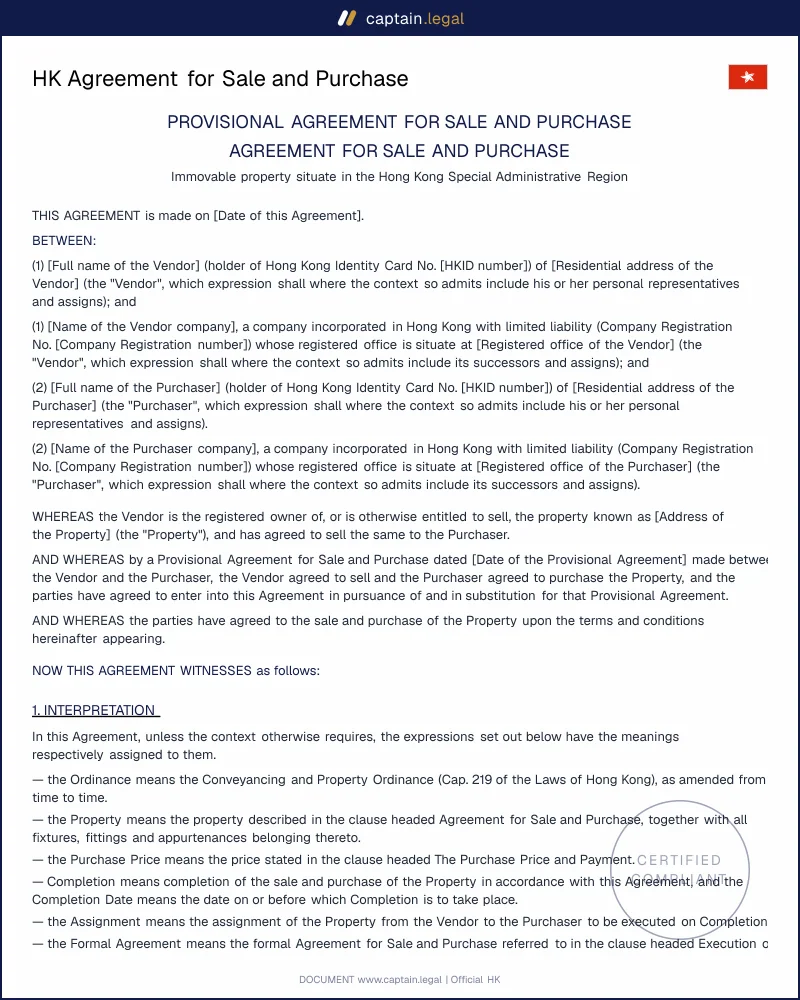
Sale and purchase agreement drafted to the Conveyancing and Property Ordinance (Cap. 219) and Cap. 117 stamping rules. Provisional and formal, Word and PDF.
4.7/517 reviews50 000+ downloadsInstant download
Share

An agreement for sale and purchase binds a vendor and a purchaser to transfer a Hong Kong property at a fixed price on a fixed date. Almost every second-hand transaction runs in two stages: a provisional agreement signed at the estate agent's office, often the same evening the offer is accepted, then a formal agreement drawn by solicitors within the following fortnight. This template covers both stages, with the price, the initial and further deposits, the completion date, the title obligations and the conditions in Part A of the Second Schedule to the Conveyancing and Property Ordinance (Cap. 219). It is written for owners selling a flat, car park or commercial unit, for purchasers who want to know what they are signing before the deposit changes hands, and for family transfers handled without an agent.

Compliant

2026 Legislation

50,000+ clients

trust us

Affordable

From $4.90 / doc

Secure payment

Instant download

HK Agreement for Sale and Purchase: Cap. 219 Template

Secure payment

Fill in the template

What is an agreement for sale and purchase in Hong Kong?

The agreement for sale and purchase is a contract for the sale of land, not the transfer itself. Hong Kong keeps the two apart. The agreement creates binding obligations and gives the purchaser an equitable interest in the property; the legal estate passes later, on completion, through an assignment executed as a deed under section 4 of the Conveyancing and Property Ordinance (Cap. 219) and registered at the Land Registry.

Practitioners distinguish three documents in the same chain. The provisional agreement, known in the market as the PASP, is the short contract signed through the estate agent and carrying the initial deposit, customarily 5 per cent of the price. The formal agreement, or ASP, is the full contract prepared by the solicitors, usually within 14 days, which takes the deposit to 10 per cent and sets out title, requisitions, apportionments and the completion machinery. The assignment completes the sale. A provisional agreement is a binding contract, not a reservation form, and a party who walks away after signing it faces forfeiture of the deposit or an action for specific performance. Our template covers the first two stages and sits alongside the rest of the Hong Kong property and rental document templates.

2

When do you need this document?

The ordinary case is the sale of a second-hand flat, shop, industrial unit or car parking space between private parties. Once price and completion date are agreed, someone has to write them down the same day, because a handshake gives neither side anything to enforce. Sales concluded without an estate agent are the second scenario: two neighbours, a landlord selling to a sitting tenant, a seller who found a buyer through a notice board in the lobby. Family transfers are the third, and they need care, since a transfer at less than market value can be treated as a voluntary disposition and creates title problems for the next purchaser.

Investors use the document in confirmor sub-sales, where a purchaser who has signed an agreement resells before completion and joins the eventual assignment as confirmor. The structure is legitimate but attracts a second charge to ad valorem duty, so each link in the chain has to be recorded accurately. Two edge cases deserve a flag. Where the vendor is a company, the agreement must be executed in accordance with the Companies Ordinance (Cap. 622) and the articles, with a board resolution approving the sale. Where the vendor has died, the sale is made by executors under a grant of probate, and the grant must be produced and registered before the purchaser's solicitors will accept title.

3

Key clauses included in our template

  • The identification of the parties records the full name, identity card or passport number and address of every vendor and purchaser, matching the Land Registry record exactly. Where a company sells, the template captures the company number and the execution formalities required by the Companies Ordinance (Cap. 622), in the same way as the other commercial agreements drafted for Hong Kong incorporation rules.
  • The description of the property covers the flat, floor, building, lot number and the undivided shares assigned to the unit under the Deed of Mutual Covenant, plus any car park or roof sold with it. A description that omits the undivided shares invites a requisition and delays completion.
  • The price and deposit structure separates the initial deposit from the further deposit, states who holds the money and in what capacity, and confirms that the balance falls due on completion against delivery of the assignment.
  • The completion clause fixes the date, the place, the firms involved and the mode of payment, usually a cashier order drawn on a licensed bank. It states that time is of the essence, which is standard in Hong Kong and turns a late completion into a repudiation rather than a delay.
  • The title and requisitions clause obliges the vendor to give and show good title under section 13 of Cap. 219, incorporates the Part A conditions, and sets the window in which the purchaser may raise requisitions and the vendor must answer them.
  • The vacant possession and apportionment clause records whether the property is sold with vacant possession or subject to a tenancy, lists the fittings included, and apportions rates, Government rent and management fees.
  • The default clause deals with forfeiture of the deposit, resale of the property and the costs recoverable from the defaulting party, and allocates stamp duty and Land Registry fees between the parties.
4

Property types and district considerations

Urban private residential flats on Hong Kong Island, in Kowloon and in the new towns are the simplest case. Title runs from the Government lease through the Deed of Mutual Covenant to the assignment of undivided shares. Watch for outstanding Buildings Department orders on unauthorised structures, because they bind the purchaser after completion and the vendor's implied covenants under section 35 of Cap. 219 rarely produce a useful remedy once the money has moved.

New Territories village houses and small houses carry restrictions that catch purchasers regularly. Many are held under a Government grant containing an alienation restriction requiring the written consent of the Director of Lands before assignment, and a premium may be payable. An agreement signed without checking the grant conditions can leave a vendor unable to complete, and an individual small house also falls outside the first-hand sales regime.

Home Ownership Scheme and subsidised flats are governed by the alienation restrictions in the Housing Ordinance (Cap. 283). During the restriction period the flat may only be sold to a buyer nominated by the Hong Kong Housing Authority through the Secondary Market Scheme, at a price that excludes the land premium. A sale in the open market requires payment of that premium first, and the agreement should record which party bears it and when.

Uncompleted flats sold by developers follow a different regime. The Residential Properties (First-hand Sales) Ordinance (Cap. 621) fixes the preliminary deposit at 5 per cent and requires the purchaser to execute the formal agreement within five working days, failing which the preliminary agreement is terminated and the deposit forfeited. These sales use the mandatory provisions and the standard forms of the Consent Scheme or the Law Society's Non-Consent Scheme, so a general template is not appropriate.

Commercial, industrial and car parking units attract duty on the non-residential scale. Permitted use under the Government lease and the occupation permit should be checked before signature, since a unit sold as a workshop and used as an office breaches the lease conditions. Buyers of parking spaces should confirm that the space is separately assigned rather than licensed under the DMC, a distinction that decides whether the buyer owns anything at all. Related paperwork sits with the personal and family documents prepared for Hong Kong law.

5

How to fill out this agreement for sale and purchase

You begin by choosing whether you need the provisional agreement, the formal agreement or both, since the form adjusts the deposit structure and the completion machinery accordingly. Next come the parties, entered as they appear on the identity documents and on the Land Registry search, with a separate block for companies and their execution clause. The property section asks for the address, lot number, undivided shares and any parking space or roof included in the sale, then prompts you for the tenancy position so the vacant possession clause matches reality.

You then set the commercial terms: the price, the initial deposit, the further deposit, the completion date and the party responsible for each item of duty and fees. Fittings and apportionments follow, then the special conditions, where you record anything negotiated outside the standard terms, such as a subject to mortgage clause or an early handover for renovation. The finished document downloads in Word and PDF, ready for signature and for your solicitors, and the Hong Kong document library covers the paperwork that surrounds the transaction.

6

Common mistakes to avoid

Most disputes start with the deposit. Parties agree a figure well above the customary 10 per cent believing it strengthens their hand, then discover on default that the excess is treated as a penalty rather than a true deposit, as the Court of Final Appeal held in Polyset Ltd v Panhandle Ltd. The second recurring error is treating the provisional agreement as informal. It gets signed in a hurry, omits the completion date or leaves the fittings undefined, and every gap becomes a negotiating point once the solicitors take over. A third is missing the stamping window, which runs from the earliest agreement in the chain, with penalties that multiply the further past the deadline the parties drift.

The rest are matters of homework. Sellers rarely check the Government lease or the Deed of Mutual Covenant before signing, so unauthorised structures, restrictions on use and pending Buildings Department orders surface only when the purchaser raises requisitions, by which time time is of the essence and the vendor has days rather than weeks to respond. Purchasers sign before their mortgage is approved and without a financing condition, then lose the deposit when the bank values the flat below the agreed price. Neither problem is expensive to prevent and both are expensive to litigate.

Key takeaways

Two-stage deal

Provisional agreement binds you straightaway

Most second-hand Hong Kong property deals start with a provisional agreement (PASP) signed through the estate agent, often on the day the offer is accepted. It is a binding contract, not a holding note. The initial deposit is customarily 5% of the price, and pulling out can mean forfeiting that deposit or facing a claim for specific performance.

Cap. 219

Sale contract is separate from assignment

The agreement for sale and purchase is a contract for the sale of land, not the transfer itself. Under section 4 of the Conveyancing and Property Ordinance (Cap. 219), the legal estate passes later on completion by an assignment executed as a deed and then registered at the Land Registry. Until then, the purchaser typically has an equitable interest and both sides must follow the agreed completion machinery.

Stamp duty

Stamp within 30 days or pay

Stamping is a common failure point. Under the Stamp Duty Ordinance (Cap. 117), the agreement must be stamped within 30 days after the earliest agreement for the transaction, usually the provisional one; if the formal agreement is signed within 14 days, the clock runs from the formal agreement instead. An unstamped agreement cannot be used in civil proceedings until duty and any penalty are paid.

Frequently Asked Questions

Yes. Both the provisional and the formal agreement are binding contracts for the sale of land, and both satisfy section 3(1) of the Conveyancing and Property Ordinance (Cap. 219) provided they are in writing and signed. The provisional agreement is not a reservation, whatever the parties call it in conversation. A vendor who refuses to proceed can be sued for specific performance, and a purchaser who walks away forfeits the deposit and may face a claim for the shortfall if the property is resold for less.

The provisional agreement is short, signed through the estate agent, and carries the initial deposit of around 5 per cent. It fixes the parties, the property, the price and the completion date. The formal agreement is prepared by solicitors, usually within 14 days, and adds title and requisitions, the conditions incorporated from Part A of the Second Schedule to Cap. 219, apportionments, fittings, default and completion mechanics. The further deposit takes the total to 10 per cent. Terms agreed in the provisional agreement carry through unless expressly varied.

Stamp duty must be paid within 30 days after the earliest agreement for the transaction, normally the provisional agreement. Where the formal agreement is executed within 14 days of it, the 30 day period runs from the formal agreement instead. Completion is a matter of contract rather than statute, and second-hand residential sales typically complete between six and ten weeks after the provisional agreement, which leaves time to arrange a mortgage and to raise and answer requisitions. Late stamping attracts a penalty calculated as a multiple of the duty.

Yes, provided the attorney holds a properly executed power of attorney covering the sale or purchase of that property. In practice the deed is signed before the party leaves Hong Kong, or executed abroad and authenticated, then registered at the Land Registry so the other side can verify the authority. A general power of attorney deed under Cap. 31 is the usual instrument. Check the scope carefully, because a power drafted for banking matters will not authorise the disposal of land, and a defect in the authority becomes a title defect.

Time is of the essence in Hong Kong sale and purchase agreements, so a purchaser who misses the completion date is in repudiatory breach immediately, with no grace period. The vendor may accept the repudiation, forfeit the deposit, resell and claim the shortfall together with the costs of the abortive sale. A purchaser facing a short delay should ask for a written extension before the date passes, since the vendor is under no obligation to grant one. The rule cuts both ways: a vendor who cannot give good title on the day is equally in breach.

Both. The agreement downloads as an editable Word file and as a PDF ready for printing and signature. The Word version matters here, because these agreements are almost always adjusted, whether to add a financing condition, record the fittings included in the price, or reflect a tenancy that survives completion. Print the final version for signature, since instruments chargeable with stamp duty in Hong Kong cannot be executed by electronic means.

4.7/5

17 verified reviews · 50 000+ downloads

HK Agreement for Sale and Purchase: Cap. 219 Template
  • Immediate access to the document
  • PDF + Word download
  • Compliant with 2026 legislation
  • Reviewed by lawyers
Fill in the template
Secure payment
Updated on August 21, 2026

You might also like

Break Clause & Notice to Quit HK
Tenancy Renewal Agreement Hong Kong