Personal & Family

Statutory Declaration Cap. 11: Hong Kong Jurat Template

Hong Kong statutory declaration built on the Oaths and Declarations Ordinance (Cap. 11) and section 36 of the Crimes Ordinance, with exhibit and jurat blocks.
4.7/526 reviews50 000+ downloadsInstant download
Share

A statutory declaration is a written statement of fact that you sign in front of an authorised officer, confirming under the Oaths and Declarations Ordinance (Cap. 11) that everything you have written is true. Hong Kong banks, consulates, schools and government departments ask for one whenever ordinary documentary proof does not exist: a lost certificate, an address you cannot evidence with a recent bill, a name spelt two ways across your papers, a family relationship recorded nowhere official. The text itself is short. The force comes from the jurat at the foot, the block in which a Commissioner for Oaths, a notary public or a solicitor records that you declared before them. Get that block wrong and the paper is worth nothing to the body that asked for it.

Compliant

2026 Legislation

50,000+ clients

trust us

Affordable

From $4.90 / doc

Secure payment

Instant download

Statutory Declaration Cap. 11: Hong Kong Jurat Template

Secure payment

Fill in the template

What is a statutory declaration in Hong Kong?

A statutory declaration is an unsworn statement made in the first person and signed before a person authorised to take declarations. You take no oath, and no court is involved. You set out facts within your own knowledge, close with the formula prescribed by Cap. 11, and sign while the officer watches. That last point is not a formality: a declaration signed at home and carried to the counter afterwards is a piece of paper with a signature on it, nothing more.

Four documents get confused. An affidavit is the sworn version, used as evidence in court proceedings. An affirmation replaces the oath where the maker objects to swearing, usually on religious grounds. A deed grants or transfers something rather than stating a fact, which is why a general power of attorney executed as a deed under the Powers of Attorney Ordinance cannot be replaced by a declaration however carefully it is drafted. And a declaration is never a will: testamentary wishes recorded this way have no effect under the Wills Ordinance (Cap. 30).

2

When do you need a statutory declaration?

The commonest trigger is a document that no longer exists. A lost birth certificate, a destroyed marriage certificate, a transcript from an institution that has closed: the receiving body cannot verify the fact, so it asks you to declare it and to carry the criminal risk of being wrong. Proof of residential address runs a close second. Where you cannot produce a utility bill or bank statement in your own name, the Registration and Electoral Office accepts a declaration of residence made before a Commissioner for Oaths, a practising solicitor or a Justice of the Peace, and landlords and schools follow the same practice.

Identity discrepancies generate a steady stream. Names transliterated differently across a passport, an HKID card and a marriage certificate need a declaration confirming that every version refers to one person, often filed alongside a deed poll for a change of name supported by Form ROP 73. Family facts follow: relationship declarations for estate applications, guardianship and consular files. Employment history is another regular use, particularly where a former employer has been wound up and cannot issue the reference that would normally support a claim under the employment and human resources documents built on the Employment Ordinance.

One edge case worth flagging: declarations supporting early withdrawal of mandatory provident fund benefits use the scheme authority's designated form rather than free text.

3

Key clauses included in our template

  • The heading and capacity block names the matter the declaration supports and states whether you declare personally or as a director, an administrator or another stated capacity. A declaration is always made in the first person and never in a company name, so capacity has to be spelt out rather than implied by a company chop.
  • The identification paragraph records your full name as it appears on your identity document, your HKID or passport number, and your residential address. Most rejections start here, because the name in the body does not match the name in the jurat or the card produced at the counter.
  • The numbered declaration paragraphs carry one fact each, with the source of belief stated where the fact sits outside your direct knowledge. The template prompts I am informed by X and verily believe instead of presenting second hand information as your own observation.
  • The exhibits block marks each supporting copy with a letter and identifies it in the body. That matters here, because a Commissioner for Oaths cannot certify a document as a true copy; attaching it as an exhibit and declaring it true is the accepted workaround.
  • The statutory closing formula reproduces the Cap. 11 wording without paraphrase, immediately above the signature line.
  • The jurat sets out the place, the date, the words Before me, and a designation line covering all four categories of officer. Declarations filed with licence applications, alongside the rest of a company incorporation and commercial contract set, are checked against this block first.
4

Where and before whom you can declare in Hong Kong

Home Affairs Enquiry Centres administer declarations for private use before a Commissioner for Oaths, free of charge, and for everyday matters that is the obvious route. There is one trap: the Enquiry Centres require their own specified declaration form, and a self prepared document cannot be substituted. The answer is to attach your drafted declaration as an exhibit to their form, which is what the Department itself suggests. Time slots vary between centres, so telephone ahead.

Solicitors and notaries work differently. They take a declaration on your own document, which is why anything with numbered paragraphs, exhibits and a bespoke recital goes to a solicitor rather than to a counter. Bring your original identity document and sign nothing before you arrive. The firm name and address in the jurat is precisely what banks and registries look for.

Documents heading overseas need a further step. The Registrar of the High Court is the competent authority for Hong Kong under the Convention of 5 October 1961 Abolishing the Requirement of Legalisation for Foreign Public Documents, and the Apostille Service Office issues the certificate. An apostille authenticates the officer's signature, so a declaration bound for a Convention country is taken before a notary public first. An electronic route now runs through registered notaries.

The Mainland sits outside that system. Documents emanating from Hong Kong for use in Mainland China must be attested by a China Appointed Attesting Officer, a local solicitor separately authorised by the Ministry of Justice, and no apostille will substitute. Non Convention countries require consular legalisation instead.

5

How to fill out this statutory declaration

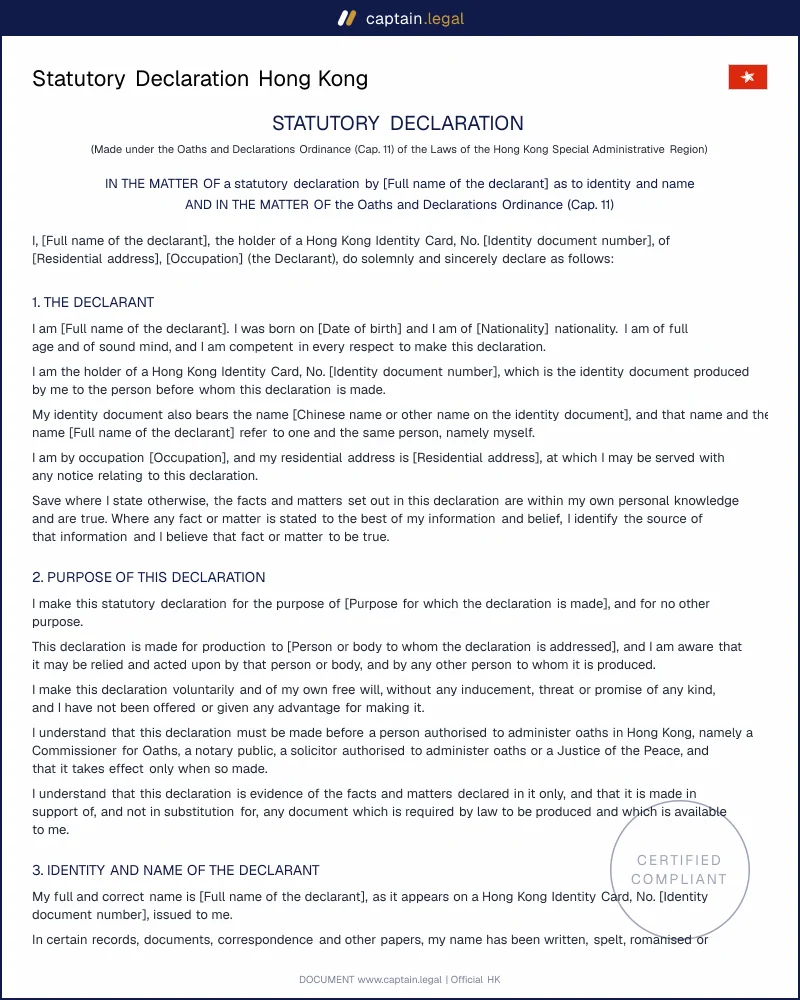
You begin by choosing the purpose, because the purpose shapes the recital: identity, residence, loss of a document, family relationship and single status each open differently. The form then collects your full name, identity document number and residential address, and inserts them into both the body and the jurat so the two cannot drift apart. Facts go in next, one per numbered paragraph, with a prompt to state the source of belief wherever you rely on what someone told you.

Supporting papers are handled as exhibits: you name each one, and the template marks it and inserts the exhibit note the officer will initial. You then select the officer you intend to see, and the jurat adjusts accordingly, with the firm details appearing only where they belong. The finished declaration downloads in Word and PDF. Print single sided, leave the signature and date empty, and take the pages plus your originals to the appointment.

6

Common mistakes to avoid

Signing in advance wastes the most trips. The declaration must be signed in the officer's presence, and no Commissioner for Oaths will accept a page already signed at home. Close behind sits the blank designation line: a jurat that does not say what the witness is, or that omits a solicitor's firm name and address, is rejected on sight. Third is the identity mismatch, where the opening paragraph follows a passport while the card produced at the counter carries a different transliteration. Declare both spellings and explain the difference.

The second cluster is about content. Opinions prove nothing: I believe the tenancy was genuine is worthless, while I paid rent by monthly transfer from the account ending 8842 between March and December is a fact a bank can act on. Hearsay presented as personal knowledge is worse, because it exposes you to section 36 if the underlying fact is false. Never declare a fact you have not verified yourself, however confident the relative who told you sounded. Photocopies stapled to the back with no exhibit marking prove nothing either.

Key takeaways

FORMALITY

Sign in front of the authorised officer

A statutory declaration only has effect if you sign it in the presence of an authorised person and they complete the jurat. Signing at home and getting it “witnessed” afterwards is commonly rejected by banks, schools and government departments. The jurat is the proof that you declared before the officer; if it is missing or wrong, the document is treated as worthless for the purpose requested.

CAP. 11

Use the statutory wording in Schedule 1

The Oaths and Declarations Ordinance (Cap. 11) supplies the model language that turns a narrative into a statutory declaration. Your facts are set out (often in numbered paragraphs), then you must close with the prescribed sentence that you make the declaration conscientiously believing it to be true and by virtue of the Ordinance. If the closing formula is not in substantially the statutory words, the recipient may refuse it.

PENALTIES

False statements can be a criminal offence

A statutory declaration carries weight because lying can trigger criminal liability. Under section 36 of the Crimes Ordinance (Cap. 200), knowingly and wilfully making a statement that is false in a material particular in a statutory declaration is an offence, with liability on conviction upon indictment to two years’ imprisonment and a fine. Treat every sentence as something you may need to justify later.

Frequently Asked Questions

A properly executed declaration is recognised across Hong Kong by government departments, banks, insurers, consulates and schools. It is not a contract, so it binds you to do nothing and creates no rights over property. It commits you to the truth of the facts stated, backed by the offence in section 36 of the Crimes Ordinance (Cap. 200). The template supplies the statutory wording and the jurat; validity then turns on signing before an authorised officer with your original identity document.

Yes, in both formats, so you can adjust the numbered paragraphs in Word before printing and keep the PDF as the version you carry to the appointment. Word matters more than usual here, because declarations are often amended at the counter when the officer asks you to narrow a paragraph or add a source of belief. The rest of the catalogue of Hong Kong legal templates works the same way. Print single sided and leave the signature and date blocks empty.

A Justice of the Peace, a notary public, a Commissioner for Oaths at a Home Affairs Enquiry Centre, or a solicitor holding a current practising certificate. The choice depends on the destination. Everyday declarations for local use go to an Enquiry Centre, where the service is free. Anything going abroad normally needs a notary public so an apostille can follow, and anything going to the Mainland needs a China Appointed Attesting Officer. A relative, an employer or a company secretary cannot take your declaration.

Taking the declaration is a counter appointment measured in minutes once the wording is settled. Apostille processing at the High Court usually runs to a few working days, and Mainland attestation takes longer. A declaration has no statutory expiry, but recipients set their own limits, and many banks, immigration authorities and registries will not look at one made more than three or six months earlier. Check that window before booking.

Under section 36 of the Crimes Ordinance (Cap. 200), knowingly and wilfully making a statement false in a material particular carries imprisonment for two years and a fine on conviction upon indictment. The threshold words are knowingly and wilfully, so an honest error corrected promptly is a different matter from a fabrication. Prosecutions cluster around provident fund withdrawals, immigration files and licence applications. If you spot an error after signing, make a fresh corrective declaration rather than amending the original.

Not automatically. For a Convention country, the declaration is taken before a notary public and then apostilled by the Registrar of the High Court, whose certificate authenticates the notary's signature and seal. Outside the Convention, consular legalisation replaces the apostille and each consulate sets its own steps. For Mainland China neither route applies: the document must be attested by a China Appointed Attesting Officer. Decide the destination before choosing the officer, because redoing the jurat means redoing everything.

4.7/5

26 verified reviews · 50 000+ downloads

Statutory Declaration Cap. 11: Hong Kong Jurat Template
  • Immediate access to the document
  • PDF + Word download
  • Compliant with 2026 legislation
  • Reviewed by lawyers
Fill in the template
Secure payment
Updated on August 19, 2026

You might also like

Loan Agreement Between Individuals Hong Kong
Letter of Authorisation Hong Kong