Personal & Family

HK Loan Agreement | Money Lenders Ordinance Cap. 163

Private loan template built on the interest caps of the Money Lenders Ordinance (Cap. 163) and the six year limit under the Limitation Ordinance (Cap. 347).
4.6/517 reviews50 000+ downloadsInstant download
Share

A loan agreement between individuals is a written contract recording money advanced by one private person to another, the interest charged if any, the repayment schedule and the consequences of default. These arrangements start on trust. The money goes to a sibling buying a flat or a friend covering a shortfall, and nothing is signed until the repayments stop. A private loan contract closes that gap. Drafted properly, it keeps the transaction outside the licensing regime of the Money Lenders Ordinance (Cap. 163), holds the interest below the statutory ceiling, and protects the lender's right to sue within the period allowed by the Limitation Ordinance (Cap. 347).

Compliant

2026 Legislation

50,000+ clients

trust us

Affordable

From $4.90 / doc

Secure payment

Instant download

HK Loan Agreement | Money Lenders Ordinance Cap. 163

Secure payment

Fill in the template

What is a loan agreement between individuals in Hong Kong?

A loan agreement between individuals is a simple contract by which one natural person lends a sum to another and the borrower promises to repay it, with or without interest, on agreed terms. Hong Kong law does not require a private loan to be in writing, and an oral loan is enforceable. The problem is proof. Without a signed document the borrower can call the transfer a gift, a repayment of an older debt or an investment, and the lender argues over bank statements years later.

Two neighbouring documents get confused with it. A promissory note is a one sided acknowledgement signed by the borrower alone, useful as evidence but silent on interest, instalments and default. An acknowledgement of debt confirms a sum already owed rather than creating a fresh advance, though it carries weight under the limitation rules below. Neither replaces a full agreement. Our template sits with the rest of the personal and family paperwork drafted for Hong Kong practice, and is written for two people who are not in the business of lending.

2

When do you need this document?

The most common trigger is a family advance towards a property deposit, where parents or a sibling fund part of the down payment and the parties want the money documented rather than treated as a gift. Banks ask about the source of funds, and a signed contract explains a large deposit better than assurances. The second is bridging money between friends, a short advance repayable in one sum once a bonus or a sale lands. Business partners form a third group, usually where one shareholder funds a co founder personally, alongside the shareholder and director documents used by Hong Kong companies.

Two edge cases deserve attention. The first is the loan by forbearance: the definition of loan in section 2 of the Money Lenders Ordinance covers forbearance to require payment of money owing, so converting unpaid rent or a deferred price into instalments creates a loan even though no fresh money moves. The second is the employer to employee advance, an exempted loan that is mishandled because recovery from wages is lawful only on the narrow grounds allowed by the Employment Ordinance (Cap. 57). If the borrower is on your payroll, read the loan with the employment contracts and staff letters for Hong Kong employers.

3

Key clauses included in our template

  • The identification of the parties captures full names as they appear on the Hong Kong Identity Card, the document numbers and the correspondence addresses. Names matter at enforcement stage, because a writ served on the wrong romanisation of a Chinese name costs months.
  • The principal and manner of advance records the exact sum, the account it is paid into and the date of transfer, with an acknowledgement of receipt by the borrower. Cash advances are the hardest to prove, so the template presses for a transfer reference.
  • The interest clause states the rate, the basis on which it accrues and whether it is simple or compound, drafted so the effective rate stays well below the thresholds in sections 24 and 25. Interest free loans are supported and the wording says so expressly.
  • The repayment schedule sets the instalment amount, the frequency, the maturity date and the right to prepay without penalty. Where the loan is repayable on demand, the clause requires a written demand, fixing the moment the limitation clock starts to run.
  • The events of default and acceleration cover missed instalments, bankruptcy, the borrower leaving Hong Kong permanently and any misstatement made to obtain the loan. The balance then falls due at once, with default interest set inside the extortionate threshold.
  • The security and guarantee options allow a guarantor to sign or a charge to be taken over property or shares. Where a family flat is offered, the effect of any existing mortgage needs checking against the tenancy and property documents used in Hong Kong.
4

Cross-border and enforcement considerations

Private lending here is rarely confined to Hong Kong. A borrower with family in the Mainland, or an advance made in renminbi, raises questions the template settles up front. Fix the currency of the loan and of repayment in the same clause, because a borrower repaying in a depreciated currency rewrites the bargain. A jurisdiction clause in favour of the Hong Kong courts is now worth more than it was: since 29 January 2024 the Mainland Judgments in Civil and Commercial Matters (Reciprocal Enforcement) Ordinance (Cap. 645) has allowed a far wider range of judgments to move between Hong Kong and the Mainland, without the exclusive choice of court agreement the old regime demanded.

Inside Hong Kong the forum depends on the size of the claim: modest debts go to the Small Claims Tribunal, where parties appear without lawyers, larger ones to the District Court, and the biggest to the Court of First Instance. Check the current monetary limits before filing. Where the borrower has no assets, a statutory demand under the Bankruptcy Ordinance (Cap. 6) is often the realistic pressure point.

Execution deserves a word. Signing as a deed buys the twelve year limitation period, and a deed by an individual must be signed, sealed and delivered. Section 19 of the Conveyancing and Property Ordinance (Cap. 219) presumes sealing where the document calls itself a deed and bears a mark representing a seal. Witnessing is not compulsory, though the Law Society treats it as good practice. A loan agreement in Hong Kong attracts no stamp duty, so there is no filing deadline to miss. Lenders advancing money to a society should also check the society and non-profit governance documents for Hong Kong, since office bearers may lack authority to borrow.

5

How to fill out this loan agreement

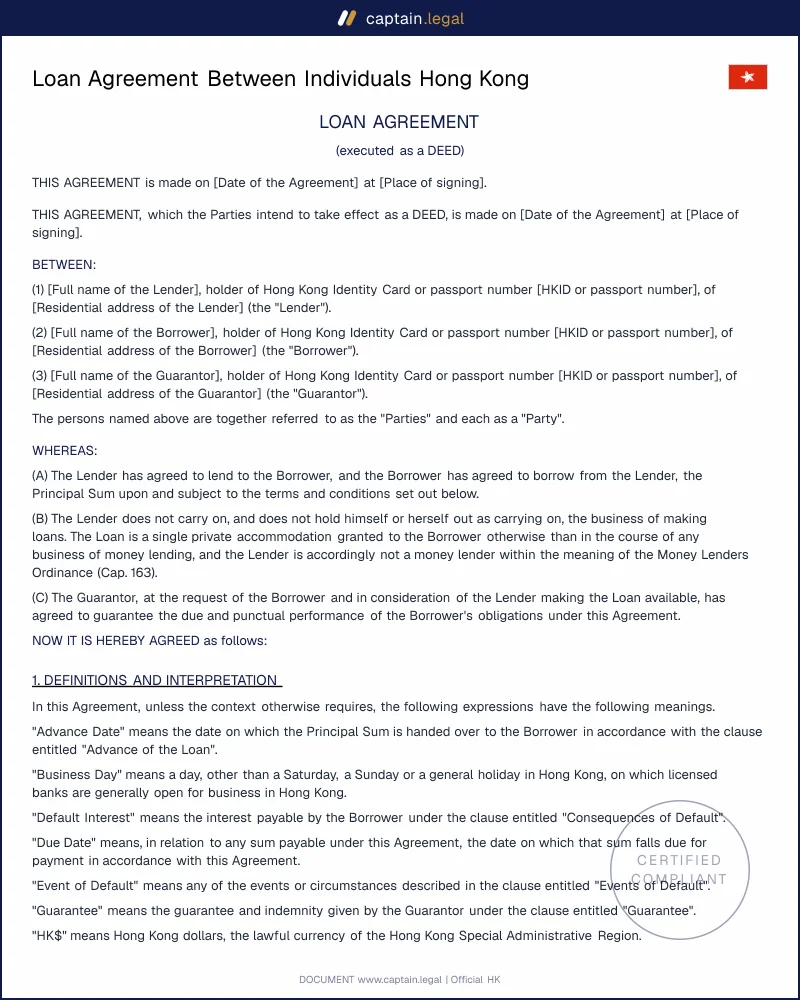
You begin by identifying the two parties and confirming that neither lends money as a business, the question that decides whether the Money Lenders Ordinance licensing regime applies at all. The form then asks for the principal, the date and method of the advance and the account details, so the receipt clause matches the bank record. Interest comes next: you choose an interest free loan or enter a rate, and the guidance flags the statutory ceiling before you commit. The repayment structure follows, whether a lump sum, equal instalments, or repayment on written demand.

Security and guarantee sections open only if you say the loan is secured or guaranteed, which keeps a family loan short. You then choose between a simple contract and a deed, and the wording, the attestation blocks and the limitation position adjust accordingly. The agreement is produced in Word and PDF, ready for signature in counterparts. Keep the signed original, the transfer receipt and any later acknowledgement in one file: those three together are what a Hong Kong court will want to see.

6

Common mistakes to avoid

The classic error is lending on trust and papering nothing, then relying on instant messages that never state a repayment date. Close behind is the rate set by feel rather than by calculation: parties agree a monthly figure that looks modest, forget that the effective rate is annualised under Schedule 2 to the Money Lenders Ordinance, and land above the extortionate threshold. A third is letting limitation run out in silence. Six years passes quickly between relatives reluctant to sue, and once it lapses the debt survives but the remedy does not.

Lenders also over rely on part payments. A small transfer restarts the clock under section 23(3) of the Limitation Ordinance, but a written acknowledgement signed by the borrower is cleaner under section 24(1), and asking for one costs nothing. Two further traps recur: advancing cash without a receipt, which turns a debt claim into a credibility contest, and lending repeatedly at interest, which risks the lender being treated as an unlicensed money lender. Where the borrower is a company rather than an individual, this template is the wrong document.

Key takeaways

PROOF

Put it in writing, avoid “gift” arguments

A private loan can be oral and still enforceable in Hong Kong, but the real fight is evidence. Without a signed agreement, the borrower may later say the transfer was a gift, an investment, or repayment of an older debt, leaving you to rely on bank statements and memory. A full loan agreement records the advance, any interest, the repayment schedule and what counts as default.

INTEREST CAPS

Stay under the Cap. 163 ceilings

The Money Lenders Ordinance (Cap. 163) sets hard boundaries even for private loans. Lending at an effective rate above 48% per annum is an offence and makes the agreement unenforceable, and rates above 36% per annum are presumed extortionate so the court may reopen the deal (sections 24 and 25(3)). An excessive rate can wipe out the claim, not just the interest.

LIMITATION

Do not miss the six-year window

Timing can decide whether you recover anything. Under section 4(1) of the Limitation Ordinance (Cap. 347), a claim on a simple contract must be started within six years from when the cause of action accrues. If the loan is executed as a deed, section 4(3) extends this to twelve years. A part payment or written acknowledgement signed by the debtor can restart time under section 23(3).

Frequently Asked Questions

Yes. A loan between two private persons is a simple contract and binds both parties once there is offer, acceptance and consideration, which the advance supplies. No registration or notarisation is needed. The written document does not create the obligation so much as prove it, which is what matters when the borrower disputes the terms years later. It fails only if it breaches section 24 of the Money Lenders Ordinance on excessive interest.

No, provided you are not making loans as a business. The licensing requirement in the Money Lenders Ordinance (Cap. 163) bites on a person whose business is making loans, and a one off advance to a friend or relative falls outside it. The risk appears with repetition: lending regularly at interest to unconnected borrowers can amount to a business, and section 23 then makes each loan unenforceable.

The effective rate must not exceed 48 per cent per annum. Above that, section 24 of the Money Lenders Ordinance creates an offence and the agreement cannot be enforced at all, including for the principal. Between 36 and 48 per cent the transaction is presumed extortionate under section 25(3) and the court may reopen it. These are ceilings, not benchmarks: family loans are usually interest free or close to prevailing deposit rates.

Six years from the accrual of the cause of action, under section 4(1) of the Limitation Ordinance (Cap. 347). For an instalment loan time runs separately for each missed instalment, and for a loan repayable on demand from the demand. A deed gives twelve years under section 4(3), and a part payment or signed acknowledgement resets the period. Once limitation expires the court will refuse the claim however clear the debt is.

Yes. The completed document is delivered in both Microsoft Word and PDF. The Word version lets you adjust names, amounts or a bespoke clause before signature, which helps where a guarantor is added late. The PDF is the version to print for wet ink signature and keep as the executed record, and most lenders sign two originals. The full catalogue of Hong Kong legal document templates covers the related guarantee forms.

Stamp duty does not apply to a loan agreement in Hong Kong, so nothing goes to the Stamp Office, and witnessing is not compulsory for a simple contract. It matters where the document is executed as a deed, since attestation by an independent witness is treated as good practice by the Law Society of Hong Kong. Choose a witness who is not a party, not a relative and not the guarantor.

4.6/5

17 verified reviews · 50 000+ downloads

HK Loan Agreement | Money Lenders Ordinance Cap. 163
  • Immediate access to the document
  • PDF + Word download
  • Compliant with 2026 legislation
  • Reviewed by lawyers
Fill in the template
Secure payment
Updated on August 19, 2026

You might also like

Enduring Power of Attorney Hong Kong
Last Will and Testament Hong Kong