Personal & Family

HK Joint Divorce: Cap. 179 s.11B and Cap. 192 s.18

Joint application drafted to s.11B Cap. 179, rules 9 and 11 of Cap. 179A and s.18 Cap. 192, with Form 2D statement and filing checklist. Word and PDF.
4.5/5— 17 reviews50 000+ downloadsInstant download
Share

A joint divorce application is the route Hong Kong law gives to spouses who both accept that the marriage is over and want to end it together, rather than have one of them petition against the other. This pack is drafted for the Family Court under section 11B of the Matrimonial Causes Ordinance (Cap. 179), for couples who have lived apart for at least one year. It contains an originating application carrying the information required by Form 2C, the statement as to arrangements for children required by Form 2D, the Statement of Truth, the joint mediation certificate and a filing checklist built on the order in which the Registry checks your papers. It suits couples who have agreed the practical terms and want an uncontested, no-fault divorce in Hong Kong.

Compliant

2026 Legislation

50,000+ clients

trust us

Affordable

From $4.90 / doc

Secure payment

Instant download

HK Joint Divorce: Cap. 179 s.11B and Cap. 192 s.18

Secure payment

Fill in the template

What is a joint divorce application in Hong Kong?

Hong Kong recognises a single ground for divorce: the marriage has broken down irretrievably (section 11 of Cap. 179). A sole petitioner must prove one of the five facts in section 11A(2), which means alleging adultery, behaviour, desertion or a period of separation against a respondent. A joint application removes that adversarial framing. Both spouses sign as joint applicants, nothing is served, and the court must be satisfied of either or both facts in section 11B(2): at least one continuous year living apart immediately before the application, or a notice of intention to divorce in Form 2E, signed by both, given to the court at least one year earlier and never withdrawn. This pack is built on the separation limb.

The joint application is often confused with a petition based on one year's separation with consent under section 11A(2)(c). The time threshold is identical, but the petition still casts one spouse as petitioner and the other as respondent, requires service, and depends on a consent the respondent can withdraw before decree nisi. A joint application is symmetrical from the first page. It must also be distinguished from a Hong Kong separation agreement drafted as a deed, which regulates living apart but leaves the marriage in place. Many couples sign the deed first, then use this pack once the twelve months have run.

When do you need this document?

The textbook case is a couple who stopped living as husband and wife more than a year ago, have agreed who keeps the flat and where the children will live, and want the marriage dissolved without allegations. A second, very Hong Kong situation involves spouses who still share a flat in Tai Koo or Tseung Kwan O because neither can yet afford to move out. They can apply jointly if they have run separate households under one roof for twelve months, with separate bedrooms, separate meals and no pooled finances. The application must describe that arrangement concretely, since the Registrar can call for further evidence or reject a joint application that does not prove the facts. Expatriate couples preparing to relocate form a third group: they file while the three year residence test is still met, because leaving Hong Kong can remove that basis of jurisdiction.

Two edge cases deserve attention. Spouses who have not yet lived apart for a full year can lodge a Form 2E notice now and apply a year later, even while still sharing a household; the checklist flags that route, though this pack assumes the separation limb is already met. Where the marriage was registered on the Mainland, the Hong Kong decree and related orders can be recognised across the boundary, so the agreed terms deserve precise drafting from the outset.

Key clauses included in our pack

  • The jurisdiction statement identifies which basis in section 3 of Cap. 179 applies and the facts behind it. Where you rely on three years' habitual residence, rule 9(6) requires each party's addresses and periods of residence across the whole period, so the template collects them address by address.
  • The marriage particulars reproduce the certificate exactly: names as registered, date and place of marriage and the registering authority. For certificates in a language other than English or Chinese, the checklist reminds you to attach a certified translation.
  • The separation statement records the date you began living apart and how the household was divided afterwards. It is drafted to the section 11C household test, with optional wording for separation under one roof.
  • The children section lists every child of the family, including stepchildren treated as such by both spouses. It feeds the Form 2D statement covering residence, schooling, health, childcare, contact and maintenance for each child.
  • The proposed orders set out the agreed position on custody, care and control and access, and record any claim for maintenance, lump sum or property adjustment. Recording the claim preserves it, while the final financial terms are embodied in a consent order approved by the court.
  • The filing checklist orders the bundle: marriage certificate, signed application, Form 2D statement, Statement of Truth, mediation certificate and court copies. It ends with the Form 5A notice for decree absolute and the written notice the lodging applicant must give the other spouse.

Practice considerations in the Hong Kong Family Court

Couples with children face the closest scrutiny, because the court has an active duty under section 18 of Cap. 192. That duty covers children under 16 and older minors still in education or training, so a teenager at boarding school in the UK belongs in the Form 2D statement. Thin arrangements can prompt a social investigation report from the Social Welfare Department, which adds months to the timetable. In genuine urgency, section 18(1)(c) allows the decree to be made absolute first, against an undertaking to return the arrangements to court within a fixed time.

Cross-boundary couples married on the Mainland, or holding property in Guangdong, should draft with enforcement in mind. The Mainland Judgments in Matrimonial and Family Cases (Reciprocal Recognition and Enforcement) Ordinance (Cap. 639) provides for a Hong Kong decree absolute and related orders to be recognised in the Mainland, and for Mainland orders to be recognised here. That mechanism rewards unambiguous orders. A maintenance term naming the currency, payment date and bank channel travels far better than a promise to "support the children".

Expatriate couples married abroad should check how their home country treats a Hong Kong decree before relying on it to remarry or to claim pension rights there. The Hong Kong court dissolves a marriage celebrated overseas once section 3 jurisdiction is established, with no local registration of the marriage needed. Once both spouses have left, domicile or substantial connection may still found jurisdiction, but proving either is slower and less certain, so filing before departure keeps the case on the residence limb.

Property and business assets are where agreed divorces most often unravel after the decree. A flat held as joint tenants passes by survivorship, so a buy-out should be completed by assignment, or the joint tenancy severed, rather than left as an intention; if the couple sells to a third party instead, the sale runs through an agreement for sale and purchase of Hong Kong property under Cap. 219. Where one spouse holds shares in a family company, any transfer must respect the shareholders agreement governed by the Companies Ordinance (Cap. 622), including pre-emption rights. Hong Kong has no pension-sharing order, so MPF accrued benefits cannot be split at source and are usually offset against other assets. A private agreement on any of these points does not bind the court until it is embodied in a consent order.

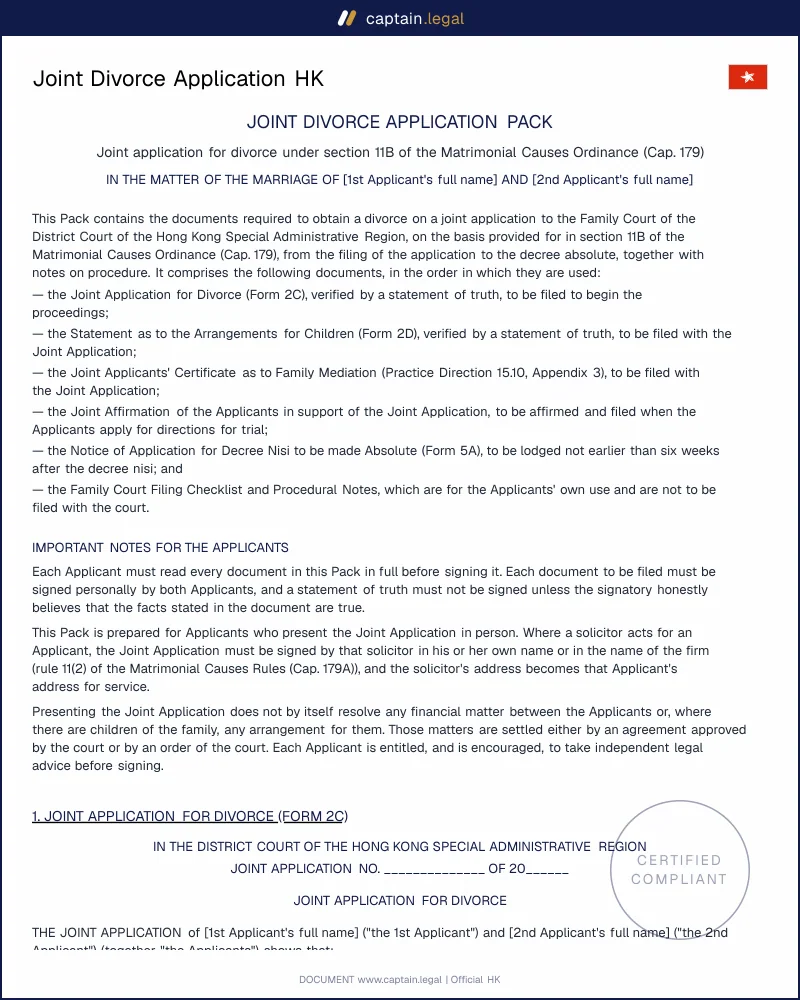
How to fill out this joint divorce application pack

You start with the facts of the marriage: both names exactly as they appear on the certificate, identity card or passport numbers, the date and place of marriage and each spouse's address. The questionnaire then asks which jurisdictional basis applies and, for the residence limb, collects three years of addresses. Next come the separation date and how the household ran afterwards. If you have children, the form takes each child in turn through residence, school, medical care, childcare, contact and financial support, and builds the Form 2D statement from your answers. You then record whether financial claims are agreed, reserved or to be settled by consent summons.

Once both of you have reviewed the draft, you download it and each applicant signs the application, the Statement of Truth and the mediation certificate personally. You book a slot through the Family Court e-Appointment System, lodge the bundle with the marriage certificate and apply for directions for trial in the Special Procedure List. After decree nisi, either applicant may lodge Form 5A, provided the other is notified in writing. Wait more than twelve months after the section 18 declaration and the Registrar may ask for an affidavit explaining the delay.

Common mistakes to avoid

The most frequent error is miscounting the year. Couples date the separation from the day one spouse moved out, then forget the weeks spent back together over Chinese New Year, which never count towards the period under section 15A(5). An application filed a few weeks early fails and has to be started again. Build in a margin of at least a month beyond the anniversary before you file. The second recurring problem is the vague statement of arrangements: "the children will live with their mother and see their father regularly" satisfies nobody, and it is the usual trigger for a social investigation report.

Financial loose ends cause the costliest problems. Couples who settle privately but never obtain a consent order leave claims for maintenance and property open, and a signed side letter does not close them. Even a genuine clean break should be recorded in an order dismissing future claims. Another trap is the forgotten will: until the decree is made absolute your spouse remains your spouse, and an existing will or the intestacy rules may still favour them, which is why many clients update their last will and testament under the Wills Ordinance (Cap. 30) as soon as they file. Finally, never sign for your spouse; each applicant signs personally and receives Registry notices in their own name.

Key takeaways

ELIGIBILITY

Hong Kong connection comes first

The Family Court can deal with the joint application only if section 3 of the Matrimonial Causes Ordinance (Cap. 179) is met: domicile in Hong Kong, three years' habitual residence, or a substantial connection. The pack is built for section 11B, using one continuous year living apart immediately before filing, with section 11C focusing on the household rather than the flat.

FILING

Both spouses sign, no service needed

This is not a petition by one spouse against the other. Both sign as joint applicants, and nothing is served on a respondent. Rule 9 of the Matrimonial Causes Rules (Cap. 179A) requires an originating application with Form 2C information, while rule 11 requires personal signature where an applicant acts in person. The Statement of Truth and mediation certificate sit alongside it.

CHILDREN

Children arrangements can stop completion

Where there is a child of the family under 16, or still in education or training, the Form 2D statement matters. Section 18 of the Matrimonial Proceedings and Property Ordinance (Cap. 192) bars the decree absolute until the court is satisfied with the arrangements. If that declaration is missing, section 18(3) says the decree absolute is void.

Frequently Asked Questions

Yes. No solicitor is required: rule 11 of the Matrimonial Causes Rules (Cap. 179A) expressly provides for applicants acting in person to sign the application themselves. The template carries the information rule 9 requires for Forms 2C and 2D. Validity then turns on the facts, namely jurisdiction under section 3 of Cap. 179 and a genuine year of living apart. Prepared this way, it stands on the same footing as one lodged by a law firm.

You can, provided you have lived as separate households for the full year. Section 11C of Cap. 179 treats spouses as living apart unless they live with each other in the same household, so the question is how you lived, not where. Separate bedrooms, separate meals, separate finances and no domestic services for each other are the markers the Registrar looks for. Short of a full year, a Form 2E notice starts the clock without moving out.

The Judiciary's performance pledge is 50 days from setting down in the Special Procedure List to the pronouncement of decree nisi, and neither applicant needs to attend. Its guidance then allows an application for decree absolute six weeks after decree nisi, using Form 5A, although section 15(5) of Cap. 179 sets three months unless a shorter period is fixed. Where there are children, the decree becomes absolute only after the court's declaration under section 18 of Cap. 192.

Before decree nisi, a joint application cannot in practice go forward without both applicants, so the spouse who still wants a divorce would need to present a sole petition under section 11A of Cap. 179. After decree nisi the position shifts: either joint applicant may lodge Form 5A alone, so a change of heart does not by itself stop the decree becoming absolute. Settling every term in writing before filing, using our Hong Kong personal and family law templates, avoids most of these reversals.

Every document comes in Word and PDF. The Word file lets you correct a date or add a child's school before printing; the PDF preserves the layout for filing. Each applicant signs their own copies of the application, the Statement of Truth and the mediation certificate in wet ink, and the checklist states how many copies the Registry needs. The same delivery applies across our full catalogue of Hong Kong legal documents.

No, but independent advice is sensible where there are substantial assets, pensions abroad or any disagreement about the children. Unrepresented litigants can use the free Procedural Advice Scheme for guidance on court procedure, although its advisers do not comment on the merits of a case. Legal aid remains open to applicants who pass the Legal Aid Department's means and merits tests. Many couples prepare the pack themselves and ask a family solicitor to review the consent order before filing.

4.5/5

17 verified reviews · 50 000+ downloads

HK Joint Divorce: Cap. 179 s.11B and Cap. 192 s.18
  • Immediate access to the document
  • PDF + Word download
  • Compliant with 2026 legislation
  • Reviewed by lawyers
Fill in the template
Secure payment
Updated on September 30, 2026

You might also like

Deed Poll Hong Kong
Probate Pack Hong Kong