Business & Incorporation

Statutory Demand HK: Cap. 32 s.178 Form 1A Notice

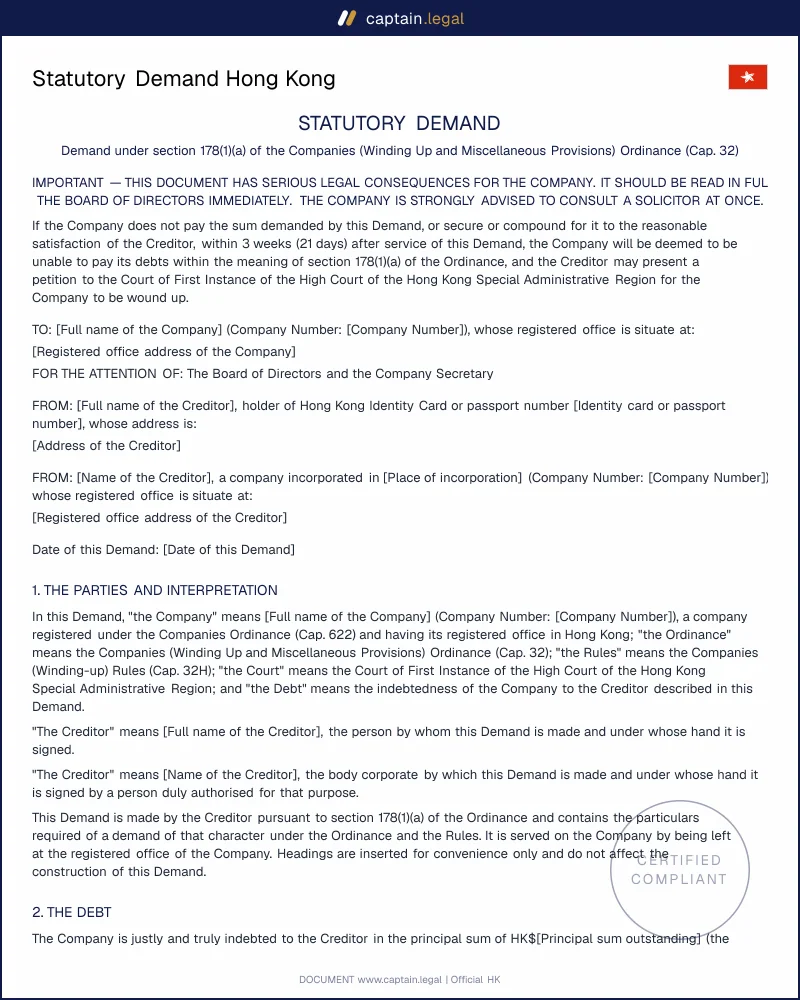
Statutory demand drafted to section 178(1)(a) of Cap. 32 and prescribed Form 1A under Cap. 32H. Service at the registered office, three week period.
4.6/517 reviews50 000+ downloadsInstant download
Share

A statutory demand is the formal written notice a creditor leaves at the registered office of a Hong Kong company before petitioning to wind it up. It is the trigger for the presumption of insolvency in section 178(1)(a) of the Companies (Winding Up and Miscellaneous Provisions) Ordinance (Cap. 32): once the demand has been served and three weeks pass without payment, the company is deemed unable to pay its debts and the Court of First Instance can be asked to appoint a liquidator. This template is drafted for suppliers, lenders, landlords, contractors and directors chasing a liquidated sum of at least 10,000 Hong Kong dollars from a debtor with no real answer to the claim. It follows Companies Court practice and downloads in Word and PDF.

Compliant

2026 Legislation

50,000+ clients

trust us

Affordable

From $4.90 / doc

Secure payment

Instant download

Statutory Demand HK: Cap. 32 s.178 Form 1A Notice

Secure payment

Fill in the template

What is a statutory demand in Hong Kong?

A statutory demand is not a court document and it does not start proceedings. It is a private notice, signed by the creditor or by solicitors on the creditor's behalf, that fixes a deadline and creates evidence. Its whole value lies in what happens when the deadline passes: the creditor no longer has to prove that the company is insolvent in the accounting sense, because section 178 supplies the presumption.

The confusion worth clearing up is the difference between a letter of demand and a statutory demand. A letter of demand is ordinary correspondence: it can claim damages, unliquidated sums and interest, and it threatens a civil action. A statutory demand claims one thing only, a debt that is presently due, ascertained and undisputed, and it threatens the company's existence. Serving the wrong one wastes the leverage. Creditors who still need to establish liability should sue first and use the judgment debt as the foundation of the demand. The rest of the business and incorporation documents for Hong Kong companies cover the contractual side of that relationship.

2

When do you need this document?

The classic case is the unpaid trade invoice. A supplier has delivered, the buyer has accepted without complaint, credit terms expired months ago, and the excuses have moved from cash flow to silence. Nothing about the debt is arguable, so the demand converts a stale receivable into a three week ultimatum with the Companies Court behind it. The second recurring scenario is enforcement of a judgment or an arbitral award carrying leave to be enforced as a judgment: liability is settled, and the demand becomes a pressure instrument rather than a proof exercise. Lenders reach for it after a facility has been accelerated, and landlords after a corporate tenant abandons premises owing arrears, alongside the Hong Kong tenancy agreements and landlord notices that document the tenancy itself.

Two edge cases justify a second look. The first is the debtor company that has quietly changed its registered office: service at the old address is worthless, and the Companies Registry record governs. The second is the guarantee. A corporate guarantor becomes a debtor in its own right once demand has been made under it, which is how the petitioner in Re Simplicity proceeded, but the guarantee must have been called properly first. Serving a statutory demand where the debt is genuinely disputed is an abuse of process and routinely attracts indemnity costs.

3

Key clauses included in our template

  • The identification of the parties names the creditor and the debtor company exactly as they appear on the Companies Registry record, with the company number and the current registered office. A demand addressed to a trading name, or to an address lifted from an old invoice, is the easiest point of attack for the debtor's solicitors.
  • The particulars of the debt set out each invoice or advance by number and date, the contract it arises under, and the sum then due. Interest stays separate and appears only where a contractual or statutory entitlement exists, because an inflated figure invites a quantum dispute that need never have arisen.
  • The statutory basis and payment demand cite section 178(1)(a) expressly and require payment, security or a compounding arrangement within 21 days of service. The wording tracks Form 1A of the Companies (Winding-up) Rules (Cap. 32H) so the demand reads as the Companies Court expects.
  • The consequences notice warns the company that non-compliance grounds a petition under section 177(1)(d) and that a winding up, once ordered, relates back to presentation. Directors take this paragraph seriously when they learn that bank accounts are usually frozen from that date.
  • The contact and payment details name an individual with whom the company may communicate about the demand, with a telephone number and address, as the prescribed form requires. Leaving it blank is a common reason for a demand being criticised.
  • The signature block and certificate of service record who signed and in what capacity, then the date and manner in which the demand was left at the registered office, ready to be exhibited later.
4

Debtor profiles and service considerations

Hong Kong incorporated companies are the straightforward case. Every company registered under the Companies Ordinance (Cap. 622) must maintain a registered office in Hong Kong, and the address on the Companies Registry record is where the demand must be left. Many small companies use a corporate services provider for that address, so the demand lands with a secretarial firm rather than a director. Service is still good, which explains why some debtors claim not to have seen it until the petition arrives.

Non-Hong Kong companies registered under Part 16 of Cap. 622 have a principal place of business here and an authorised representative on the register, and service follows the registered address. Foreign companies with no local registration are harder. Winding up proceeds under section 327 of CWUMPO, and the court applies the three core requirements confirmed in Kam Leung Sui Kwan v Kam Kwan Lai (2015) 18 HKCFAR 501, starting with a sufficient connection to Hong Kong.

Companies limited by guarantee, including many charities and clubs, are wound up on the same footing as companies limited by shares, and their governing papers sit with the society constitutions and charity governance documents. Sole proprietors and partners are not companies at all: a demand against them runs under the Bankruptcy Ordinance (Cap. 6) and uses the bankruptcy prescribed form. Check the Companies Registry and Business Registration records before you choose which document to send.

5

How to fill out this statutory demand

You begin with the creditor's details, then the debtor company's exact registered name, company number and registered office, which you should verify against a Companies Registry search on the day you prepare the document. The form then asks for the debt: the invoices, advances or judgment, each with its date and amount, and the total presently due. Interest is entered only where a contract or statute allows it. The document then generates the statutory wording, the 21 day period and the consequences notice, and closes with the signature block and a certificate of service you complete once the demand has been left at the registered office. Word and PDF versions download together. Related company paperwork sits in the full catalogue of Hong Kong legal templates.

6

Common mistakes to avoid

The mistake that ends most demands is serving one where the debt is genuinely disputed. A company showing a bona fide dispute on substantial grounds, or a cross-claim that overtops the debt, will restrain presentation by injunction, and the creditor pays the costs. The second is arithmetic. Adding interest that was never agreed, or costs that have not been assessed, hands the debtor an argument about quantum, even though the court can still wind up where the sum genuinely owed exceeds the threshold. The third is service. The statute requires the demand to be left at the registered office, not posted, emailed or handed to a director in a lobby, and a creditor who cannot prove proper service has effectively served nothing.

Timing errors follow close behind. Counting 21 days from the date typed on the letter rather than the date of service shortens the period, and a petition presented early will be struck out. Creditors also forget the Limitation Ordinance (Cap. 347): a simple contract debt is time barred after six years, and a demand does not revive it. The last mistake is strategic. A demand against a company that is solvent but slow usually produces payment; against one that is genuinely insolvent, it produces a liquidation in which unsecured creditors recover very little.

Key takeaways

CAP. 32 s.178

Three weeks triggers deemed insolvency

Under section 178(1)(a) of the Companies (Winding Up and Miscellaneous Provisions) Ordinance (Cap. 32), a written demand served at the company’s registered office for a sum then due of at least HKD 10,000 creates real leverage. If, after three weeks, the company has neglected to pay, or to secure or compound for the debt to the creditor’s reasonable satisfaction, it is deemed unable to pay its debts.

RIGHT TOOL

A statutory demand is not a lawsuit

A statutory demand is a private notice, not a court document, and it does not start proceedings. It is designed for a liquidated, presently due, ascertained and undisputed debt, not damages or unliquidated claims. If liability is still being argued, using a statutory demand can backfire: you may need to sue first, obtain a judgment debt, and then use that judgment as the foundation for the demand.

FORM & DISPUTES

Use Form 1A and check clauses

Form and forum can decide whether the tactic works. Since 13 February 2017, corporate statutory demands are expected to follow the prescribed Form 1A under the Companies (Winding-up) Rules (Cap. 32H), reducing scope for technical fights over validity. Separately, recent Hong Kong decisions mean the Court may dismiss or restrain insolvency steps where the debt dispute is caught by an exclusive jurisdiction clause or an arbitration clause, so review the contract before serving.

Frequently Asked Questions

The template is drafted to section 178(1)(a) of CWUMPO and follows prescribed Form 1A under the Companies (Winding-up) Rules (Cap. 32H), so a demand completed and served correctly produces the statutory presumption that the company cannot pay its debts. The demand is not a court order and does not by itself compel payment. What it creates is the evidential foundation for a winding-up petition, and that is where its force comes from. A winding-up order still depends on the debt being undisputed and on the court's discretion.

Section 178(1)(a) gives the company three weeks from service before the presumption bites, and the prescribed form expresses this as 21 days. The clock runs from the day the demand is left at the registered office, not from the date typed on it, which is why the certificate of service matters. Payment, security or a compounding arrangement reaching the creditor's reasonable satisfaction within that window defeats the demand. A petition presented early is premature and will be dismissed, usually with costs.

Not on a company. Section 178(1)(a) requires the demand to be left at the registered office, and Hong Kong practice is to have it delivered there physically, with the person delivering it recording the date, time and address. Posting or emailing the demand may reach the right people, but it does not satisfy the statutory wording, and the debtor will say so at the hearing. Bankruptcy demands against individuals under Cap. 6 follow different service rules, so do not carry the practice across.

The petition route closes. Hong Kong courts will not use the winding-up jurisdiction to resolve a genuine dispute, and a company that shows a bona fide dispute on substantial grounds can obtain an injunction restraining presentation. The position is stricter still where the contract contains an arbitration clause or an exclusive jurisdiction clause, following Re Guy Kwok-Hung Lam [2023] HKCFA 9 and Re Simplicity & Vogue Retailing (HK) Co Ltd [2024] HKCA 299. The creditor should then pursue the agreed forum, obtain an award or judgment, and only afterwards consider a demand.

The demand downloads in Word and PDF. The Word version lets you adjust the particulars of the debt, attach an invoice schedule or insert your solicitors' details before printing, and the PDF is the version most creditors sign and serve. Keep the signed original and a dated copy, because the copy is exhibited to the affirmation supporting the petition and the Companies Court expects to see it.

Rarely the right choice. Wage claims normally go to the Labour Tribunal, and employees of an insolvent employer can apply to the Protection of Wages on Insolvency Fund, which pays out without waiting for a liquidation to conclude. A demand may still be served for a liquidated sum properly due under a contract of employment, but the tribunal route is faster. The underlying paperwork sits among the employment contracts prepared under the Employment Ordinance.

4.6/5

17 verified reviews · 50 000+ downloads

Statutory Demand HK: Cap. 32 s.178 Form 1A Notice
  • Immediate access to the document
  • PDF + Word download
  • Compliant with 2026 legislation
  • Reviewed by lawyers
Fill in the template
Secure payment
Updated on August 20, 2026

You might also like

Partnership Agreement Hong Kong
Share Transfer Form HK