Business & Incorporation

Letter of Demand HK: Unpaid Invoices, Cap. 32 s. 178

Hong Kong letter of demand for unpaid invoices, built on the six year limit in Cap. 347 s. 4(1)(a), interest under Cap. 4 s. 48 and the Cap. 32 s. 178 route.
4.7/516 reviews50 000+ downloadsInstant download
Share

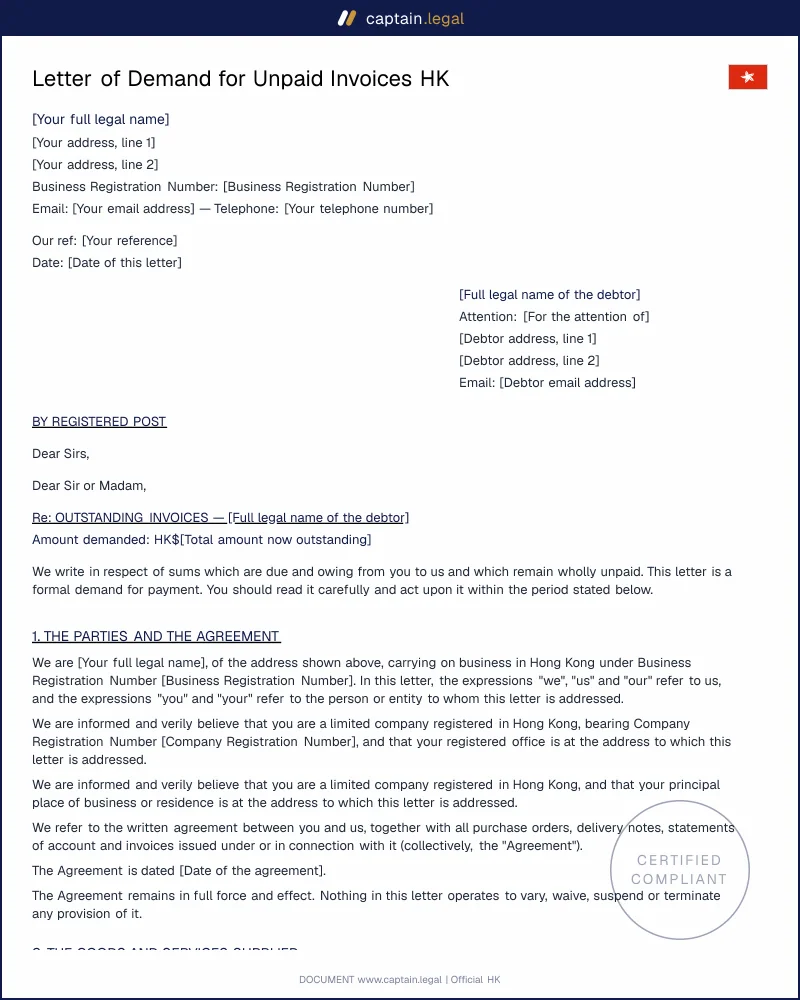
A letter of demand for unpaid invoices is the formal written notice a Hong Kong creditor sends before it starts recovery proceedings. It identifies the invoices that have fallen due, states the total claimed, sets out the interest position and fixes a date by which payment must reach the creditor. Most commercial debts settle at exactly this stage, because a demand drafted to solicitor standard signals that the next step is a statutory demand under the Companies (Winding Up and Miscellaneous Provisions) Ordinance (Cap. 32) or a writ. This template gives you that letter in Word and PDF, with the six year limitation rule in the Limitation Ordinance (Cap. 347) and the section 178 escalation route built into the drafting.

Compliant

2026 Legislation

50,000+ clients

trust us

Affordable

From $4.90 / doc

Secure payment

Instant download

Letter of Demand HK: Unpaid Invoices, Cap. 32 s. 178

Secure payment

Fill in the template

What is a letter of demand for unpaid invoices?

A letter of demand for unpaid invoices is a private contractual document, not a court process. It records that a sum has fallen due under identified invoices, that payment is required by a stated date, and that proceedings will follow if the money does not arrive. Hong Kong law prescribes no form for it and no rule says one must be sent before a writ. In practice the courts expect it: a plaintiff who sues without ever having written to the debtor invites questions about costs and about its conduct under Practice Direction 31.

The document is regularly confused with the statutory demand. A statutory demand is a creature of statute, served under section 178(1)(a) of Cap. 32 at the company's registered office in prescribed Form 1A under the Companies (Winding-up) Rules (Cap. 32H), and its expiry creates a deemed inability to pay debts. A letter of demand has no deeming effect. It fixes the debtor with notice and preserves your position on costs. Creditors who need the harder instrument move on to the Form 1A statutory demand template for Hong Kong companies once the letter has expired. Sending a letter of demand does not stop time running under the Limitation Ordinance. Only proceedings, a signed acknowledgment or a part payment do that.

2

When do you need this document?

The ordinary trigger is a customer who has gone past the agreed credit period and stopped answering the accounts team. Once two cycles have slipped, informal chasing has failed and the file needs a document a judge could read. A second pattern is the debtor who keeps paying small amounts without clearing the balance: those payments restart limitation under section 24, but they disguise an account that has been rolling for years.

Professional firms use it when a client challenges the fee note only after the work is delivered. Subcontractors use it on retention money and certified but unpaid final account balances. Trading companies use it against buyers who took delivery and went quiet. Where the contract routes disputes to arbitration, the letter is still worth sending but the winding-up threat should be softened, because the Guy Lam line of authority may stay any petition. Where the debtor is about to be struck off for non-filing, the demand goes out at once alongside an objection to deregistration, since a dissolved company cannot be sued without restoration. Anyone trading under a framework contract should read the demand against the payment terms in their master services agreement for Hong Kong suppliers.

3

Key clauses included in our template

  • The identification of the parties uses the debtor's full registered name, company number and registered office as they appear on the Companies Registry record, not the trading name on the purchase order. A demand addressed to "ABC Trading" when the contracting entity is ABC Trading (HK) Limited hands the debtor a free point, and it is the commonest defect in letters drafted in house.
  • The schedule of invoices lists each invoice number, date, due date and outstanding amount, with a running total and any credit notes applied. A statutory demand later requires a precise liquidated sum, so a figure that shifts between the letter and the demand is a gift to the debtor.
  • The interest claim is drafted in the alternative: contractual interest where the terms provide for it, and the discretionary jurisdiction under section 48 of Cap. 4 or section 49 of Cap. 336 where they do not. Separating the limbs stops the claim collapsing if the contractual clause is later found unenforceable.
  • The demand and deadline state a calendar date and the settlement account, then name the next step: a statutory demand under section 178(1)(a) of Cap. 32 for a corporate debtor, a bankruptcy demand under section 6(2) of the Bankruptcy Ordinance (Cap. 6) for an individual, or a writ. Seven to fourteen days is the usual window, and vague threats of legal action carry no weight where a named statutory route does.
  • The reservation of rights and acknowledgment invitation closes the letter, preserving all other claims and inviting the debtor to confirm the balance or propose terms. That invitation is deliberate, because a signed acknowledgment restarts limitation under section 24 of Cap. 347.
4

Corporate debtors, sole proprietors and the right forum

Hong Kong incorporated companies are the most straightforward target. Serve at the registered office shown on the Companies Registry record and copy the letter to the director and to any contractual address for service. Run a company search first: it will tell you whether the debtor has changed name, moved office, or already faces a petition. If the balance sits above the statutory threshold and is undisputed, say plainly that a statutory demand under section 178(1)(a) will follow. That sentence does most of the work.

Sole proprietors and partnerships hold a business registration certificate but no separate legal personality, so the debt is the proprietor's personal debt. Address the letter to the individual by name, adding the trading style, and check the registration record for the principal place of business. Escalation runs through Cap. 6, with a statutory demand in Form 162 under the Bankruptcy Rules (Cap. 6A). Never serve Form 1A on a sole proprietor. The wrong instrument is fatal and the debtor will apply to set it aside with costs.

Individual guarantors need a separate letter, not a copy of the company demand. A guarantee is a distinct contract with its own limitation clock and its own notice mechanics, often requiring that the principal debtor be called on first. Read it before drafting, as you would read the repayment terms in a personal loan agreement between individuals.

Forum selection shapes the closing paragraph. Small balances belong in the Small Claims Tribunal under Cap. 338, mid-range commercial claims in the District Court under Cap. 336, and larger ones in the Court of First Instance, where an unarguable defence can be disposed of by summary judgment under Order 14. Name the court you will use, because a demand that identifies the correct forum reads as if a solicitor is already instructed. Related recovery documents sit in the business and incorporation section for Hong Kong and, for landlords, in the rent arrears demand letter for Hong Kong tenancies.

5

How to fill out this letter of demand

You start by telling the form what kind of debtor you are dealing with, because the whole letter turns on that answer. Choose a Hong Kong company and the escalation paragraph switches to section 178(1)(a) of Cap. 32 and asks for the registered office and company number. Choose a sole proprietor or individual and it switches to the bankruptcy route under Cap. 6. Then you enter the invoices line by line: number, issue date, due date and balance. The template totals the schedule and carries the figure into the operative demand, so the two always agree.

The interest step asks whether your terms contain an interest clause. If they do, you paste the wording and the letter quotes it before calculating from each due date. If they do not, it falls back on the statutory discretion and says so, which is more honest than inventing a rate. You then set the deadline and the settlement account, choose delivery by post, by hand or by email, and pick the tone: firm first demand, or final notice before proceedings. Download in Word for your letterhead, or in PDF to send as it stands.

6

Common mistakes to avoid

The costliest mistake is threatening a winding-up petition over a debt the customer has already disputed in writing. After Re Guy Kwok-Hung Lam and the appellate decisions that followed it, a debtor with an arbitration clause or a real defence will have the petition stayed and will ask for indemnity costs. Read the correspondence file before you draft. The second error is arithmetic: totals that do not match the schedule, credit notes left out, interest run from the invoice date instead of the due date. Every inconsistency becomes a paragraph in the debtor's affidavit.

The third failure is service to the wrong address, typically the operational office rather than the registered office. Silence then gets mistaken for stonewalling. Fourth, creditors let limitation drift on the assumption that repeated demands preserve the claim. They do not. Only proceedings, a signed acknowledgment or a part payment restart the six year period under sections 23 and 24 of Cap. 347. Last, and most damaging to the creditor, is the letter that goes beyond a legitimate legal remedy: calls to a debtor's family, disclosure of the debt to customers or staff, or language capable of being read as criminal intimidation under section 24 of the Crimes Ordinance (Cap. 200).

Key takeaways

LIMITATION

Six years runs on, demand or not

Before chasing anything, check limitation under section 4(1)(a) of the Limitation Ordinance (Cap. 347): most unpaid invoice claims (simple contract) must be sued on within six years from when the cause of action accrued, usually the contractual due date. A letter of demand does not stop the clock. Time only resets with proceedings, a signed written acknowledgement, or a part payment (sections 23 and 24).

INTEREST

Interest depends on contract or court

Do not assume you can add late payment interest in Hong Kong. If your supply contract or invoice terms contain an interest clause, use it and state the calculation clearly in the demand. If there is no clause, interest is not automatic: you are relying on the court’s discretion under section 48 of the High Court Ordinance (Cap. 4) (or section 49 of the District Court Ordinance (Cap. 336)), with best lending rate plus 1% as a common starting point.

ESCALATION

Letter of demand is not statutory demand

A letter of demand is a private notice: it puts the debtor on notice, fixes a payment deadline, and supports your position on costs, but it has no statutory deeming effect. If the debtor is a company and the debt is a liquidated sum above the statutory threshold, the next step may be a statutory demand under section 178(1)(a) of the Companies (Winding Up and Miscellaneous Provisions) Ordinance (Cap. 32), served in prescribed Form 1A under Cap. 32H.

Frequently Asked Questions

Six years from the date the debt became payable, under section 4(1)(a) of the Limitation Ordinance (Cap. 347). Time runs from the contractual due date, not from the date you issued the invoice and not from the date you last chased. Twelve years applies where the contract was executed as a deed. The period restarts if the debtor acknowledges the debt in writing with a signature, or makes a part payment, under sections 23 and 24. Verbal admissions do not count, which is why written confirmation is worth more than a promise.

The letter itself creates no obligation; the underlying contract and the invoices do. What it carries is legal effect. It puts the debtor on notice, evidences an attempt to settle before proceedings, supports an application for costs and starts contractual interest where the terms allow it. Courts read pre-action correspondence when they assess conduct, so a demand that states the debt precisely with a realistic deadline reflects well on the creditor. Accuracy matters more than force.

Seven to fourteen days is standard practice for a first demand, and fourteen is safer where the debtor is a larger organisation with an approval chain. A final notice can be shorter. Do not confuse this with the twenty one day period under a statutory demand, which is fixed by section 178(1)(a) of Cap. 32 and runs from the date of service, not the date on the document. Deadlines that are too short read as pressure tactics and hand the debtor a complaint about your conduct.

Yes, but not automatically. Hong Kong has no general statutory right to late payment interest on commercial debts, so without a contractual clause you rely on the court's discretion under section 48 of the High Court Ordinance (Cap. 4) or section 49 of the District Court Ordinance (Cap. 336). The Court of Appeal's starting point for pre-judgment interest is best lending rate plus one percent. State which basis you claim on: inventing a rate with no contractual foundation weakens the document, and a debtor's solicitor will notice.

Both formats download together. Most businesses use the Word version, because you will want the letter on your own letterhead with your company chop and bank details, and the schedule often needs adjusting after a part payment lands. The PDF is ready to print, sign and send by registered post. Keep the signed copy and the proof of posting, since an affidavit will need to exhibit both. Other templates sit in the full catalogue of Hong Kong legal documents.

Stop and assess the dispute before escalating. If the objection has any substance, the insolvency route closes: the courts will not wind up a company over a debt bona fide disputed on substantial grounds, and after Re Simplicity & Vogue Retailing (HK) Co Ltd an arbitration clause is usually enough on its own to have a petition stayed. Press on and you risk indemnity costs. Reply in writing, narrow the dispute to the invoices actually in issue, demand the undisputed balance separately, and take the contested part to the agreed forum.

4.7/5

16 verified reviews · 50 000+ downloads

Letter of Demand HK: Unpaid Invoices, Cap. 32 s. 178
  • Immediate access to the document
  • PDF + Word download
  • Compliant with 2026 legislation
  • Reviewed by lawyers
Fill in the template
Secure payment
Updated on September 1, 2026

You might also like

Share Transfer Form HK
Significant Controllers Register HK