Personal & Family

Small Claims Tribunal HK: Cap. 338 Forms and Hearing

Claim pack drafted to the Small Claims Tribunal Ordinance (Cap. 338): section 13 particulars, section 33 interest and the six year limit of Cap. 347.
4.5/518 reviews50 000+ downloadsInstant download
Share

A Small Claims Tribunal claim pack is the working file a Hong Kong claimant assembles to recover a money debt of up to HK$75,000 without a lawyer: the claim forms, the calculation behind the sum claimed, the interest schedule, the witness statement and the enforcement paperwork that follows judgment. The Tribunal sits under the Small Claims Tribunal Ordinance (Cap. 338) and hears monetary claims founded in contract, quasi-contract or tort. Unpaid invoices, withheld deposits, defective renovation work, goods delivered and never paid for: this is the daily diet at West Kowloon. A properly built pack keeps your claim inside the Tribunal's forms and inside the six year window of the Limitation Ordinance (Cap. 347).

Compliant

2026 Legislation

50,000+ clients

trust us

Affordable

From $4.90 / doc

Secure payment

Instant download

Small Claims Tribunal HK: Cap. 338 Forms and Hearing

Secure payment

Fill in the template

What is a Small Claims Tribunal claim pack?

The Tribunal does not issue one single claim document. A claimant fills in Form 1, the Title to Claim, and Form 2, the Form of Claim, files both at the registry in the West Kowloon Law Courts Building, and receives Form 3 with the date and courtroom fixed for the call over. This pack is the drafting layer around those forms: the wording that goes into Form 2, the arithmetic behind the figure, the witness statement the adjudicator will direct you to file, and the execution paperwork you need if the defendant ignores the award. Forms 1 and 2 have to be filed in person at the registry, never by post, fax or email.

A claim pack is not a letter of demand. The demand letter is the pre-action step that fixes the amount in writing and often produces payment before a filing fee is spent, which is why our letter of demand for rent arrears is the natural first move in a rental dispute. Nor is it a District Court writ, where the pleadings, the right to be represented and the costs regime all change.

2

When do you need this document?

The classic file is the unpaid invoice. A designer, a contractor or a trading company delivers, invoices, chases for months, then finds the debtor has stopped replying. Anything at or under the ceiling belongs here rather than in the District Court, and is worth filing once the last promise to pay has been broken. The second recurring scenario is the withheld deposit: a tenancy deposit that never came back, a prepayment for services never rendered, a beauty or tuition package cut short.

Property damage and defective work fill the rest. A vehicle damaged in a car park, a flat flooded by a renovation upstairs, a kitchen fitted with the wrong materials: each is a claim the Tribunal will hear, provided money is the only relief sought.

Two edge cases justify a careful pack. The first is the debt that slightly exceeds the ceiling, where section 9 lets you abandon the excess and stay in the cheaper forum, a trade off worth quantifying before you sign Form 2. The second is the old debt revived by conduct: under sections 23 and 24 of Cap. 347, a signed written acknowledgment or a part payment restarts the six year clock and often rescues a stale private loan between individuals.

3

Key clauses included in our template

  • The party identification block follows what Form 1 demands. Every party needs a full legal name and a Hong Kong address, since post office boxes and care of addresses are refused at the counter, and a sole proprietor must be named in the "Chan Tai Man trading as XYZ Company" style used on the Business Registration Application Form.
  • The statement of the ground of claim is drafted to section 13(d), in short numbered paragraphs telling the defendant what was agreed, what was delivered and what went wrong. Wording as vague as "money owed" leaves the adjudicator no basis for entering judgment if the defendant stays away.
  • The calculation schedule breaks the figure down invoice by invoice, with dates, credits for part payments and a running balance, so the sum in Form 2 is traceable line by line. This usually decides whether an undefended claim is entered on the spot.
  • The interest computation applies section 33 in two stages, pre award interest from the date the cause of action arose and post award interest at the judgment debt rate, with a daily figure you can update on the morning of the hearing.
  • The witness statement is written in the first person, in numbered chronological paragraphs, confined to facts within the maker's own knowledge and paginated with the C and D convention. Hearsay dressed up as evidence is the commonest reason a sound claim collapses.
  • The enforcement request closes the file with the praecipe and writ of fieri facias wording and a debtor asset checklist, so a winning claimant is not starting from a blank page if the award goes unpaid.
4

Which forum hears your claim in Hong Kong

Hong Kong has one Small Claims Tribunal for the whole territory, so venue is never the question. What matters is whether the dispute belongs to the Tribunal at all, because the Schedule to Cap. 338 carves out several categories while section 5(2) makes claims within its jurisdiction non actionable elsewhere. Filing in the wrong forum costs you the fee and the months: the Tribunal transfers the case under section 7 rather than decide it.

Employment claims are the first exclusion. Wages, wages in lieu of notice, severance and long service payment go to the Labour Tribunal under Cap. 25, or to the Minor Employment Claims Adjudication Board under Cap. 453, so a dispute over a final payslip belongs with our employment and HR templates drafted to the Employment Ordinance rather than here.

Land and tenancy matters split in a way that catches landlords out. A money claim for arrears within the ceiling is a small claim, but possession of the premises is not, and new tenancy or rating disputes go to the Lands Tribunal under Cap. 17. Estate agency complaints before the Estate Agents Authority under section 49 of the Estate Agents Ordinance (Cap. 511) are excluded while that body retains jurisdiction.

Defamation, maintenance agreements and licensed money lending complete the list, the Schedule barring defamation actions, proceedings on a maintenance agreement within section 14 of the Matrimonial Proceedings and Property Ordinance (Cap. 192), and recovery actions by a lender licensed under the Money Lenders Ordinance (Cap. 163). A private lender who holds no licence is not caught by that exclusion and may sue in the Tribunal like any other creditor. Everything above the ceiling goes to the District Court, and under section 10 a counterclaim outside the Tribunal's jurisdiction drags the whole case with it.

5

How to fill out this Small Claims Tribunal claim pack

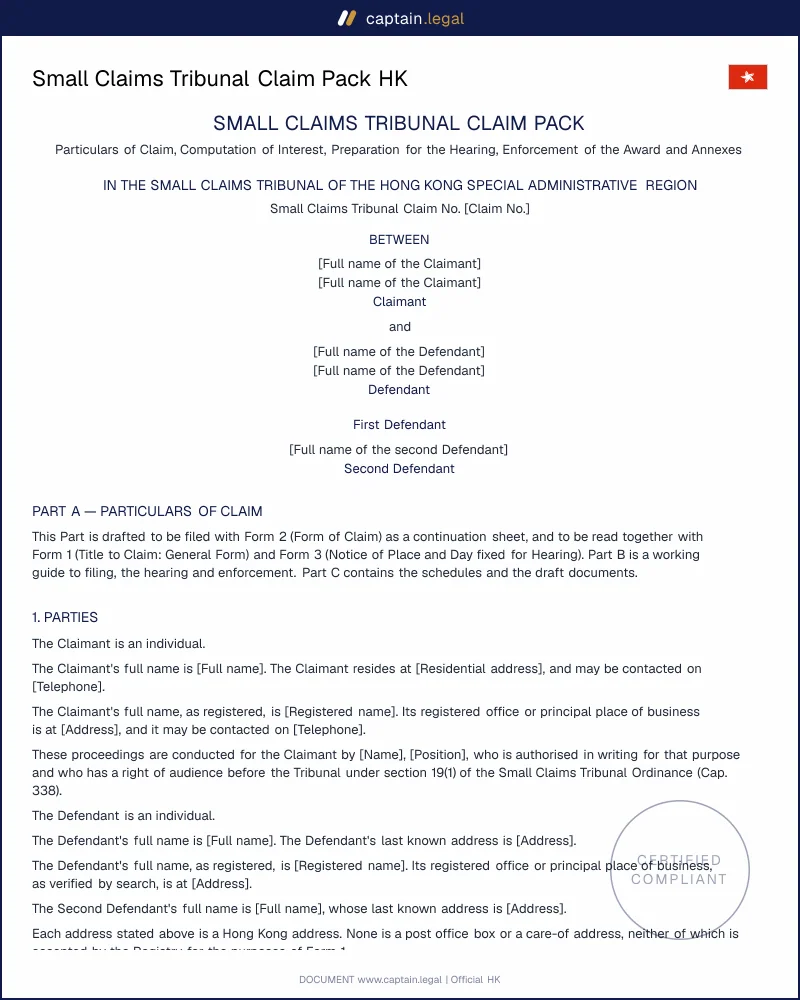
You begin by identifying the defendant properly, because the form is unforgiving about names. The questionnaire asks whether you are suing an individual, a sole proprietorship, a partnership or a company, then prompts you for the company search or Business Registration details the adjudicator will want at the call over. You set out the agreement or the incident, the dates, the amount invoiced and anything already paid, and the pack assembles the particulars in the format section 13 requires.

The interest step comes next. You give the date the cause of action arose, and the schedule computes the pre award period, leaving the post award rate to be inserted at judgment. Questions about your evidence then produce a witness statement in your own voice rather than a form to sign blind, and if you send someone in your place the pack generates the written authorisation naming your representative the Tribunal requires before it will hear anyone other than a party.

6

Common mistakes to avoid

Naming the wrong defendant wastes the most time. A shop trading under a brand name is often a sole proprietorship, and suing the brand rather than the proprietor produces an award enforceable against nobody. The related failure is the address: a care of address or a post office box will be rejected, and a claim that cannot be served eventually dies. Splitting one debt into two to stay under the ceiling breaches section 8 and is spotted at the call over.

Deadlines are the second trap. An application to review an award under section 27A must be filed within 7 days, and an application to the Court of First Instance for leave to appeal on a point of law under section 28 runs on the same clock from service of the written award. Filing an application for leave to appeal does not stay execution unless a stay is ordered under section 31. The last mistake is treating judgment as the finish line. The Tribunal chases nobody, and a claimant who never asks for interest under section 33 or never applies for a writ of fieri facias has bought a piece of paper. Tight paperwork upstream, starting with the payment terms in our Hong Kong business and contract templates, keeps most files away from the registry altogether.

Key takeaways

ELIGIBILITY

HK$75,000 cap and no claim-splitting

The Small Claims Tribunal only hears money claims in contract, quasi-contract or tort within the HK$75,000 ceiling under the Small Claims Tribunal Ordinance (Cap. 338). Section 8 stops you splitting one cause of action into smaller claims just to fit under the limit. If your claim is higher, section 9 lets you abandon the excess and sue for the balance instead.

FILING

File Forms 1 and 2 in person

Proceedings start by filing Form 1 (Title to Claim) and Form 2 (Form of Claim) at the registry in the West Kowloon Law Courts Building. You cannot file these by post, fax or email. Under section 13 of Cap. 338, Form 2 must set out the sum claimed and particulars that explain the basis of the claim and how your figure is calculated.

TIME & MONEY

Watch the six-year limit and interest

Do not miss the time bar: section 4(1)(a) of the Limitation Ordinance (Cap. 347) blocks contract or tort claims brought more than six years after the cause of action accrued. On the money side, section 33 of Cap. 338 allows interest from accrual to the award, and the award then carries interest at the District Court judgment debt rate under section 50 of the District Court Ordinance (Cap. 336) until paid.

Frequently Asked Questions

The pack is a set of drafting documents and becomes binding through the Tribunal, not on its own. Once Forms 1 and 2 are accepted at the registry the proceedings are validly commenced under section 12 of Cap. 338, and the award the adjudicator makes is a court decision enforceable in the District Court under section 32.

No. Section 19(2) removes the right of audience of any barrister or solicitor unless they appear as a party in their own case. You may take advice before and between hearings, but nobody with a practising certificate speaks for you in the courtroom, and legal costs are not recoverable even if you win. A company appears through an officer, a partnership through a partner, and any other representative needs written authorisation and permission from the Tribunal.

Section 14(1)(a) requires the registrar to fix the first hearing, the call over, no later than 60 days after filing. Undefended claims can finish there, since the adjudicator may enter judgment where the defendant fails to appear and service is proved. A defended claim goes on to directions for defence and witness statements, then to one or more mention hearings, and only then to trial, which realistically takes months.

Yes, and you should. Section 33(1) lets the Tribunal include interest on the sum claimed between the date the cause of action arose and the date of the award, whether or not you asked for it. Section 33(3) then makes the award carry interest until satisfied, at the rate applicable to judgment debts under section 50 of the District Court Ordinance (Cap. 336).

Six years in most cases. Section 4(1)(a) of the Limitation Ordinance (Cap. 347) bars an action on simple contract or tort six years after the cause of action accrued, which for an unpaid invoice means the day payment fell due. A contract executed as a deed carries twelve years, and a signed written acknowledgment or a part payment under sections 23 and 24 starts a fresh six year period.

Nothing automatic. Enforcement is your job, and the usual route is a writ of fieri facias obtained from the registry by filing a praecipe, then delivered to the Bailiff Office with a deposit. The bailiff seizes goods and, after a grace period, sells them at public auction. A bailiff cannot break into domestic premises, so a debtor with no visible assets may leave you weighing bankruptcy or winding up.

Yes, in both formats, which matters because the Tribunal accepts no filing by email and everything must be printed and signed before it reaches the counter. Word lets you adjust the particulars or the interest figures right up to filing; the PDF is the clean copy for the registry and for service. The same dual format applies across our personal and family documents for Hong Kong.

4.5/5

18 verified reviews · 50 000+ downloads

Small Claims Tribunal HK: Cap. 338 Forms and Hearing
  • Immediate access to the document
  • PDF + Word download
  • Compliant with 2026 legislation
  • Reviewed by lawyers
Fill in the template
Secure payment
Updated on September 2, 2026

You might also like

Probate Pack Hong Kong
Statutory Declaration Hong Kong