Employment & HR

Resignation Letter Hong Kong: Cap. 57 ss. 6, 7 and 25

Resignation letter drafted to ss. 6, 7 and 25 of the Employment Ordinance (Cap. 57): statutory notice, payment in lieu, leave in notice, 7-day final pay.
4.8/5— 18 reviews50 000+ downloadsInstant download
Share

A Hong Kong resignation letter is the written notice an employee serves to end a contract of employment under the Employment Ordinance (Cap. 57). It fixes the three facts behind almost every exit dispute: the date notice was given, the length of notice or the payment in lieu of notice that replaces it, and the termination date from which the seven day deadline for final pay runs. Built for staff on continuous contracts, employees on probation and expatriates leaving the city, this template is drafted the way a Hong Kong employment practitioner would draft it: short, unconditional and anchored to sections 6 and 7 of the Ordinance. Ready in Word and PDF.

Compliant

2026 Legislation

50,000+ clients

trust us

Affordable

From $4.90 / doc

Secure payment

Instant download

Resignation Letter Hong Kong: Cap. 57 ss. 6, 7 and 25

Secure payment

Fill in the template

What is a resignation letter in Hong Kong?

In Hong Kong, resignation is a unilateral act. Section 6(1) of the Employment Ordinance lets either party end a contract of employment at any time by giving notice, orally or in writing, so the employee needs neither consent nor a reason. Once served, the notice cannot be withdrawn without the employer's agreement, which is why the wording matters. A resignation letter is less a polite farewell than an evidential document: it proves when notice started, which period applied and how the employment ends.

A dismissal comes from the employer and follows its own rules, including summary dismissal under section 9; our employer-side Hong Kong termination letter covers that route. A mutual separation agreement is a negotiated contract, usually with a release of claims, signed by both parties. A resignation letter is neither: it is a one-sided notice with statutory consequences of its own.

When do you need a resignation letter?

The usual trigger is a new job offer. Offer letters are built around a start date that only holds if notice is served correctly, so the resignation letter should go out the day the offer is signed. The second case is the employee who needs to leave quickly. Here the letter records an election under section 7 to pay in lieu for all or part of the notice, which turns an uncertain departure date into a fixed one. Staff leaving to start their own venture should reread their restraint clauses before turning to our Hong Kong business and incorporation templates.

Some exits need no notice at all. Where wages remain unpaid more than one month after they fall due, section 10A lets the employee treat the contract as terminated by the employer without notice and claim wages in lieu on top of the other termination payments. Section 10 allows immediate resignation where the employee reasonably fears physical danger by violence or disease not contemplated by the contract, suffers ill-treatment, or has five years' service and is certified by a registered medical practitioner as permanently unfit for the work. In each case the letter must cite the ground precisely.

Key clauses included in our template

  • The identification block names the employer exactly as it appears on the contract, the addressee (usually the line manager, with HR in copy), your position and your staff number. A letter sent to the wrong group entity can be argued never to have reached the employer.
  • The statement of resignation is dated and unconditional, drafted as notice under section 6. Any request for early release sits in a separate, expressly conditional paragraph; in Life Young Medical Group Ltd v Chiu Suet Man, one email blending the two went from the Labour Tribunal to the Court of First Instance.
  • The notice clause cites your contractual notice term, or the statutory default where the contract is silent, and states the termination date as a calendar date. Where accrued leave is taken within the notice, the last working day appears separately, because only the termination date starts the section 25 clock.
  • The optional payment in lieu clause sets out an election under section 7 and how the sum will be settled. Because section 32 bars deductions the Ordinance does not authorise, nothing is left to a unilateral set-off.
  • The final payments paragraph lists outstanding wages, untaken and pro rata annual leave under section 41D, any contractual end of year payment and, where relevant, long service payment, with a request for settlement under section 25.
  • The handover clause confirms the return of laptops, access cards and files, acknowledges continuing confidentiality duties, requests a certificate of service and reminds the employer to file Form IR56F, or IR56G for a departure from Hong Kong.

Sector-specific considerations in Hong Kong

Foreign domestic helpers resign under the Standard Employment Contract ID 407. Clause 10 requires one month's notice in writing or one month's wages in lieu. Clause 12 obliges both parties to notify the Director of Immigration within seven days of termination, with a copy of the other party's written acknowledgement. The helper may then stay for two weeks or the remainder of the permitted stay, whichever is earlier. Employers will find the matching papers in our foreign domestic helper hiring and termination pack.

Employees leaving Hong Kong face a tax overlay of their own. Under section 52(6) of the Inland Revenue Ordinance (Cap. 112), the employer files Form IR56G at least one month before departure. Section 52(7) then freezes all payments for one month from that notice unless the Commissioner issues a letter of release earlier. Employment visa holders should also report the end of their sponsorship to the Immigration Department as soon as possible. Serving notice early leaves time to clear tax, end a lease with our Hong Kong tenancy and real estate documents and collect final pay before the flight.

Part-time and shift workers should confirm continuity before relying on any statutory minimum. Under the 468 rule, a week below 17 hours still counts if it and the three weeks before it total 68 hours. Continuity decides whether the one month default notice applies, whether pro rata annual leave is due and whether long service payment is possible.

Employees aged 65 or over have a specific reason to resign in writing. Section 31R grants long service payment to an employee with at least five years' service who resigns at 65 or above, or on certified grounds of permanent ill health. The resignation letter should state that ground and attach the medical certificate where relevant. Since the MPF offsetting arrangement was abolished on 1 May 2025, the post-transition portion can no longer be reduced by the employer's mandatory contributions.

How to fill out this resignation letter

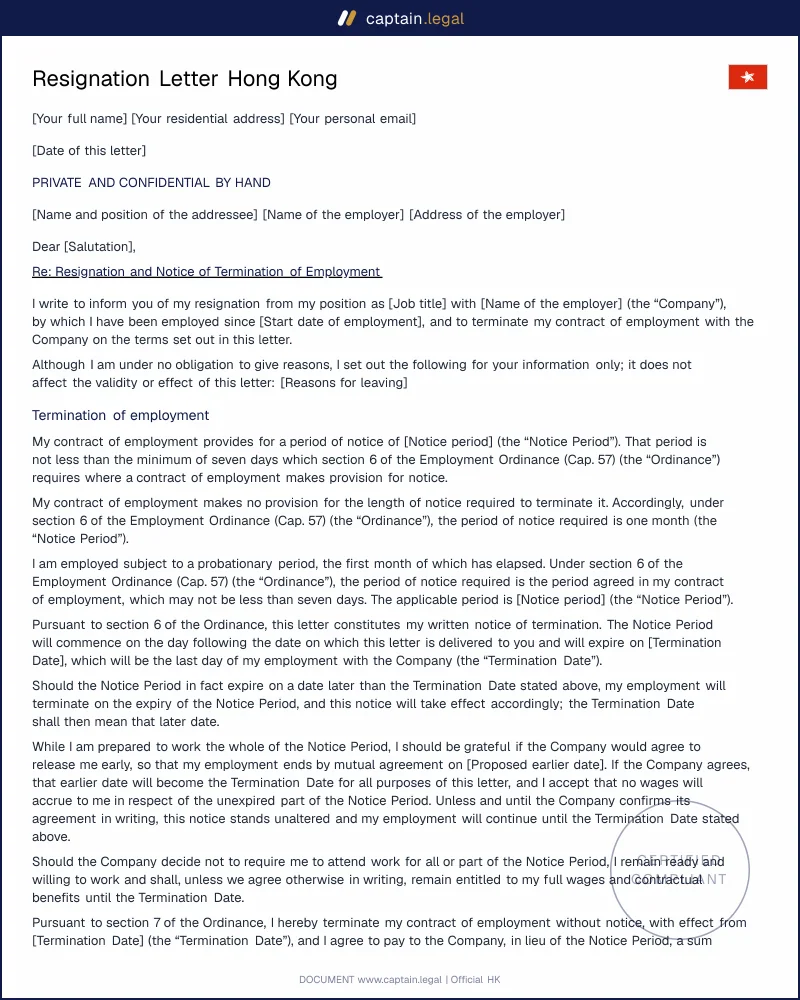
You start with your contract of employment open beside you. The questionnaire asks for the employer's legal name, your start date and whether you are still on probation, then for the notice clause as written. From there it applies the right statutory floor, flags any clause under seven days and proposes a termination date. You then choose how to leave: by working the full notice, by paying in lieu under section 7, or by combining both, in which case the letter states the days covered by each. If you take accrued annual leave during the notice, you enter the dates and the letter shows your last working day separately. Once you review the draft, you download the resignation letter in Word to adjust the tone or in PDF to sign as it stands. Deliver it in a way you can prove, either by hand against a signed copy or by email to your manager and HR.

Common mistakes to avoid

The most expensive error is ambiguity. Employees write that they "would like to leave as soon as possible", or ask in the same message whether notice can be waived, and the employer reads it as immediate termination with payment in lieu owed. A second mistake is assuming one month is always the answer: senior contracts in banking and law often carry three months, and the contract governs as long as it respects the seven day floor. A third is walking out early without a written release, which leaves the employee owing wages in lieu for the unserved days.

Money mistakes follow. Many employees count on a pro rata double pay the Ordinance does not grant on resignation; under section 11F, a resigning employee receives a share of the end of year payment only if the contract provides for it. Check the bonus clause before fixing your resignation date, because a few days can decide whether a full payment period is completed. Another frequent slip is giving only a last working day when leave runs beyond it, which leaves the termination date, and with it the seven day deadline, open to argument.

Key takeaways

LEGAL EFFECT

Notice works without employer consent

Under section 6(1) of the Employment Ordinance (Cap. 57), resignation is a unilateral act. The employee does not need approval or a reason, but the letter should pin down the date notice is given, the applicable notice period and the termination date. Once served, the notice cannot be withdrawn unless the employer agrees.

NOTICE PERIOD

Contract terms cannot undercut Cap. 57

For a continuous contract, the notice period is the period stated in the employment contract, but it cannot be less than seven days. If the contract is silent, the floor becomes one month. Probation is different: no notice is needed during the first month, then the agreed period applies, with seven days as the statutory floor and default.

FINAL PAY

Seven days to settle final sums

Section 7 allows payment in lieu of all or part of the notice period, calculated by reference to average wages rather than basic salary alone. Section 25 then starts the final pay clock: sums due on termination must be paid as soon as practicable and no later than seven days after termination. Wilful default can trigger criminal liability, including for company directors under section 64B.

Frequently Asked Questions

Yes. Section 6(1) of the Employment Ordinance accepts notice given orally or in writing, so the signed resignation letter is evidence rather than a legal formality. It takes effect on delivery, and your employer's acceptance is not needed for it to bind. The template follows the structure of sections 6 and 7, which is what the Labour Tribunal examines when an exit is disputed, and no witness, chop or notarisation is required.

The notice period in your contract applies if it is at least seven days; if the contract is silent and you are on a continuous contract, the default is one month. On probation, no notice is needed in the first month and seven days is the minimum afterwards, unless the contract agreed more. You can also shorten or skip the notice by paying in lieu under section 7, based on your average wages over the previous twelve months.

No. Resignation is a unilateral right, so the employer cannot refuse or delay it. It can decline your request to shorten the notice, in which case you work the full period or pay in lieu for the days you skip. If the employer itself asks you to leave before the notice expires, it owes you wages in lieu for the remaining period. Where talks turn into a negotiated exit, our employment and HR templates under Cap. 57 include the deeds used for that.

Section 25 requires every sum due on termination to be paid within seven days of the termination date: outstanding wages, untaken and pro rata annual leave and any contractual end of year payment. Late payment exposes the employer to prosecution and to interest under section 25A. The main exception is departure from Hong Kong, where section 52(7) of the Inland Revenue Ordinance holds the money for a month after IR56G is filed, unless released earlier.

Usually, yes. Section 6(2A) stops statutory annual leave from counting towards notice, but in Kao, Lee & Yip v Lau Wing the Court of Final Appeal held that this restriction protects the employee, not the employer. A resigning employee may therefore choose to take accrued statutory leave within the notice. The Labour Department still treats each case on its merits, which is why the template puts the leave dates in the letter itself.

The finished resignation letter downloads in Word and PDF. The Word file lets you adjust the tone or add a line of thanks; the PDF is the version to sign and send, by email or by hand. Both carry the same statutory wording, termination date and final pay schedule. If your exit brings other paperwork, the full catalogue of Hong Kong legal templates lists every form available for the territory.

4.8/5

18 verified reviews · 50 000+ downloads

Resignation Letter Hong Kong: Cap. 57 ss. 6, 7 and 25
  • Immediate access to the document
  • PDF + Word download
  • Compliant with 2026 legislation
  • Reviewed by lawyers
Fill in the template
Secure payment
Updated on October 3, 2026

You might also like

Contract Variation Letter Hong Kong
Employment Contract HK