Employment & HR

Contract Variation Letter HK: Cap. 57 Part VIA Consent

Variation letter drafted to ss. 32A, 32K, 45 and 70 of the Employment Ordinance (Cap. 57): consent, valid reasons, notice of change. Word and PDF.
4.7/5— 13 reviews50 000+ downloadsInstant download
Share

A contract variation letter records a change that employer and employee have agreed to make to an existing employment contract in Hong Kong: a new salary, revised working hours, a different job title or another workplace. Once both sides sign it, the letter is the written proof of consent that the Employment Ordinance (Cap. 57) looks for when a change is challenged before the Labour Tribunal. The template suits HR managers, business owners and in-house counsel who need to amend terms of employment without reopening the whole contract. Complete it online and download it in Word and PDF.

Compliant

2026 Legislation

50,000+ clients

trust us

Affordable

From $4.90 / doc

Secure payment

Instant download

Contract Variation Letter HK: Cap. 57 Part VIA Consent

Secure payment

Fill in the template

What is a contract variation letter?

A contract variation letter is a short written instrument that amends one or more terms of an existing employment contract while leaving everything else in force. It identifies the original agreement, sets out the new wording and its effective date, and closes with a countersignature block in which the employee confirms acceptance. That last element does the legal work. Without it, the document is only a notice, and a unilateral notice is what Part VIA of the Ordinance treats with suspicion.

The letter sits between two neighbouring documents. A full Hong Kong employment contract drafted to the 417/468 rule is the right tool when the relationship starts, or when the changes are extensive. A memo announcing a new shift pattern works only where the contract already contains an express variation clause covering that change. The contract variation letter covers the ground in between: a promotion with a salary increase, a relocation from Kwun Tong to Central, or a temporary pay reduction agreed during a downturn. Practitioners also call it a letter of variation; the signed consent matters more than the label.

When do you need this document?

Pay changes account for most variation letters. A salary increase on promotion rarely causes disputes, yet it still deserves a signed record, because it usually carries a new title and fresh obligations. A pay reduction is the riskiest case. An agreed cut recorded in a signed contract variation letter is defensible; a cut pushed through payroll is the classic Part VIA claim. For a team-wide reduction, employers usually document the decision first through board resolutions approving the restructuring, then issue individual letters.

Changes to working hours come next: a four-day week, a move from full time to part time, or a switch to rotating shifts, each touching overtime, rest days and continuous contract status. Changes of role and changes of workplace complete the picture, from a demotion to a hybrid arrangement that becomes contractual.

When an employee refuses a change that the business genuinely needs, the discussion often turns toward an exit, and a negotiated mutual separation agreement executed as a deed is usually safer than forcing the change through. For employees who are pregnant or on extended sick leave, a detrimental change can ground a claim under the Sex Discrimination Ordinance (Cap. 480) or the Disability Discrimination Ordinance (Cap. 487), which runs outside Part VIA, so the reason must be documented with care.

Key clauses included in our template

  • The reference to the original agreement identifies the employment contract by date and parties and confirms that every term not mentioned stays unchanged. This closes off any argument that the letter replaced the contract and dropped its confidentiality or restrictive covenants.
  • The description of the change sets out old and new wording side by side, whether the variation concerns wages, wage period, hours, title, duties or place of work. Where a section 44 condition is affected, the new figure or period is stated in full, never as "the revised pay scale".
  • The effective date is aligned with the start of a wage period, so that payroll and contributions under the Mandatory Provident Fund Schemes Ordinance (Cap. 485) follow cleanly. A pay reduction can never take effect for a period already worked.
  • The reason for the variation is optional but useful. A genuine operational requirement recorded in neutral language supports a section 32K defence to a Part VIA claim, although it never replaces consent as a matter of contract.
  • The consideration and duration clause records what the employee receives in exchange (a pay rise, a retention payment) and whether the change is permanent or temporary, with a reversion date for temporary cuts. A restrictive covenant added mid-employment is tied to fresh consideration, the safest footing at common law.
  • The acceptance and execution block holds the employee's signed confirmation that the change was explained, that time was given to consider it and that consent is voluntary. Company execution follows section 127 of the Companies Ordinance (Cap. 622), with an optional deed format under section 128.

Sector-specific considerations

Financial services firms licensed by the SFC cannot let a promotion into a responsible officer position take effect before the SFC approves it under section 126 of the Securities and Futures Ordinance (Cap. 571), so the letter makes the new title conditional on that approval. Moving someone out of a responsible officer or licensed representative role, or changing a Manager-In-Charge appointment, must be notified to the SFC, generally within seven business days, under the Securities and Futures (Licensing and Registration) (Information) Rules (Cap. 571S).

Employers sponsoring work visas under the General Employment Policy or the Admission Scheme for Mainland Talents and Professionals must check the variation against the conditions of stay. Permission to work is tied to the sponsoring employer, so moving the employee to an associated company is a change of employer that needs the prior approval of the Director of Immigration under the Immigration Ordinance (Cap. 115), and a reduced salary may be examined at the next extension of stay. Our employment visa sponsorship pack for GEP applications covers the immigration side.

Households employing foreign domestic helpers must follow clause 15 of the Standard Employment Contract (ID 407), which requires the prior consent of the Commissioner for Labour or the approval of the Director of Immigration depending on the term, so a side letter changing the helper's duties or contract period outside that procedure is ineffective.

Retail, catering and shift-based employers should run every cut in hours through the revised continuous contract test. Falling below both the 17-hour and 68-hour thresholds puts that status at risk, and with it rest days, paid annual leave, sickness allowance and severance or long service payment protection.

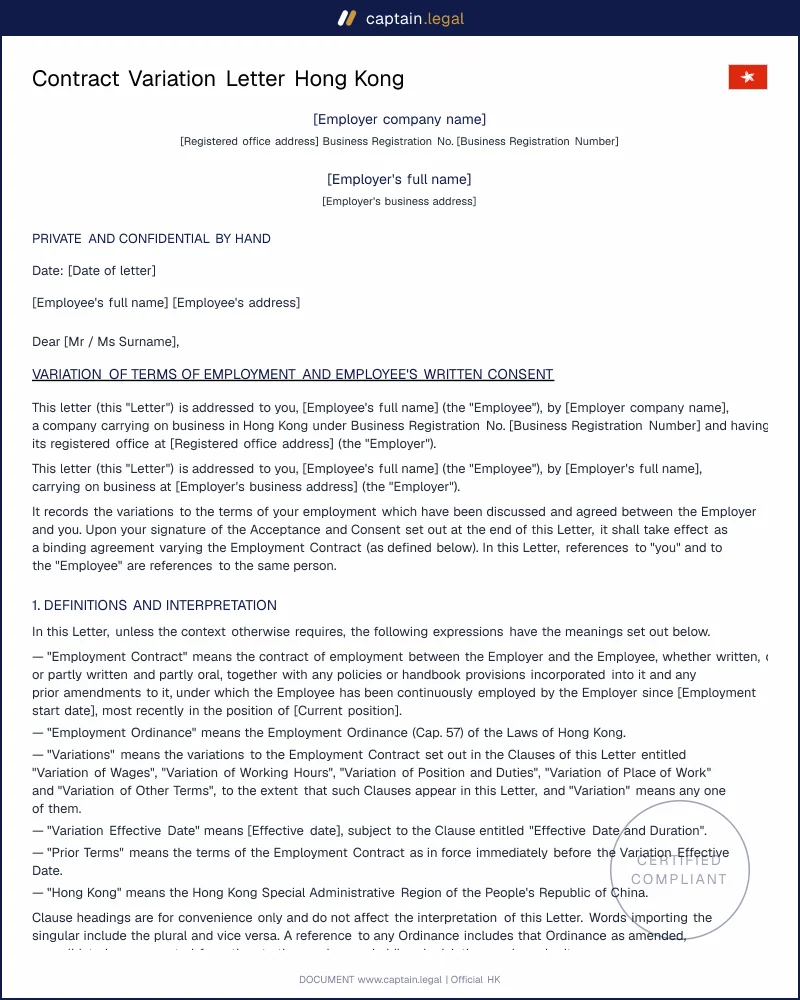
How to fill out this contract variation letter

You begin with the parties, exactly as named in the original contract, and the date of that contract. You then select the terms being changed. For wages, you enter the current and new rate, the wage period and any allowance affected. For hours, you describe the new weekly pattern, keeping the 17-hour and 68-hour thresholds in mind. For a new workplace or title, a short description of the location or duties is enough.

Next comes the effective date, ideally the first day of a wage period, then the optional reason and the consideration offered; a temporary change also needs a reversion date. You then choose between a countersigned contract variation letter, which suits most changes, and a deed under section 128 of Cap. 622 where the employee gives up a benefit without receiving anything in return. Hand the employee a signed copy straight away, as section 45 requires, and keep the original on file.

Common mistakes to avoid

The most expensive mistake is treating silence as consent. An employer announces a pay cut by email, the employee keeps working, and HR assumes the matter is closed. Continued work may be argued as acceptance, but the Labour Tribunal tests whether consent was real, and an employee who objected even once has the makings of a Part VIA claim or a resignation for repudiatory breach. The second mistake is pressure: presenting the letter at 6 pm with an instruction to sign that day, or tying signature to a bonus already earned.

Drafting errors follow. Vague wording such as "salary adjusted in line with company policy" fails the section 45 duty to explain the change. Backdating a reduction turns an agreed variation into an unauthorised deduction from wages already earned. A cut imposed without consent is worse still: the contractual wage remains due, and wilful failure to pay it within the seven days allowed by section 23 is an offence under section 63C, for which directors can be personally liable under section 64B. Employers also forget that a pay cut shortly before a redundancy lowers the wages used for severance payment, though the employee may elect the average of the previous twelve months instead.

Key takeaways

CONSENT

Signed consent does the legal work

A variation letter is more than an HR note: it records the employee's acceptance of a specific change to an existing contract. The countersignature block is the key evidence if a new salary, hours, job title or workplace is later challenged before the Labour Tribunal. Without that signature, the paper may look like a unilateral notice.

PART VIA

Unilateral changes face Part VIA claims

Under section 32A(1)(b) of the Employment Ordinance (Cap. 57), an employee under a continuous contract can challenge an unconsented variation where no express variation term applies. The employer then needs a section 32K reason, such as conduct, capability, redundancy, statutory requirements or another substantial reason. Written notice of claim is due within three months, with Tribunal filing within nine months.

STATUTORY FLOOR

Explain changes and preserve minimum rights

Section 45 requires the employer to explain changes to employment conditions intelligibly and give the employee a copy of the written amendment immediately after signature. Section 70 then draws the line: a signature cannot validate a term that reduces rights under the Employment Ordinance (Cap. 57). This matters where reduced hours may affect continuous contract status from 18 January 2026.

Frequently Asked Questions

Yes, once both parties sign it. An agreed variation becomes part of the employment contract, provided it stays above the minimum standards of the Employment Ordinance (Cap. 57) and the Minimum Wage Ordinance (Cap. 608). The employee's countersignature is the evidence of consent that defeats a Part VIA claim. Where the employee gives up a benefit and receives nothing in return, executing the letter as a deed removes any argument about missing consideration.

Not lawfully, unless your contract contains an express clause allowing that specific change. A unilateral cut is a breach of contract: you can claim the shortfall as unpaid wages, treat a serious change as a repudiatory breach and resign, or, under a continuous contract, claim for unreasonable variation under Part VIA. A section 32K valid reason only answers that statutory claim. It does not turn an unconsented pay cut into a lawful one.

The existing terms stay in force. The employer can keep the current arrangement, return with a better offer or, where a genuine operational reason exists, end the contract on proper notice. That route is risky, because an employee with 24 months' service can claim for unreasonable dismissal unless the employer shows a section 32K reason. The Hong Kong employment and HR templates cover each next step, from termination letters to separation deeds.

The change takes effect on the date stated, ideally the first day of a wage period, and never retrospectively for a reduction. A review period of five to seven working days is sound practice. An employee challenging the change must serve written notice of the claim within three months of the effective date, extendable by up to six months with the Commissioner for Labour's approval, and file with the Labour Tribunal within nine months.

Not below the statutory minimum. Section 70 voids any term that reduces a right, benefit or protection conferred by the Ordinance, even where the employee has signed. A letter can trim contractual extras, such as annual leave above the statutory 7 to 14 days or a discretionary bonus scheme, but not rest days, statutory holidays, sickness allowance or maternity and paternity leave.

The completed letter downloads in Word and PDF. The Word file lets you add letterhead, adapt the wording for a group change or prepare a bilingual English and Chinese version, while the PDF suits signing. The full catalogue of Hong Kong legal document templates offers related contracts and notices in the same formats.

4.7/5

13 verified reviews · 50 000+ downloads

Contract Variation Letter HK: Cap. 57 Part VIA Consent
  • Immediate access to the document
  • PDF + Word download
  • Compliant with 2026 legislation
  • Reviewed by lawyers
Fill in the template
Secure payment
Updated on October 3, 2026

You might also like

Internship Agreement Hong Kong
Warning Letter Hong Kong