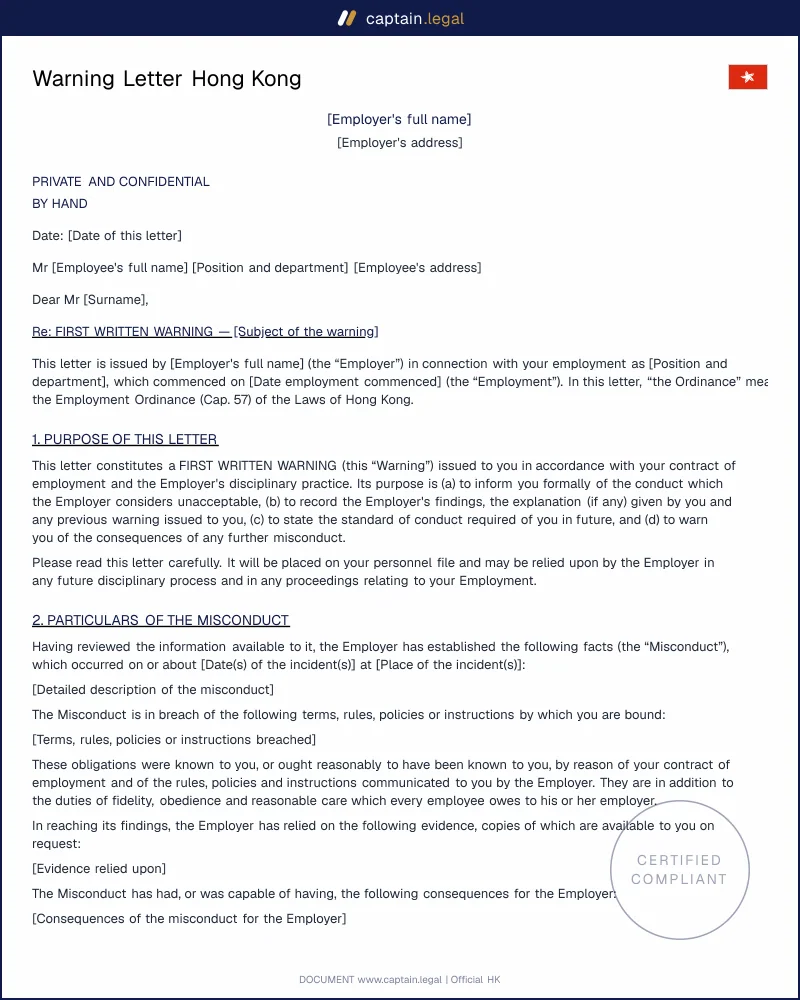
Section 9 of the Employment Ordinance allows an employer to end a contract without notice or payment in lieu where the employee wilfully disobeys a lawful and reasonable order, misconducts himself in a way inconsistent with the due and faithful discharge of his duties, is guilty of fraud or dishonesty, or is habitually neglectful in his duties. Section 9(1)(b) adds any ground available at common law. The burden of proving the ground rests entirely on the employer. In Qvist Henrik v Clatronic Far East Ltd (HCA 1144/2015), the Court of First Instance found breaches in only four of fifty alleged transactions, rejected habitual neglect, and noted that prior warnings, though not legally required, bear on whether the employee intended to remain bound. Hu Yangyong v Alba Asia Ltd [2025] HKCFI 2484 added that not all dishonesty justifies summary dismissal, that persistent minor misconduct can do so cumulatively, and that tolerating misconduct too long may amount to acquiescence.
An employee validly dismissed under section 9 loses notice pay, pro rata annual leave pay, pro rata end of year payment and, under section 31S, any long service payment. If the ground fails, the employer owes all of it, including the long service payment and severance entitlements under Parts VA and VB, and an employee with 24 months' continuous service, now counted under the 468 rule, may add a Part VIA claim for unreasonable dismissal. Employees who have notified a pregnancy, are on a paid sickness day or have a pending employees' compensation claim may be dismissed only under section 9 (section 15, section 33(4B) and section 48 of the Employees' Compensation Ordinance (Cap. 282)). If that ground fails, the employer faces possible prosecution and unlawful dismissal remedies with no qualifying period. The Labour Department's Concise Guide chapter on termination and summary dismissal treats summary dismissal as a serious disciplinary action, and the PCPD's Code of Practice on Human Resource Management limits retention of a former employee's records to seven years in most cases.