
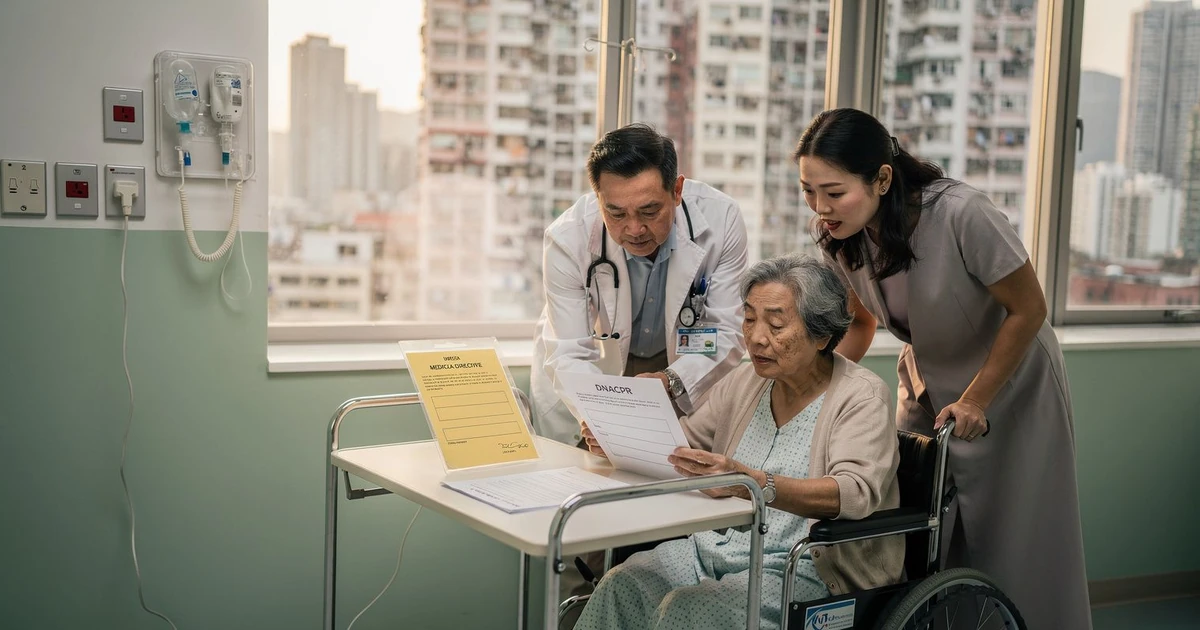
Since 2010, the Hospital Authority has let patients sign advance directives under common law. On 31 July 2026 the Advance Decision on Life-sustaining Treatment Ordinance (Cap. 651) came into operation and put the advance medical directive on a statutory footing. The obvious question for anyone holding an older document is whether it still binds the doctors who will read it. The short answer is reassuring but conditional. A directive signed before commencement generally remains valid if it meets the Ordinance's requirements and its instructions are clearly presented. Old-format DNACPR orders are a different matter: they must be replaced. This guide explains which documents survive and which need to be remade.
What an advance medical directive does under Cap. 651
An advance medical directive (AMD) is made by an adult who is mentally capable of deciding on a life-sustaining treatment. It records, in advance, the treatments the maker refuses if two conditions later coincide: the maker has lost the capacity to decide, and a specified precondition written into the instruction has been reached. The Health Bureau lists examples such as cardiopulmonary resuscitation, artificial ventilation, blood products, dialysis and artificial nutrition and hydration. An AMD cannot refuse basic care, such as food and drink offered by mouth, or palliative care.
The AMD is often confused with its neighbours. An enduring power of attorney made under Cap. 501 covers property and financial affairs only, so an attorney has no power to refuse treatment for you. The 2017 consultation draft of a Continuing Powers of Attorney Bill would add personal care matters. Even that draft keeps decisions on life-sustaining treatment and advance directives outside the attorney's authority. A DNACPR order is different again. It is a clinical instrument signed by doctors, not by the patient, so that rescuers can withhold resuscitation within seconds.
Legal framework
The Legislative Council passed the Ordinance on 20 November 2024, and it was gazetted on 29 November 2024. Section 1(2) left commencement to the Secretary for Health, whose Commencement Notice, gazetted on 22 May 2026, appointed 31 July 2026. The scheme follows a principle the Government summarises as cautious making and easy revoking. To make an AMD, the maker must be an adult who is mentally capable of deciding on a life-sustaining treatment. The instructions must be clearly presented and the directive must show the date of signing. The maker must sign in the presence of two witnesses, neither of whom may be an interested person of the maker.
One witness must be a registered medical practitioner. That doctor must explain the nature of the directive and the effect of each instruction on the maker. The doctor must also be satisfied that the maker is mentally capable when signing, and declare both points in the document. The other witness must be an adult. Schedule 2 provides two model forms, a full form and a form limited to refusing CPR. Their use is encouraged but not compulsory.
A directive is not valid if the treatment provider has no notice of it or if the making requirements were not met. The same applies if it was procured by wrongful means or has been revoked, or if the maker later did something clearly inconsistent with it that shows the instruction is no longer wanted. It is not applicable if an unanticipated circumstance arises that would likely have changed the maker's instruction. Doctors and rescuers who honestly and reasonably believe a directive is valid and applicable are protected from civil, criminal and professional liability. The Health Bureau guidance on pre-existing AMDs and DNACPR orders sets out the Government's reading of the transitional rules.
Directives signed before 31 July 2026: three scenarios
The transitional rules sit in Schedule 1 to the Ordinance, and Part 2 of that Schedule sets the conditions for directives not made on Hospital Authority forms. The same Schedule also recognises revocations made before commencement. In practice, three situations arise. The first is the Hospital Authority form. The Health Bureau states that directives made on the Authority's forms already comply with the Ordinance's requirements. A patient who signed one with a hospital doctor as witness can generally rely on it.
The second is a directive on another form, such as an NGO template or a solicitor's "living will". It remains valid if it meets the Ordinance's requirements and its instructions are clearly presented. The check is concrete. Were there two witnesses, one of them a doctor registered in Hong Kong? Was either witness an interested person, such as a successor to the maker's estate or a beneficiary under the maker's insurance? Does each instruction name a precondition and a treatment clearly enough for a clinician to act on it?
The third scenario is the uncomfortable one. A directive that is clearly written but fails a statutory requirement does not bind anyone under the Ordinance. According to the Health Bureau, a doctor who agrees that the refused treatment is not in the patient's best interests may still withhold it under common law. That is guidance weighed by a clinician, not an instruction the clinician must follow. A document saying "no heroic measures" is unlikely to count as clearly presented at all, because it names neither a precondition nor a treatment. Both situations call for a fresh directive.
DNACPR orders, eHealth and the practical checks
The Ordinance governs DNACPR orders that travel with the patient outside hospital, not in-patient orders meant to lapse on discharge. For those continuing orders, only the prescribed forms in Schedule 3 count. An order on an older format must be replaced to remain valid, while an order already written on a prescribed form before commencement is recognised. An order based on an AMD is signed by two registered medical practitioners, at least one a specialist. There is no electronic version. Rescuers are not required to search a patient's belongings for it, which is why the Hospital Authority provides its patients with a labelled pouch. At home, whoever is present must know where it is kept. A live-in carer employed under a domestic helper contract and hiring pack for Hong Kong should know where the pouch is and whom to call.
The eHealth system offers a useful test for an older AMD. From commencement, paper AMDs can be stored, viewed and revoked electronically, while electronic making will follow later. A registered medical practitioner must assist with the upload and first confirm that the directive complies with the Ordinance. If the doctor will not upload your pre-2026 directive, treat that as a clear signal to remake it. Treatment providers act on a validating copy, which includes a certified true copy certified by a doctor or a solicitor practising in Hong Kong.
Remaking your AMD with Captain.Legal
Where an older directive fails the checks above, remaking it is quicker than arguing about it later. The advance medical directive template drafted to Cap. 651 follows the structure of the Schedule 2 model form. You choose between the full directive and the version limited to refusing CPR. You then take each specified precondition in turn: terminal illness, a persistent vegetative state or irreversible coma, or another named end-stage, irreversible, life-limiting condition. The instructions attached to each precondition can differ, and the attestation blocks give each witness a separate panel with the doctor's declaration. The document downloads in Word and PDF. Do not sign it at home. Take it to the witnessing appointment, sign in front of both witnesses, and remember that a new AMD revokes the earlier one automatically. Then collect every old copy so that no hospital acts on a superseded version.
Common mistakes with pre-2026 directives
The most damaging error is the witness chosen for convenience. A son or daughter who would inherit is an interested person, and a directive witnessed by two relatives without a doctor fails the statutory test outright. The second error is vague drafting, such as "I do not want to be kept alive on machines", which a clinician cannot apply to a specific treatment. The third is keeping only a photocopy in a drawer, since a treatment provider with no notice of the directive is protected for treating you.
The remaining errors arise after remaking. People sign a new AMD but leave the old one, and its certified copies, in circulation with relatives. Others forget that a DNACPR order on an old format is not valid under the Ordinance until it is reissued on the prescribed form. Some healthy people rush to sign a directive for an illness they do not yet have. The Health Bureau, relying on the Hong Kong Academy of Medicine's guidelines, advises against making an AMD prematurely. Finally, families often expect an EPA attorney to decide on treatment, a point covered in our explainer on the Hong Kong EPA reform. Without an AMD, those decisions rest with the treating doctors. They act in the patient's best interests after consulting the family or any guardian appointed by the Guardianship Board under the Mental Health Ordinance (Cap. 136).
Frequently asked questions
Is my advance medical directive signed before 31 July 2026 still valid?
Generally yes, if it meets the Ordinance's requirements and its instructions are clearly presented. Directives on Hospital Authority forms already comply, according to the Health Bureau. Other forms survive if they were signed by an adult with capacity before two witnesses who were not interested persons, one of them a Hong Kong registered doctor. A clearly written directive that fails a requirement loses statutory force, although a doctor may still take it into account under common law.
Is there a deadline to update an old AMD or DNACPR order?
There is no deadline for AMDs. A compliant pre-existing directive continues without any re-signing, and you can remake it at any time while you remain mentally capable. DNACPR orders are treated differently. An order issued before 31 July 2026 on an older format must be replaced with one on the prescribed forms in Schedule 3 to remain valid. A patient holding such an order should ask the treating doctors to reissue it without waiting.
Can a family member witness my advance medical directive?
Only if that person is not an interested person of the maker. The Ordinance excludes, for example, a successor to the maker's estate and a beneficiary under the maker's insurance, which usually rules out spouses and children. One witness must be a registered medical practitioner, and the other must be an adult. The Health Bureau suggests asking a disinterested adult, such as a friend or a nurse who is present, where there is any doubt.
Can I sign or store my AMD electronically?
You can store a paper AMD in eHealth, provided a registered medical practitioner reviews it before upload. Electronic making is planned for a later phase, through eHealth as the designated system, so the safe course remains a paper directive signed in the presence of both witnesses. The general rules in the guide to electronic signatures in Hong Kong under the ETO do not override the Ordinance's own witnessing requirements.
How do I cancel an old advance medical directive when I sign a new one?
Signing a new AMD revokes the earlier one automatically, provided you are mentally capable at the time. The practical work is retrieving copies. Collect the original and every certified true copy from relatives, your family doctor and any care home, and revoke any version stored in eHealth. You may also revoke in writing, orally before an adult witness, or by crossing out the old document and signing each of its pages.
Is it an offence to hide or ignore someone's advance medical directive?
The Ordinance creates offences for obstructing compliance with an instruction in an AMD, and for misleading another person into complying or not complying with an advance decision instrument. Falsely telling doctors that a directive was revoked, or presenting a revoked one as current, falls within that territory. A doctor who knowingly disregards a valid and applicable AMD is answerable under the general law and professional codes rather than under the Ordinance.
Can I prepare a new AMD in Word before seeing my doctor?
Yes. The Cap. 651 AMD template for Hong Kong downloads in both Word and PDF. The Word file lets you refine the description of an end-stage condition or name specific treatments after discussion with your doctor, and the PDF is the clean version to print. Leave the signature blank until the witnessing appointment, since the statutory signing must happen in the presence of both witnesses. Bring the draft to the doctor who knows your condition best.