Personal & Family

Parenting Plan HK: Cap. 13 Custody and Access Template

Parenting plan drafted to Cap. 13 and its best interests test, with s.18 Cap. 192 arrangements for the decree absolute. Hong Kong template, Word and PDF.
4.7/5— 18 reviews50 000+ downloadsInstant download
Share

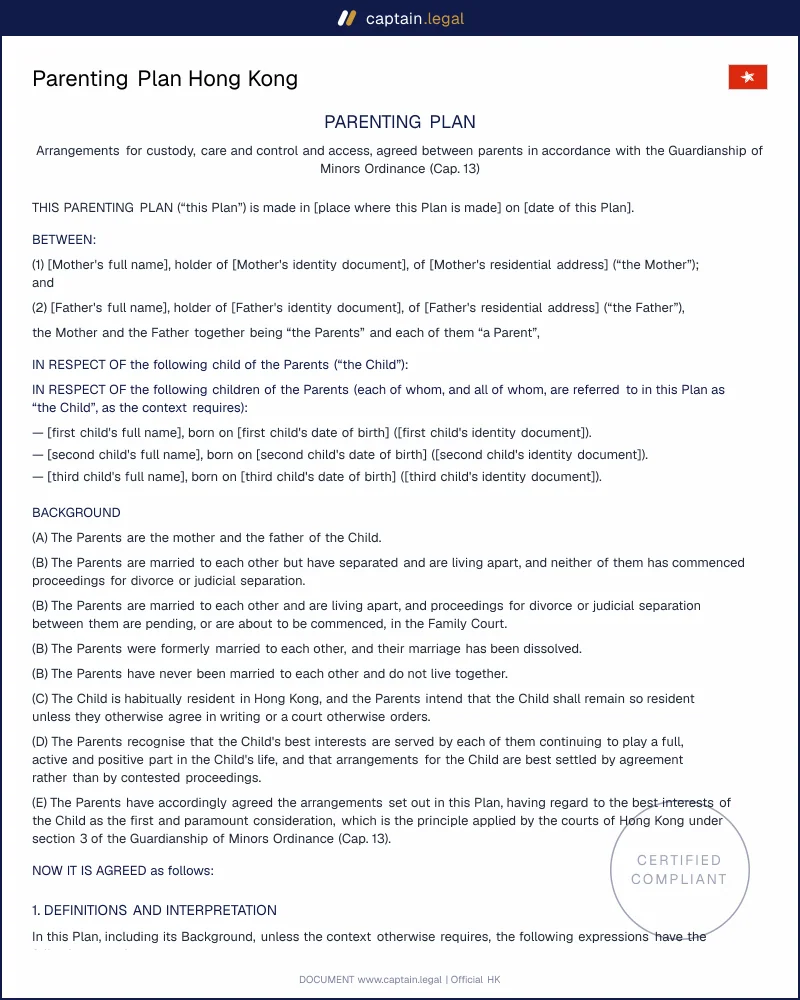
A parenting plan sets out, in one signed document, how separated parents will raise their children: who holds custody, who has care and control, and how and when the other parent exercises access. Our Hong Kong parenting plan is drafted to the Guardianship of Minors Ordinance (Cap. 13) and its best interests principle, using the vocabulary the Family Court still applies in every children order. It is built for married parents preparing a separation deed or a joint divorce application, for unmarried parents who want certainty without litigation, and for solicitors who need a working draft to annex to a consent order. The finished plan downloads in Word and PDF.

Compliant

2026 Legislation

50,000+ clients

trust us

Affordable

From $4.90 / doc

Secure payment

Instant download

Parenting Plan HK: Cap. 13 Custody and Access Template

Secure payment

Fill in the template

What is a parenting plan in Hong Kong?

Hong Kong has never adopted the parental responsibility model used in England, so parental authority after separation is still divided into three orders. Custody is the right to take the major decisions in a child's life: choice of school, religious upbringing, elective medical treatment, change of surname and emigration. Care and control belongs to the parent with whom the child lives day to day. Access is the other parent's time with the child, either "reasonable access" left to agreement or defined access fixed by days and hours. The Court of Appeal set out these distinctions in PD v KWW [2010] 4 HKLRD 191, and joint custody is now common wherever both parents can still cooperate on major decisions, with care and control going to one parent or, less often, shared.

A parenting plan turns those three elements into a working schedule. It is not a court order in itself, and it is not a separation deed. A separation deed drafted to section 14 of Cap. 192 deals with finances, maintenance and living apart; the parenting plan is the children's chapter. It can be scheduled to that deed, filed with a divorce application or attached to a consent summons so that its terms become a sealed order.

When do you need this document?

The most frequent trigger is a separation by agreement. Couples who will rely on one or two years' separation under section 11A of the Matrimonial Causes Ordinance (Cap. 179) usually sign the separation deed and the parenting plan together, so the children's routine is settled during the waiting period. The second scenario is a joint application under section 11B of Cap. 179, where the agreed arrangements must satisfy section 18 of Cap. 192. Parents already in litigation use the plan as the settlement document after a CDR hearing or mediation.

Unmarried parents are a growing share of users. The divorce ordinances do not apply to them, yet section 10 of Cap. 13 is open to either parent, and a signed plan gives the court a clear record if one of them later applies. A plan is also worth revisiting when a parent takes on shift rosters (airline crew and hospital doctors are classic examples) or a new partner arrives in either household. The hardest edge case is a proposed relocation to the Mainland or overseas, where long distance access must be agreed before the move, not after it.

Key clauses included in our template

  • The identification of the parties and children uses full names as they appear on the birth certificate and HKID card, with each child's date of birth. Identifiers are limited to what courts and schools need, in line with the Personal Data (Privacy) Ordinance (Cap. 486).
  • The custody clause states whether custody is joint or sole and lists the decisions that require prior consultation: school selection, religious instruction, elective surgery, change of name and emigration. A response period stops one parent's silence from blocking a school application deadline.
  • The care and control and residence clause names the parent with whom the children primarily live and the address used for school allocation. Where care is shared, the weekly rhythm is fixed in days and hours, not in percentages.
  • The access schedule covers term weekends, weekday dinners or overnights, summer and Christmas holidays, and a rotation for Lunar New Year, Ching Ming, the Mid-Autumn Festival and each child's birthday. Handover points are stated precisely, down to the MTR exit.
  • The travel and relocation clause requires written consent and an itinerary for any trip outside Hong Kong, and says who keeps each child's passport. Individual trips can then be covered by a child travel consent letter for journeys outside Hong Kong, while a permanent move needs agreement or the court's leave.
  • The communication and review clause sets the channel for parenting messages and video calls, gives each parent direct access to school and medical information, and requires mediation before any court application, with a review at Primary 1 and Secondary 1 entry.

Hong Kong practice considerations

Cross-boundary families are the defining Hong Kong case. Where one parent lives in Shenzhen or elsewhere in the Mainland, the plan has to address cross-boundary schooling, the control point used for handovers and who holds each child's Home Return Permit. The Mainland Judgments in Matrimonial and Family Cases (Reciprocal Recognition and Enforcement) Ordinance (Cap. 639), in force since 15 February 2022, allows custody orders made under Cap. 13 to be recognised on the Mainland. That is a strong reason to turn the agreed plan into a consent order rather than leave it as a private document.

International families face a different risk. Many plans involve a parent whose employer may transfer them abroad at short notice, so the relocation clause sets a written notice period and requires a proposed long distance schedule with the notice. Leaving relocation to be "sorted out later" invites a contested leave to remove application at the worst possible moment.

Households with a domestic helper or grandparents need their own wording. In many families the helper handles the school run and much of the weekday care, so the plan says whether the helper may accompany the children to the other parent's home and how a change of helper is communicated. Employment terms stay with the parent who signed the employment contract, under a separate foreign domestic helper hiring and termination pack. Grandparents' time is best provided through a parent's access.

School places turn on residence. Under the Primary One Admission system, the child's home address, normally the home of the parent with care and control, determines the school net for central allocation. An ambiguous residence clause can cost a child a place in the preferred net.

How to fill out this parenting plan

You begin with the parents' relationship status, because the template adjusts its recitals for married couples, separated spouses and unmarried parents. From there you add each child, with the current school and the address used for school allocation. The next screen is the custody model: joint or sole, followed by the decisions subject to consultation and the number of days allowed for a reply. Care and control comes next, with a choice between a primary home and a shared pattern. The access schedule is then built week by week, then holiday by holiday, and festivals appear as a calendar alternating odd and even years, which spares you a fresh negotiation every Lunar New Year. Finally you choose how the plan will be used, whether scheduled to a separation deed, filed with a divorce application or annexed to a consent summons, and the closing clauses change to match. Independent legal advice for each parent is strongly advisable before the plan goes to court.

Common mistakes to avoid

The commonest error is "reasonable access" with nothing behind it. It collapses the first time one parent cancels a weekend, because there is nothing concrete to enforce. A close second is confusing custody with care and control. Parents agree to "joint custody" believing it means equal time, then discover it only governs major decisions, while the residence schedule they never wrote down decides where the children live. Plans also fail on calendars, ignoring Christmas, Easter and the summer holiday, exactly when disputes arise.

The other two mistakes are structural. Some parents make access conditional on maintenance, writing that a father may see the children "provided payments are up to date". A court will not enforce access as a reward for payment, because each obligation stands on its own; maintenance belongs in the separation deed or a maintenance order. The last mistake is leaving the signed plan in a drawer. An agreement that never reaches the court cannot satisfy section 18 of Cap. 192 and carries less weight if one parent later issues a summons, so decide from the outset how the document will get to the Family Court.

Key takeaways

ORDERS

Separate custody, care and access

Hong Kong still uses three distinct children orders. Custody covers major choices such as school, religion, elective medical treatment, surname and emigration. Care and control is the child's day-to-day home. Access is the other parent's time, either reasonable or fixed by days and hours. Mixing these terms can make an agreed plan hard to enforce or approve.

BEST INTERESTS

The child comes before both parents

Section 3(1)(a) of the Guardianship of Minors Ordinance (Cap. 13) makes the minor's best interests the court's first and paramount consideration. The court also gives weight to the child's views according to age and understanding, and neither parent's claim ranks above the other's. A plan should show how decisions serve the child, not parental convenience.

COURT APPROVAL

A plan is not yet an order

A signed parenting plan carries weight, but it does not remove the Family Court's jurisdiction. In a divorce, section 18 of the Matrimonial Proceedings and Property Ordinance (Cap. 192) stops the decree absolute until arrangements are satisfactory for every child of the family, including stepchildren. Filing the plan with a consent summons can turn agreed terms into a sealed order.

Frequently Asked Questions

A signed plan is a serious record of what both parents committed to, but it does not bind the court. Section 3 of Cap. 13 obliges the judge to decide on the child's best interests, and parents cannot oust that jurisdiction by contract. The plan becomes enforceable once its terms are incorporated into a consent order. A breach can then be brought back before the Family Court for enforcement or variation and, in serious cases, contempt proceedings.

Yes. Both formats are generated as soon as the questionnaire is complete. Word is the version to send to a solicitor or adapt into a consent summons schedule, with tracked changes intact. PDF is the clean copy for signature and for annexing to a separation deed. You can reopen the questionnaire and regenerate both files if arrangements change, and related forms sit together among our personal and family documents for Hong Kong.

In a divorce, the plan should reach the court well before the decree absolute, because section 18 of Cap. 192 blocks the final decree until the children's arrangements are approved. Inside the plan, the reply period for major decisions is the number of days you choose. Fourteen days is a common default, with a shorter window, often seven days, for holiday travel requests. A missed deadline sends the issue to mediation rather than leaving it open.

Joint custody suits parents who can still discuss schools, health and religion without lawyers in the room, and it is the order Hong Kong judges most often make. Sole custody fits cases where cooperation has broken down, one parent is largely absent, or violence has led to an injunction under the Domestic and Cohabitation Relationships Violence Ordinance (Cap. 189). Sole custody does not by itself remove the other parent's access; it changes consultation, not contact.

Under the template, any trip outside Hong Kong needs the other parent's written consent and an itinerary sent in advance. Where proceedings are pending or an order prohibits removal, taking a child out of Hong Kong without consent or leave can be treated as wrongful removal, and Cap. 512 gives effect to the Hague Convention return mechanism. A standing travel procedure in the plan beats an urgent application on the eve of a flight.

Yes. A plan that has not been made into an order can be varied by a written amendment signed by both parents. Once it forms part of a consent order, the change should be filed by consent summons so the sealed order matches reality. The court keeps its power over custody and access until each child turns 18. A revised plan often comes with other paperwork, and every Hong Kong form we offer is listed in our catalogue of Hong Kong legal templates.

4.7/5

18 verified reviews · 50 000+ downloads

Parenting Plan HK: Cap. 13 Custody and Access Template
  • Immediate access to the document
  • PDF + Word download
  • Compliant with 2026 legislation
  • Reviewed by lawyers
Fill in the template
Secure payment
Updated on October 1, 2026

You might also like

Cohabitation Agreement Hong Kong
Last Will and Testament Hong Kong