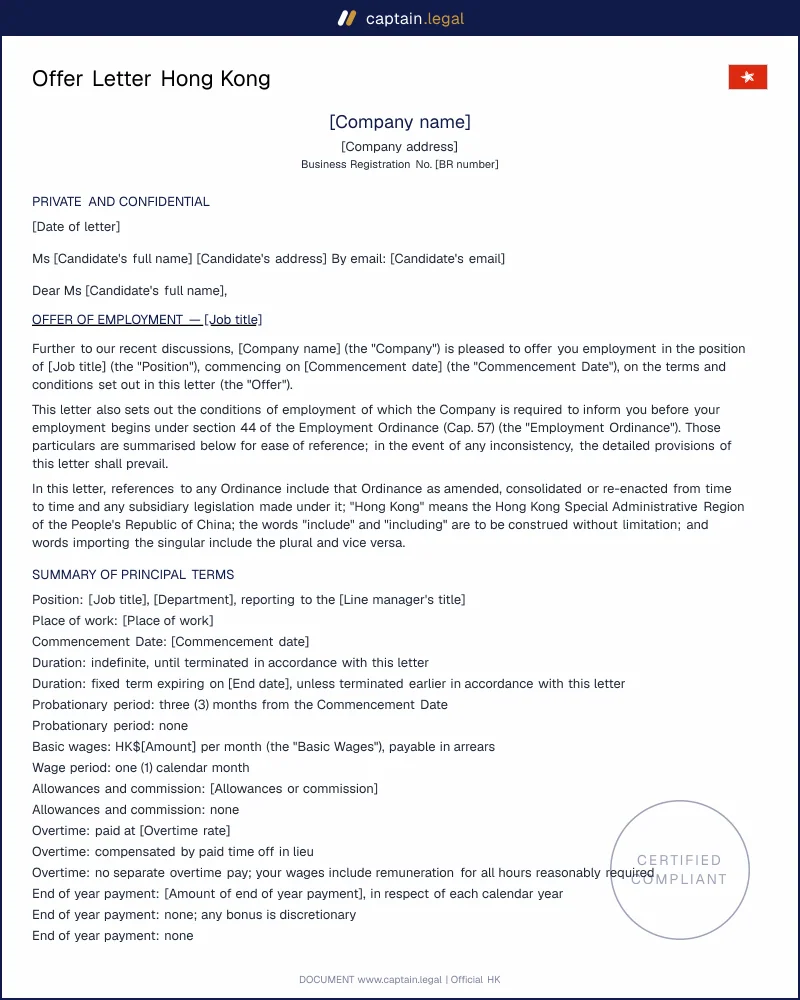
The anchor provision is section 44 of the Employment Ordinance (Cap. 57). Before employment begins, the employer must disclose the wages (rate, overtime rate and allowances), the wage period, the notice required to terminate and any end of year payment with its payment period. A written contract must be copied to the employee, and an employee hired orally may ask for the terms in writing before starting. Section 45 extends the duty to later changes, and an employer who wilfully and without reasonable excuse fails to comply commits an offence. The Labour Department guide to the conditions of service disclosed before employment gives the official reading.
Section 70 voids any term that reduces a right under the Ordinance, whatever the candidate signs. The wage period is presumed to be one month under section 22, and section 23 requires payment within seven days of its end. Once probation is over, section 6 sets notice for a continuous contract at one month where the parties are silent and never less than seven days where they agree a figure, with wages in lieu under section 7. Since 18 January 2026, the Employment (Amendment) Ordinance 2025 has replaced the 418 rule: after four weeks with the same employer, an employee is on a continuous contract if they work at least 17 hours each week or 68 hours over four consecutive weeks.
Around Cap. 57 sit the Mandatory Provident Fund Schemes Ordinance (Cap. 485), with MPF enrolment due within the first 60 days, the Employees' Compensation Ordinance (Cap. 282), which makes insurance compulsory from day one, and the Minimum Wage Ordinance (Cap. 608). Section 52(4) of the Inland Revenue Ordinance (Cap. 112) adds an IR56E filing within three months of the start date. The offer itself is caught by anti-discrimination law: section 11 of the Sex Discrimination Ordinance (Cap. 480) prohibits discrimination in the terms on which employment is offered, as do the disability, family status and race ordinances.