A Terms of Service agreement — sometimes called Terms & Conditions or Terms of Use — is the contract that governs the relationship between an online business and the users who interact with its website, mobile app, or SaaS platform. For any U.S. company that operates online, this document is not optional : it allocates risk, sets the rules of engagement, defines acceptable use, and gives the operator a defensible legal posture if a user files suit, breaches the platform, or contests a charge. A well-drafted set of Terms of Service covers everything from arbitration and class-action waivers to DMCA takedown procedure, intellectual property licensing, limitation of liability, and the operator's right to terminate accounts. Without one, an American business is exposed to plaintiffs' lawyers in 50 jurisdictions at once.
Captain.Legal generates a U.S.-compliant Terms of Service template that incorporates state-specific carve-outs for California, Texas, Florida and New York, plus the federal frameworks that bind every online operator regardless of where the business is incorporated.
Compliant
2026 Legislation
50,000+ clients
trust us
Affordable
From $4.90 / doc
Secure payment
Instant download
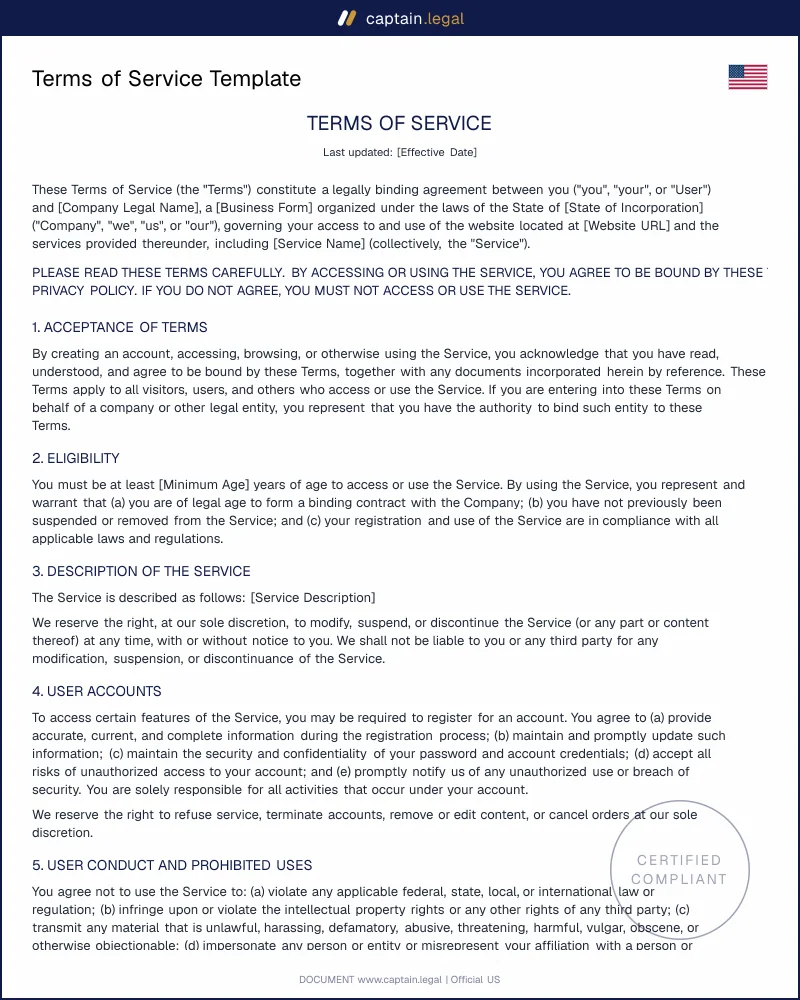
Terms of Service Template (US) | Word & PDF
Secure payment
What is a terms of service agreement?
A Terms of Service agreement is a unilateral contract between a website operator and each end user, drafted by the operator and accepted by the user as a condition of access. Courts treat it as a standard-form contract of adhesion, which means it is enforceable only when the user has been given conspicuous notice of the terms and has manifested objective assent to them, typically through a click. The document combines three legal layers in a single instrument : a license granting the user limited rights to the site or application, a disclaimer allocating risk between operator and user, and a set of procedural rules governing dispute resolution, account termination, and amendments.
Practitioners often conflate Terms of Service, Terms & Conditions and Terms of Use — and for most consumer-facing sites the labels are interchangeable. The substantive distinction sits elsewhere : a EULA (End User License Agreement) governs installed software and emphasizes the license grant, while a Terms of Service governs an ongoing online relationship and emphasizes use rules and account lifecycle. Privacy policies are a separate document required by California's CCPA/CPRA, Virginia's VCDPA, and a growing list of state statutes ; the two should always be referenced cross-link, never merged. A site that posts a Privacy Policy without separate Terms of Service is one of the weakest legal postures online, because no contract has been formed at all : the operator has only made a unilateral disclosure, not bound the user to anything. Browse Captain.Legal's full catalog of US business and legal templates to assemble the complete stack a website needs before launch.
Legal framework
No single federal statute creates a general "terms of service law" in the United States. Enforceability flows instead from state common-law contract doctrine, refined through twenty-five years of online-contract case law and overlaid with sector-specific federal statutes. The two foundational electronic-signature statutes are the federal Electronic Signatures in Global and National Commerce Act (E-SIGN, 15 U.S.C. §7001) and the Uniform Electronic Transactions Act (UETA), adopted in 49 of 50 states. Together they confirm that an electronic record and an electronic signature carry the same legal weight as ink on paper, provided the parties have consented to transact electronically and the system reliably retains the record.
The body of case law that actually shapes a Terms of Service on the ground is judge-made. Specht v. Netscape Communications Corp., 306 F.3d 17 (2d Cir. 2002), is the foundational decision : a hyperlink to terms placed below the download button, with no obligation to scroll or click, did not put a reasonable user on inquiry notice and the arbitration clause failed. Nguyen v. Barnes & Noble, 763 F.3d 1171 (9th Cir. 2014), confirmed that a footer-only browsewrap is presumptively unenforceable. Berman v. Freedom Financial Network, 30 F.4th 849 (9th Cir. 2022), tightened the standard further by requiring that the assent button itself put the user on notice that clicking forms a contract. The Ninth Circuit rule that emerged is now followed nationwide : a digital agreement binds the user only when (i) the website provides reasonably conspicuous notice of the terms and (ii) the user takes an affirmative action that unambiguously manifests assent. The plain-English consequence is that clickwrap is enforceable, browsewrap is not, and sign-in wrap sits in a contested middle ground that depends entirely on how the assent screen is designed. The Cornell Legal Information Institute's Wex entry on clickwrap agreements summarizes the doctrine and the controlling cases.
Layered on top, several federal statutes constrain what a Terms of Service may say. The Federal Trade Commission Act §5 prohibits unfair and deceptive practices, which captures any term that contradicts the operator's marketing or hides material conditions. The Restore Online Shoppers' Confidence Act (ROSCA, 15 U.S.C. §8403) governs negative-option billing : recurring charges require clear and conspicuous disclosure before payment information is collected, plus a simple cancellation mechanism. The Consumer Review Fairness Act of 2016 voids any gag clause that prohibits honest customer reviews, with parallel state penalties under California Civil Code §1670.8. The Digital Millennium Copyright Act §512 conditions safe-harbor immunity on a registered DMCA agent and a stated takedown procedure inside the Terms. Skipping any of these is not a stylistic shortcut — it is a federal compliance failure that no template language can paper over after the fact.
When do you need this document?
The most common trigger is the launch of a new website, mobile app, or SaaS product that allows visitors to do anything beyond passive reading : create an account, post content, make a purchase, subscribe to a service, request a quote. Each of those actions involves data collection, payment processing, or user-generated content, and each opens a vector of liability that only a written agreement can close. Operators sometimes assume that a brochure-style site without sign-up has no need for terms, but even a marketing site that shows pricing or accepts contact-form submissions benefits from a basic Terms of Use governing intellectual property, prohibited use, and dispute resolution.
The next scenario is a major product change : a free service moving to paid tiers, the introduction of automatic renewals, the addition of user-generated content, or a pivot toward AI-powered features that train on user inputs. Each of these triggers new disclosure obligations under federal and state law, and each requires a fresh acceptance screen rather than a silent edit to the existing terms. Courts routinely refuse to enforce material amendments that were posted to a stale page without re-prompting users for assent.
A third trigger is investor or acquirer due diligence. M&A counsel will ask, on the first day of diligence, for the current Terms of Service, the assent flow screenshots, and the version history. A platform that cannot produce these is treated as carrying unquantified consumer-protection risk and the deal multiple drops accordingly. The cheapest moment to fix Terms is before fundraising, not during it. One edge case worth flagging : platforms hosting third-party content under Section 230 of the Communications Decency Act must align their content-moderation provisions with the safe harbor's good-faith requirements, and operators that target users in the European Union must additionally comply with the Digital Services Act through a parallel set of EU terms.
Key clauses included in our template
The Captain.Legal Terms of Service template is structured around the clauses that U.S. courts actually scrutinize when an agreement is challenged. Each clause is drafted to the level of detail a litigation defense expects, not the boilerplate that fails on motion to compel arbitration.
- The acceptance and assent clause is the gateway. It recites that continued use of the service plus the click on the I agree button constitute affirmative assent under E-SIGN and UETA, captures the version number and timestamp, and confirms the user's legal capacity to contract under the age of majority in their state.
- The license grant narrows what the user may do with the platform : a limited, revocable, non-exclusive, non-transferable license, with explicit prohibitions on scraping, reverse engineering, and competitive benchmarking. This is the clause that carries CFAA weight if a competitor harvests data from the site.
- The acceptable use policy lists the conduct that justifies immediate account termination, drafted to align with the moderation tools the platform actually deploys. Vague prohibitions are useless ; the template uses categorical, defensible language.
- The intellectual property clause distinguishes operator IP (the site, code, and trademarks, all reserved) from user-generated content (a license back to the operator, scoped to operate, display, and promote the service). The license avoids overreach that California and New York courts have struck down in unconscionability challenges.
- The disclaimers and limitation of liability sit together. AS IS and AS AVAILABLE warranties are stated in the all-caps form required by UCC §2-316, followed by a cap on liability set to the higher of fees paid in the prior twelve months or one hundred dollars, with carve-outs for gross negligence and willful misconduct as required in California.
- The arbitration and class-action waiver is drafted to the Federal Arbitration Act and tracks the Berman notice requirements — a 30-day opt-out window, plain-English summary above the clause, and bold treatment of the jury and class waiver.
- The DMCA takedown procedure names a registered agent, the §512(c)(3) elements of a valid notice, and the counter-notice protocol. Without it, the platform forfeits the safe harbor entirely.
- The modification, governing law and termination clauses close the document with a procedure for material amendments that requires fresh assent, a choice-of-law and venue selection, and a survival provision.
For ancillary documents that almost every U.S. platform pairs with its Terms — confidentiality with vendors, contractor agreements for engineering work, founder protections — the non-disclosure agreement template for U.S. businesses is the natural companion piece.
State-specific considerations
A Terms of Service drafted as a single nationwide instrument can still violate the law of a single state. The four jurisdictions that matter most for U.S. consumer-facing platforms are California, Texas, Florida and New York, each of which imposes distinct constraints.
California is the strictest jurisdiction by a wide margin. The California Consumer Privacy Act and its CPRA amendment require a separate, conspicuously-linked privacy notice and grant residents specific rights — access, deletion, correction, opt-out of sale or sharing — that the Terms must reference rather than override. California Civil Code §1670.8 makes any gag clause prohibiting consumer reviews unenforceable and exposes the operator to statutory penalties of up to $10,000 for willful violations. The Automatic Renewal Law (Business and Professions Code §17600) requires clear and conspicuous disclosure of renewal terms and an online cancellation mechanism that mirrors the signup flow. Arbitration clauses that survive elsewhere are routinely struck down in California for procedural unconscionability if the assent flow is not visibly fair, following Armendariz v. Foundation Health Psychcare Services, 24 Cal. 4th 83 (2000). California sites need a more careful template than the rest of the country.
Texas sits at the opposite pole on consumer terms but is increasingly active on data. The Texas Data Privacy and Security Act, effective July 2024, applies to operators meeting volume thresholds and requires a clear privacy notice, opt-outs, and contractual terms with processors. Texas courts are friendly to arbitration and forum-selection clauses under the Texas Arbitration Act, but consumer-facing arbitration must still satisfy basic notice. Venue clauses pointing to Travis or Harris County are typically respected.
Florida enforces the Florida Digital Bill of Rights (effective July 2024) for operators above its volume threshold, and the Deceptive and Unfair Trade Practices Act (FDUTPA, Fla. Stat. §501.204) for any consumer-facing terms. Florida courts have repeatedly invalidated forum-selection clauses that route Florida consumers to distant courts under Resort Tax Service v. International Bancshares Corp. and its progeny ; the template uses a Florida-friendly venue option for sites with significant Florida traffic.
New York brings General Business Law §349 (deceptive practices), §520-a (automatic renewal), and the New York SHIELD Act for breach notification. New York courts apply heightened scrutiny to limitation of liability and indemnity clauses, and the Court of Appeals has rejected agreements where the assent button was less prominent than surrounding marketing copy. The Captain.Legal template uses New York-conforming language for any platform that markets to NY residents.
How to fill out this terms of service
The Captain.Legal flow takes about ten minutes for an operator who has the basic facts of their business at hand. You start by selecting the entity type that owns the platform : sole proprietor, LLC, C-corp, S-corp or partnership. The form then asks for the legal name and registered address of the operator, the trade name used on the website, and a contact email that will appear in the notice clause. From there, the questionnaire branches based on what your platform actually does — pure information site, e-commerce, SaaS, marketplace, user-generated content platform, AI-powered service — and adds the clauses that match.
The next stage covers the commercial layer : whether you charge users, whether the charge is one-time or recurring, whether you offer free trials or freemium tiers, and whether you ship physical goods. Each answer toggles the appropriate disclosure language for ROSCA, automatic renewal, refund policy, and shipping terms. The final stage covers risk allocation : the states you target, whether you elect arbitration or court litigation, the governing law, and the limitation of liability cap you want. The output is a fully drafted Terms of Service in Word and PDF formats, with version control fields ready for the launch date and an assent flow checklist that engineering can hand to the front-end team. If you also need to incorporate the entity that operates the site, the articles of incorporation template for U.S. corporations and the LLC operating agreement template for U.S. LLCs sit one click away.
Common mistakes to avoid
The single most expensive mistake is using a browsewrap model — placing a Terms of Service link in the footer and assuming continued use of the site equals consent. Twenty years of case law from Specht to Berman has made browsewrap presumptively unenforceable, and any platform that relies on it cannot compel arbitration, cannot enforce its limitation of liability, and cannot reliably terminate abusive accounts without litigation risk. The fix is a clickwrap or sign-in wrap checkbox at registration, with the link to the Terms styled as a visible blue underline next to text that says "By clicking Sign Up I agree to the Terms of Service and Privacy Policy". The second recurring mistake is a stale version : operators amend their Terms by silently editing the page, never re-prompting existing users for assent, and then discover at the first dispute that the amended arbitration clause is unenforceable against anyone who registered before the change. Material amendments require fresh, dated, logged assent.
The third mistake is overreach in the intellectual property clause — claiming a perpetual, irrevocable, worldwide license over user content for unrelated commercial uses. California and New York courts have struck these down as unconscionable, and even where they survive on paper they trigger user backlash that damages the platform more than the clause was ever worth. The fourth is missing the DMCA designated agent registration with the U.S. Copyright Office, which voids §512 safe harbor regardless of what the Terms say. The fifth is treating the Privacy Policy as a section of the Terms instead of a freestanding document : CCPA, VCDPA, CTDPA and the rest of the state privacy statutes require a separate, distinctly-linked notice with prescribed elements. Burying privacy inside Terms is a fast path to a state attorney general action.
Frequently Asked Questions
28 verified reviews · 50 000+ downloads
- Immediate access to the document
- PDF + Word download
- Compliant with 2026 legislation
- Reviewed by lawyers
You might also like