Real Estate & Rental

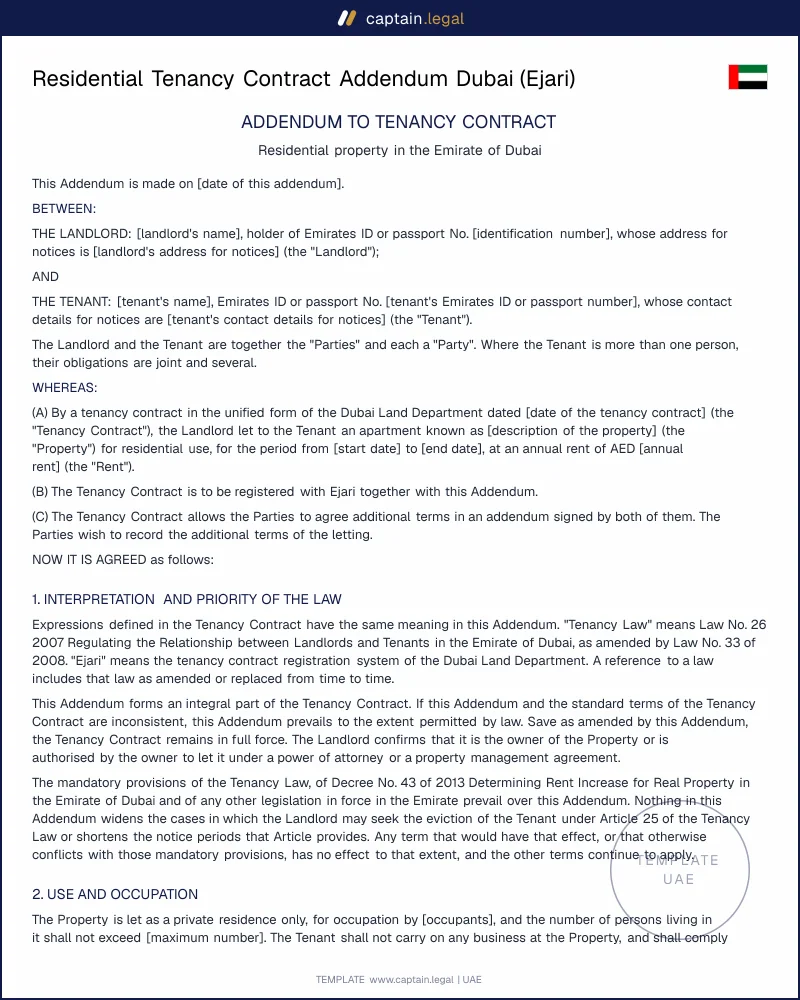
Tenancy Contract Addendum Dubai: Ejari Addendum for Apartments and Villas

Addendum to the Dubai Land Department unified tenancy contract for an apartment, villa or townhouse: rent cheques, occupants, pets, furniture, maintenance, chiller and Ejari fees, deposit refund, tenant break clause and renewal, with Dubai tenancy law stated to prevail.
4.8/5— 29 reviewsUAE federal law 2026Instant download
Share

A tenancy contract addendum Dubai landlords and residential tenants sign is the page that turns the short unified Ejari contract into a workable house agreement. It records how the rent cheques are handled, who may live in the flat or villa, whether a cat is welcome, who replaces a broken air-conditioning filter, what happens to the deposit and how the tenant can leave early. This self-service template covers apartments, villas and townhouses let for residential use under Dubai tenancy law, outside the DIFC, and states plainly that the law prevails where the two differ.

UAE federal law

Updated for 2026

50,000+ clients

trust us

Clear prices

From AED 49.00, VAT incl.

Secure payment

Instant download

Tenancy Contract Addendum Dubai: Ejari Addendum for Apartments and Villas

Secure payment

Fill in the template

What is a tenancy contract addendum Dubai landlords register with Ejari?

The unified tenancy contract of the Dubai Land Department lists the parties, the property, the rent, the deposit and the mode of payment, then a short set of standard terms. Those terms already say that the tenant pays electricity, water and cooling unless agreed otherwise in writing, that subletting needs the landlord's written approval, that any additional condition conflicting with the law will not be considered and that the Arabic text prevails. A note at the end allows the parties to add an addendum for additional terms, signed by all of them. Everything specific to the letting, from the number of cheques to the pet policy, belongs there.

An addendum is not a second lease. It sits under the unified form, it cannot remove a protection the law gives the tenant, and it should be registered with Ejari together with the contract or as an amendment to it. It also differs from documents that deal with a single moment of the tenancy: the 90-day notice of new renewal terms is sent before expiry to propose a change, and an early exit agreed in the middle of the term is recorded separately. Office, shop and warehouse lettings raise different issues, which is why the Dubai real estate templates keep residential and commercial addenda apart.

When do you need this document?

The most common moment is the signing of a new lease through an agent. The unified form says nothing about the four post-dated cheques the tenant hands over, so the addendum fixes their dates and what happens if one bounces. Families moving into a villa use it to name the occupants and the maximum number, which protects both sides when the community management asks questions. Furnished apartments need an inventory signed with the move-in report, otherwise every missing spoon becomes a deposit dispute.

Pets are the second trigger. Many buildings restrict animals, and a landlord who allows a cat wants the tenant to carry the cost of cleaning and damage. The chiller question comes next: some towers bill cooling separately, others include it in the service charges, and tenants often discover the difference with the first bill. Writing down who pays avoids that surprise.

Early exit is the third reason, and probably the one tenants ask about most. A job move abroad in month seven is common in Dubai, and a clause allowing termination with notice and an agreed compensation turns a stressful negotiation into a calculation. An edge case worth knowing: when a landlord lives abroad and signs through a representative, the addendum identifies that representative and the power of attorney used to let the property, and a copy is attached to it.

Key clauses included in our template

The first clause sets the order of priority. Mandatory provisions of the tenancy law and of Decree No. 43 of 2013 come first, nothing in the addendum widens the eviction grounds or shortens the notice periods of Article 25, and a conflicting term simply falls away while the rest of the addendum stays in force.

  • Occupation is limited to the people you name, up to a maximum number, with no business use, no shared housing and no short stays or holiday home lettings.
  • If a cheque comes back unpaid, the tenant replaces it within seven days with the bank charges actually incurred; that period is a payment term, not a legal notice, and the consequences stay civil.
  • Deposit deductions are limited to unpaid rent and charges, damage beyond fair wear and tear and missing items, each supported by an itemised statement.
  • Depending on your answers, maintenance follows the statutory default or gives the tenant minor repairs up to an amount per item.
  • An optional break right lets the tenant leave on notice against a compensation you set, and the cheques dated after the exit date are returned.

Further clauses cover utilities and the chiller choice, who pays the Ejari fees, furniture and pets, alterations and access, renewal within the rent index, the landlord's duty to deliver the property in good condition under Article 15, the move-out inspection, notices, personal data and the dispute forum. Where a tenant has already left without a break clause, the tenancy early termination agreement for Dubai records the agreed exit instead.

How to fill out this tenancy addendum

You start with the property type and its description, copied from the tenancy contract with the unit, building, plot and Makani numbers. The next screens take the contract date, the term and the annual rent, then ask whether the lease is already on Ejari: the recital and the registration clause change with the answer. The landlord can be an individual signing personally or through a representative, or a company with a named signatory, and the tenant is identified by Emirates ID or passport, with all names entered for joint tenants.

The middle of the questionnaire covers the practical terms. You list the occupants and the maximum number, choose cheques or bank transfer and the number of payments, enter the deposit, decide who pays for cooling and for Ejari, then answer the furniture, pet and maintenance questions. Each answer rewrites its own clause in the preview, so you can see the effect before moving on. The last questions deal with early termination and the tenant's renewal notice. Click Finish to generate the addendum in Word and PDF, sign it with the other party and let the landlord register it with Ejari.

Common mistakes to avoid

The first mistake is copying a "two months' rent" early exit penalty and presenting it as the law. No Dubai text sets that figure; it is market practice, and the addendum works because both parties chose it. The second is a deposit clause that lets the landlord keep the deposit for "cleaning and repainting" whatever the condition of the flat. Ordinary fading of paint is fair wear and tear, and a vague clause is the first thing contested.

Occupancy causes the next set of problems. Tenants who sublet a room to cover the rent expose themselves to eviction under Article 25 for unauthorised subletting, and the shared housing rules now add separate penalties. Landlords make the opposite mistake: they agree a pet or an extra occupant by message and later deny it, so record every consent in writing. A cheque returned unpaid is a civil debt to settle, not a reason to threaten anyone. Finally, an unregistered tenancy contract addendum Dubai parties rely on is weak evidence when a disagreement arises, which is why the template provides for its registration.

Key takeaways

LAW FIRST

The tenancy law prevails over every clause

The unified contract already says that a condition conflicting with the law is not considered, and the addendum repeats it. Law No. 26 of 2007 as amended in 2008 and the rent caps of Decree No. 43 of 2013 come first: nothing in the addendum adds an eviction ground or shortens the notice periods of Article 25, and a conflicting term simply falls away while the other agreed terms keep applying.

HOUSE RULES

Occupants, pets and furniture agreed in writing

Most residential disputes in Dubai start with things the unified form never mentions. The addendum names the occupants and their maximum number, bars letting rooms or beds and holiday home use, records the pet policy chosen by the landlord and attaches an inventory to the move-in report for a furnished home. Each consent is written once, signed by both sides, and no longer depends on a message thread.

EARLY EXIT

A break clause the tenant can actually use

Article 7 of the tenancy law stops either party ending a lease alone during its term, so an exit right exists only if it is agreed. The template lets the tenant leave on the notice you choose against a compensation you set, often two months' rent by market practice rather than by law, and makes the landlord return the post-dated cheques dated after the exit and refund any rent paid in advance.

Frequently Asked Questions

Once signed by the landlord and the tenant, the addendum is part of their tenancy contract, as the unified form expressly allows. It binds them within the limits of the tenancy law: a clause conflicting with a mandatory rule, such as an extra eviction ground, has no effect, and the template says so in its first clause. Article 4 of the tenancy law requires leases and their amendments to be registered, and the template makes the landlord responsible for registering the signed addendum with Ejari. The template is written for Dubai residential lettings governed by Law No. 26 of 2007; it does not apply to the DIFC or to Abu Dhabi.

Both formats are produced when you click Finish. Most parties print and sign the PDF, then the landlord uploads it to Ejari with the tenancy contract or as an amendment. The Word file helps when you want to attach the inventory or adjust a description before signing. If you change the Word text, read the defined terms again, because the Move-in Report, the Deposit and the Rent are referred to across several clauses. Each party keeps one signed original, together with the inventory if the property is furnished.

Under Articles 13 and 14 of the tenancy law, a party who wants to change the rent or any other term for the renewal must notify the other at least 90 days before the lease ends, unless the contract sets another period. A tenant who simply stays on without objection is renewed on the same terms. The template adds an optional clause asking the tenant to announce, within a period you choose, whether it will renew or move out. Eviction on expiry is a different matter and needs twelve months' notice on the grounds Article 25 lists.

Yes, as long as they are named in the occupancy clause or fall within its description and the total stays within the maximum you set. The clause covers family members and household staff living with the tenant, and it excludes letting rooms or beds to anyone else. Community and building rules still apply, including limits on the number of residents in some towers. For guardianship, travel or school questions involving children, the family templates for the UAE address those matters separately.

Only the items the addendum lists: rent and charges still unpaid, the cost of repairing damage beyond fair wear and tear, and the value of missing items from the inventory. Each deduction must appear in an itemised statement backed by invoices or quotations. The refund falls due within thirty days after the later of the end of the lease, the handback of the keys and the final electricity and water bill. Normal fading of paint and ageing of fittings are not deducted, which matches Article 21 on the condition in which the property is returned.

No. A commercial letting raises fit-out periods, works approvals, reinstatement and trade licence questions that a residential addendum does not answer. The commercial lease addendum for Dubai handles offices, shops and warehouses under the same tenancy law, with clauses on the licensed activity, the fit-out period and the tenant's works. Using a residential text for business premises also creates a use problem, since Article 25 lets a landlord seek eviction where a property is used for a purpose other than the one let.

4.8/5

29 verified reviews · UAE federal law 2026

Tenancy Contract Addendum Dubai: Ejari Addendum for Apartments and Villas
  • Immediate access to the document
  • PDF + Word download
  • Written to UAE federal law
  • Self-service template, no legal advice
Fill in the template
Secure payment
Updated on 17 November 2026

You might also like

Tenancy Early Termination Agreement Dubai
Commercial Lease Addendum Dubai (Ejari)