Family (non-Muslim residents)

Parenting Plan UAE: Shared Custody Plan for Non-Muslim Parents

A parenting plan for non-Muslim parents divorcing or divorced in Abu Dhabi or another emirate: residence schedule, holidays, decisions, travel and passports, relocation and child maintenance. It takes effect only once the competent court approves it.
4.6/5— 25 reviewsUAE federal law 2026Instant download
Share

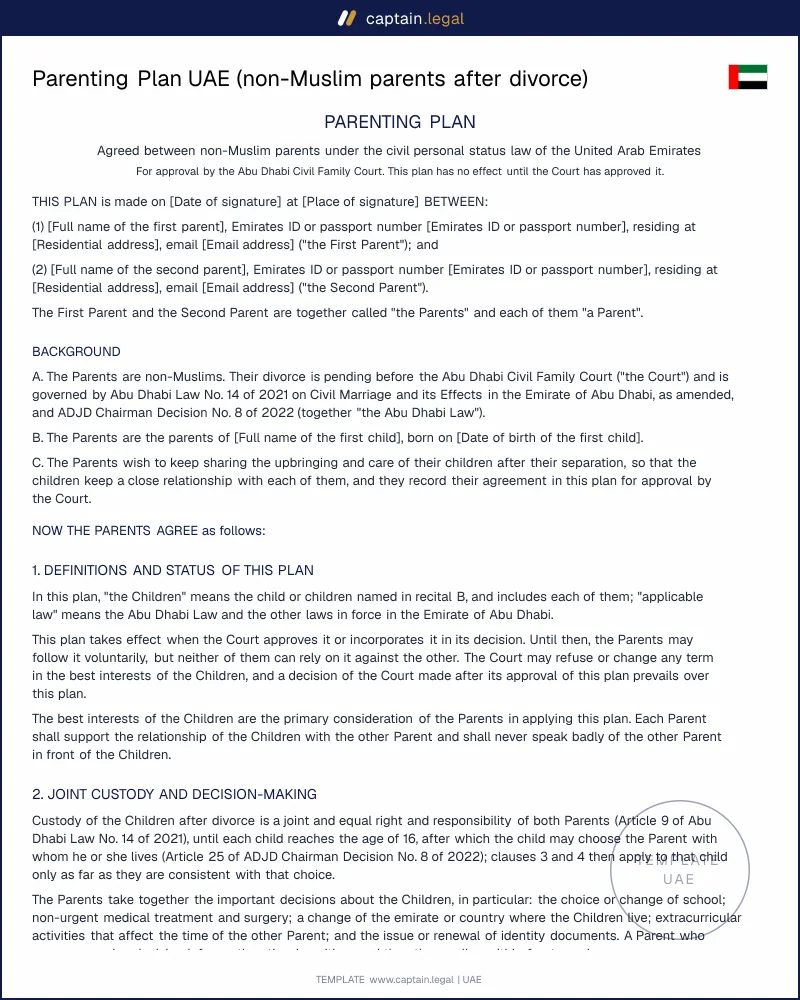
A parenting plan UAE courts can approve is a written agreement in which separated parents set out where their children live, how holidays are split, who decides on school and health, how travel abroad works and who pays for what. This self-service template is written for non-Muslim parents who are divorcing or divorced under the civil personal status law, in Abu Dhabi or in another emirate, and it reflects UAE federal and Abu Dhabi law as in force on 17 November 2026. The plan has no effect until the competent court approves it, and the court can change any term in the children's best interests.

UAE federal law

Updated for 2026

50,000+ clients

trust us

Clear prices

From AED 49.00, VAT incl.

Secure payment

Instant download

Parenting Plan UAE: Shared Custody Plan for Non-Muslim Parents

Secure payment

Fill in the template

What is a parenting plan in the UAE?

A parenting plan in the UAE is the parents' own proposal for the custody arrangements after a civil divorce. Under the civil family rules for non-Muslims, custody after divorce is shared by both parents, and the court decides how that shared custody works when the parents cannot agree. A plan signed by both parents gives the judge a ready answer: a residence schedule, a holiday calendar, rules for handovers, schooling and medical decisions, a travel regime and a financial arrangement. Once approved, or incorporated in the court's decision, it becomes the reference both parents follow and the court enforces.

The plan is different from the divorce itself, which the court grants on the application of either spouse, and from a post-divorce financial settlement between the former spouses, which deals with alimony and property. It also differs from a one-off travel consent: the plan sets the general rule for every trip, while a child travel consent letter for the UAE covers a single journey. This template is limited to non-Muslim parents under the civil personal status law. Muslim families, whose custody rules follow the Sharia-based personal status law, parents who never married, and the DIFC and ADGM courts are outside its scope.

When do you need a parenting plan in the UAE?

The obvious moment is a pending civil divorce with children under 16. Parents who arrive at the court with a signed parenting plan in the UAE avoid an imposed schedule that may not fit their working hours or the distance between their homes. The plan is just as useful after the divorce, when the default joint custody ordered by the court no longer matches reality: one parent takes a rotation job in Saudi Arabia, a child needs to stay in one home during the exam years, or the parents want a two-week rhythm instead of one.

A second trigger is travel. Expatriate families fly home every summer, and in Abu Dhabi each trip needs a court-authorised consent; agreeing the rules in advance avoids a fight before every school holiday. A third trigger is money. School fees in the UAE are often the largest single expense, and a plan that sets the share of each parent, the health insurance premium and the yearly increase of the monthly amount removes the commonest source of conflict. Housing usually moves at the same time; if one parent signs a new lease or changes an existing one, an addendum to a Dubai tenancy contract records the change with the landlord. Under the template, a parent planning to leave the UAE with the children needs the other parent's written agreement or a court decision.

Key clauses included in our template

Our parenting plan UAE template opens with its own status. It takes effect when the court approves it, the parents may follow it voluntarily before then, and a later court decision prevails. A loyalty clause commits each parent to support the children's relationship with the other and never to speak badly of him or her in front of them.

  • Four residence patterns are offered: equal time by alternating weeks or two-week periods, or a main home with one parent and a schedule you describe for the other.
  • Important decisions (school, non-urgent treatment, a move to another emirate, identity documents) are taken jointly, with a written proposal and fourteen days to answer.
  • School holidays are split in halves that alternate each year, while religious and national holidays and birthdays have their own rule and a fallback if you do not agree on the calendar.
  • For travel, you choose between consent for each trip and an advance agreement for holiday trips up to a set number of days, with notice, return tickets and passport handover; on the Abu Dhabi route, each parent undertakes to sign the court's consent form.
  • Money comes last: a monthly amount, paid by the parent with whom the children do not mainly live or chosen when time is equal, or daily costs borne by each parent, plus shares of school fees, uninsured medical costs and insurance.

Mediation before court is encouraged but never compulsory, and the plan ends with signature lines and a space for the court's approval.

How to fill out this parenting plan

You start by choosing the court that will approve the plan: the Abu Dhabi Civil Family Court, or another UAE court applying the federal law, whose name you then type. That choice changes the legal references, the travel clause and the language clause. You then say whether the divorce is pending or already granted, with the date of the judgment in the second case, and enter each parent's name, Emirates ID or passport number, address and the email address used for written notices.

The children come next, one to three, with their names and dates of birth. The residence step offers the four patterns; if the children live mainly with one parent, a text box appears for the other parent's regular time, and you also give the usual handover place. The money steps ask how costs are shared, who pays the monthly amount when time is equal, the amount and any fixed yearly increase, then the first parent's percentage of school fees and medical costs. The travel step sets the consent rule, the maximum holiday trip, the notice in days and who keeps the passports. The preview changes with every answer, and Finish generates the plan in Word and PDF, ready to sign and file with the court. If a financial agreement between the former spouses is also needed, the templates on the UAE personal documents page cover loans and acknowledgments of debt.

Common mistakes to avoid

The most frequent error is treating the signed plan as already in force. Until the court approves it, neither parent can rely on it against the other, and in Abu Dhabi the travel clause still needs the court's consent form for each trip. A second mistake is copying a schedule from another country without checking school hours: a handover "on Sunday evening" that ignores a Monday school start creates a dispute every week. The template fixes the handover at the end of the school day when the receiving parent collects the children, which removes that weekly friction.

Money causes the rest. Parents often agree a monthly figure and forget school fees, often the heaviest item of the year, or forget the health insurance premium. Others leave the amount frozen for years; the template lets you choose a fixed yearly increase or an annual review. A parent can never waive the children's right to maintenance, so a plan that says "no support is payable" while one parent carries all the costs is open to change by the court. Finally, parents with a prenup sometimes assume it settled custody. It cannot: a prenuptial agreement for non-Muslim couples deals with property and divorce claims, and leaves the children to the court.

Key takeaways

COURT APPROVAL

The plan applies once the court approves it

The plan records your agreement, but it takes effect only when the Abu Dhabi Civil Family Court, or the court named for the federal route, approves it or includes it in its decision. Until then you may follow it voluntarily. The court can refuse or change any term in the children's best interests, and in Abu Dhabi a parent who ignores the approved schedule may be fined and lose custody days.

JOINT CUSTODY

Equal time or a main home, decisions shared

Abu Dhabi law makes custody after divorce a joint and equal right of both parents until the child turns 16. The template offers alternating weeks or two-week periods, or a main home with one parent and a schedule you describe for the other. In every case school, non-urgent treatment, a move and identity documents are decided together, with a written proposal and fourteen days to reply.

TRAVEL

Trips abroad, passports and court consent

In Abu Dhabi a parent can take a child abroad only with the other parent's written consent authorised by the court on its form, or the judge's permission. The plan sets your rule: consent for each trip, or advance agreement for holiday trips up to a set length, with notice, return tickets and a passport handover. Both of you undertake to sign the form, and a travel ban always prevails.

Frequently Asked Questions

It becomes binding when the court approves it or incorporates it in its decision. Before that, it records your agreement and you may follow it voluntarily, but neither parent can enforce it against the other. Once it is part of the court's decision, the schedule can be enforced: in Abu Dhabi, a parent who does not respect it may be fined and lose custody days. The court can also refuse or change any term that does not serve the children's best interests, which is why a complete and realistic plan has the best chance of being approved as written.

You choose the number of days in the form, and thirty days is a common figure for a summer trip. Within that notice period, the travelling parent sends the dates, the destination, the addresses where the children will stay, contact details and a copy of the return tickets. If you choose the advance agreement for holiday trips, any trip within the maximum length you set is accepted in principle, and only longer trips need a new consent. In Abu Dhabi, each consent must still be authorised by the court on its form, and the plan commits both parents to sign it.

Not without the written agreement of the other parent or a decision of the court. The template treats a move to another emirate in the same way as a move abroad, because it changes school, handovers and the time each parent spends with the children. The parent who considers the move informs the other at least ninety days in advance, with a proposal for the new schedule, the schooling and the travel costs. If the move follows the end of a lease, the 90-day notice on tenancy renewal terms in Dubai gives a useful timetable. Without agreement, the court decides.

Under Abu Dhabi law, the equal right of both parents to joint custody lasts until the child reaches 16, after which the child may choose the parent he or she lives with. The plan continues to apply to the arrangements that still make sense, and the parents review it together, which the template requires anyway at each new stage of schooling and every two years. Maintenance does not stop at 16: in the template, it continues until 18 or the end of full-time secondary education, unless the court decides otherwise.

No. This template is written for non-Muslim parents whose divorce falls under the civil personal status law, because it relies on the custody rules that apply after a civil divorce. Parents who never married face different questions first, starting with the registration of the birth and proof of parentage, which the Abu Dhabi court handles through its own procedure. Muslim families are also outside the template, since their custody rules follow the Sharia-based personal status law, as are cases before the DIFC or ADGM courts.

You get both when you click Finish. The Word file lets you adjust a detail agreed at the last minute, such as a handover time, before you both sign. The PDF is the clean copy to sign, keep and file with the court. You can also return to the form, change an answer such as the residence pattern or the travel rule, and download an updated version of the whole plan.

4.6/5

25 verified reviews · UAE federal law 2026

Parenting Plan UAE: Shared Custody Plan for Non-Muslim Parents
  • Immediate access to the document
  • PDF + Word download
  • Written to UAE federal law
  • Self-service template, no legal advice
Fill in the template
Secure payment
Updated on 17 November 2026

You might also like

Non-Muslim Will UAE (draft for registration)
Prenuptial Agreement UAE (non-Muslims)