Real Estate & Tenancy

Commercial Lease Addendum Dubai: Ejari Addendum for Offices, Shops and Warehouses

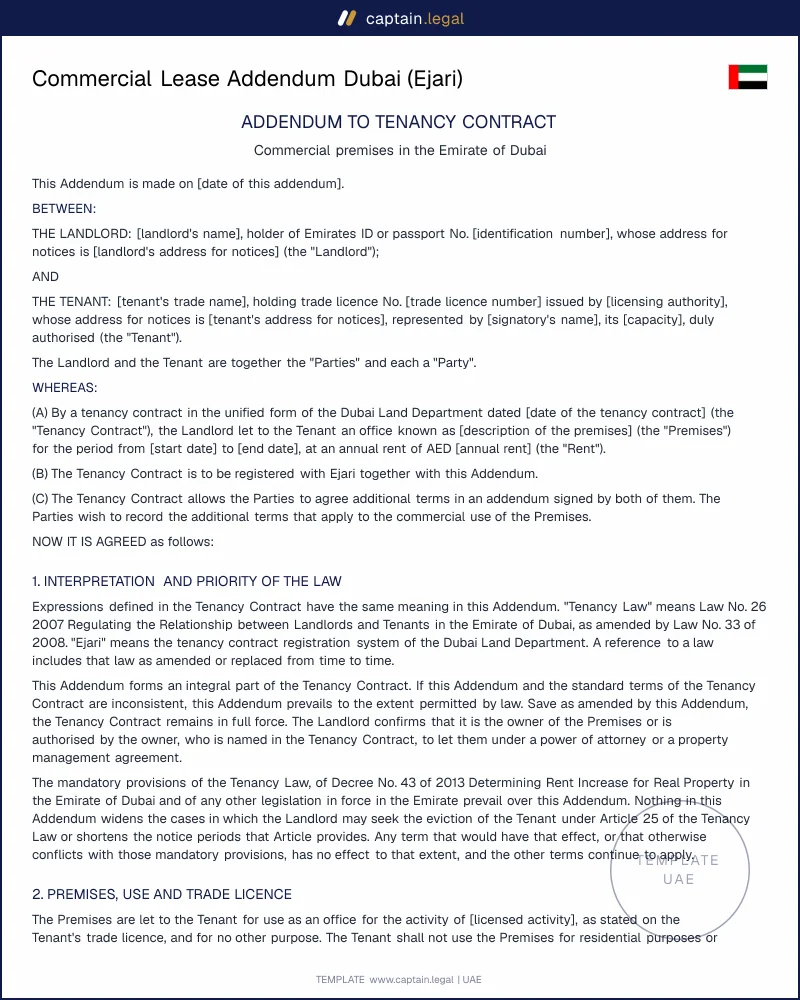
Addendum to the Dubai Land Department unified tenancy contract for an office, shop or warehouse: fit-out period, works approvals, reinstatement, maintenance split, subletting, tenant break clause and renewal, with the Dubai tenancy law stated to prevail.
4.5/5— 25 reviewsUAE federal law 2026Instant download
Share

A commercial lease addendum Dubai landlords and business tenants sign sits on top of the unified tenancy contract of the Dubai Land Department and records everything the standard form leaves blank: the fit-out period, approvals for works, who removes the partitions at the end, how maintenance is shared, whether the tenant can sublet or leave early. The unified contract fits on three short pages and was never meant to carry the commercial deal. This self-service template turns that deal into numbered clauses, for an office, a shop or a warehouse let under Dubai tenancy law, outside the DIFC.

UAE federal law

Updated for 2026

50,000+ clients

trust us

Clear prices

From AED 49.00, VAT incl.

Secure payment

Instant download

Commercial Lease Addendum Dubai: Ejari Addendum for Offices, Shops and Warehouses

Secure payment

Fill in the template

What is a commercial lease addendum Dubai parties attach to Ejari?

The Dubai Land Department publishes a unified tenancy contract that every lease in the emirate is expected to use. Its own terms say that any condition conflicting with the law will not be considered, that the Arabic text prevails over the English one, and that the parties may add an addendum for additional terms, provided all of them sign it. That addendum is not a side letter. It forms part of the lease, it is uploaded with the contract, and in a dispute it is read together with the standard terms. For an office or a retail unit, it is usually where the real negotiation sits: the rent-free fit-out period, the handover condition, the reinstatement obligation, the payment schedule and the break option.

An addendum is not a full lease drafted from scratch. It does not replace the unified form and cannot contradict the mandatory rules of the tenancy law; it only fills the space those rules leave to the parties. It also differs from a renewal notice or a termination agreement, which deal with one event rather than with the terms. A commercial lease addendum Dubai tenants negotiate is signed at the start, or when a registered lease is renegotiated, and governs the whole term. Residential lets need different wording, because questions such as occupants, pets and shared housing replace fit-out and trade licence issues, which is why the Dubai property templates separate the two.

When do you need this document?

The classic case is a new letting of a shell and core office or shop. The tenant needs two or three months to build partitions, ceilings and air-conditioning ducts before trading, and the landlord agrees to waive rent for that period. Without a written clause, the unified contract shows a full year's rent from day one, so the first instalment becomes the first dispute.

A second trigger is the end of the tenancy. Landlords who let a fitted unit often want the fit-out left in place for the next occupier, while others insist on a return to bare shell. Article 23 decides the default, and the addendum lets the parties choose otherwise. Warehouse lettings bring their own concern, because racking, mezzanines and power upgrades are expensive to remove.

Payment terms are the third reason. A tenant paying by bank transfer instead of post-dated cheques needs the account and the timing written down, and a tenant paying by cheque benefits from a clear civil rule for a cheque that comes back unpaid. Groups also use the addendum to let an affiliate share the space, subject to the licensing authority. One edge case deserves attention: a tenant whose activity is licensed in a free zone but whose premises are on the mainland, or the reverse, may find that the licensing authority refuses to link the lease to the licence. That has to be solved before signing, not after.

Key clauses included in our template

The template opens with a priority clause. It states that the mandatory provisions of the tenancy law and of Decree No. 43 of 2013 prevail, so a term that would widen the eviction grounds or shorten the statutory notice simply has no effect, while the rest of the addendum keeps working. Everything that follows is built on that footing.

  • Fit-out comes with three answers: a rent-free period that applies to the first term only, a fit-out period during which rent remains payable, or no period at all. Approvals from Dubai Municipality, the civil defence and the building management are always the tenant's job, with the landlord's documents under Article 18.
  • At the end of the tenancy, you choose between full reinstatement to the condition recorded in the move-in report, leaving the approved fit-out without compensation, or a landlord election made ninety days before expiry.
  • Maintenance can follow the statutory default, give the tenant the whole interior, or split major and minor repairs with an amount per item that the tenant carries.
  • Subletting is either subject to consent not unreasonably withheld, open to group companies on notice, or excluded altogether.
  • An optional tenant break clause sets a notice period and a fixed compensation, and the template offers no landlord break right, which Article 25 would not support.

The remaining clauses cover rent and the civil handling of a returned cheque, value added tax where the landlord is registered, the security deposit under Article 20, utilities and insurance, renewal within the rent index, notices, personal data, and Ejari registration of the addendum itself. Before signing, compare the result with the tenancy early termination agreement for Dubai, which handles a negotiated exit when no break clause was agreed.

How to fill out this commercial lease addendum

You begin with the premises: the type of unit, the description copied from the tenancy contract and the activity shown on the trade licence. The next screens take the contract date, the term and the annual rent, then ask whether the lease is already on Ejari, so the recital either quotes the registration number or states that registration will follow. The landlord can be an individual, signing personally or through a representative with a power of attorney valid in the UAE, or a company with a named signatory. The tenant is always identified by its trade licence and licensing authority.

From there, each commercial choice rewrites the clause it controls. Picking a bank transfer replaces the cheque wording with an account clause, choosing a rent-free fit-out adds the pro rata rule and the first-term limit, and opening a break option asks for the notice and the compensation. The preview updates as you answer, and when you click Finish the addendum is generated in Word and PDF. Both parties sign it, the landlord registers it with Ejari, and any fit-out contractor should then be engaged under a separate services agreement for UAE businesses.

Common mistakes to avoid

The most frequent error is a rent-free period that appears only in emails. When the Ejari contract shows the full annual rent and the cheques cover twelve months, the tenant has little to show if the landlord later claims the waived months. A close second is silence on reinstatement: the landlord assumes the tenant will strip the unit, the tenant reads Article 23 and leaves everything in place, and the deposit becomes the battlefield. Parties also copy a "two months' rent penalty" for early exit from a residential precedent without checking that it reflects their own deal, or worse, give the landlord a right to terminate at will, which the tenancy law does not recognise.

Licensing issues come next: a tenant whose licence lists consultancy while it signs for a warehouse creates a use problem that Article 25 treats seriously. Finally, a commercial lease addendum Dubai parties sign is often never registered. An amendment that stays in a drawer is the first thing the other side challenges. Check the 90-day notice for renewal terms in Dubai as well, because rent reviews on renewal follow their own timetable.

Key takeaways

LAW FIRST

Dubai tenancy law prevails over the addendum

The unified tenancy contract itself says that a condition conflicting with the law is not considered. The addendum states it plainly: the mandatory rules of Law No. 26 of 2007, as amended in 2008, and the rent caps of Decree No. 43 of 2013 come first. A clause that tried to add an eviction ground or shorten the twelve months' notice on expiry would have no effect, while the other agreed terms keep applying.

FIT-OUT

Works, approvals and reinstatement in writing

Most disputes on commercial units start with the fit-out. The addendum fixes whether a rent-free period applies, for the first term only, and who obtains each approval from Dubai Municipality, the civil defence and the building management. At the end, the parties pick one rule: full reinstatement to the move-in condition, approved works left without compensation, or a landlord choice made ninety days before expiry.

EJARI

Register the addendum with the tenancy contract

Article 4 of the Dubai tenancy law requires lease contracts and their amendments to be registered, which in practice means Ejari. The template makes the landlord responsible for registering the addendum together with, or as an amendment to, the unified contract, and the tenant for providing its trade licence. An addendum kept in a drawer is the first thing the other side challenges, so registration belongs in the signing plan.

Frequently Asked Questions

Once both parties sign it, the addendum is a contract between them and forms part of the tenancy contract, as the unified form itself allows. Its clauses apply only within the limits of the tenancy law: a term that conflicts with a mandatory rule, for instance one that adds an eviction ground or a landlord break right, has no effect, and the priority clause of the template says so. Registration with Ejari is required by Article 4 for leases and their amendments, and the template makes the landlord responsible for registering it. The template reflects Dubai law and the unified contract; it does not cover DIFC premises or leases in Abu Dhabi.

Both formats are available after you click Finish. The PDF is the version to print, sign and upload with the tenancy contract, while the Word file is useful if the parties want to adjust a description or add a schedule of works before signing. If you edit the Word version, read the priority clause and the defined terms again, because a change in one clause can leave a reference elsewhere out of step. Each party keeps a signed original.

Answering the questionnaire takes about fifteen minutes when the tenancy contract, the trade licence and the payment schedule are at hand. Registration happens through the Ejari channels of the Dubai Land Department, and the documents usually requested include the signed contract, the Emirates ID of the applicant and the tenant's trade licence. Plan the registration before the tenant applies for its licence renewal, because the licensing authority often asks for a registered lease.

Not beyond what the law allows. Any increase on renewal must stay within the caps of Decree No. 43 of 2013, measured against the rent index approved by the Real Estate Regulatory Agency, and the party who wants new terms has to notify the other at least 90 days before expiry under Articles 13 and 14. The addendum repeats that framework instead of fixing an automatic escalation, which an index-based cap would override anyway. A tenant who stays after expiry without objection is renewed on the same terms for the shorter of the original term or one year.

That depends on the option chosen. Under full reinstatement, the tenant removes its works and returns the unit to the condition recorded in the move-in report, fair wear and tear excepted. Under the second option, approved works stay and belong to the landlord without compensation: Article 23 already bars their removal, and the addendum settles payment. The third option lets the landlord decide, at the latest ninety days before expiry, which works must go. In every case the landlord may carry out unfinished removal after handover and deduct the documented cost from the deposit, so photographs at the start are worth the effort.

A company licensed by a free zone authority can sign it for premises governed by the Dubai tenancy law, provided its licensing authority accepts those premises for its activity. Units inside the Dubai International Financial Centre are a different matter: they follow the centre's own leasing rules, so this addendum is not suitable there. Leases in Abu Dhabi are registered through Tawtheeq under another legal framework and are also outside its scope. For a company still being set up, the business templates for the UAE cover the shareholder and contract side.

4.5/5

25 verified reviews · UAE federal law 2026

Commercial Lease Addendum Dubai: Ejari Addendum for Offices, Shops and Warehouses
  • Immediate access to the document
  • PDF + Word download
  • Written to UAE federal law
  • Self-service template, no legal advice
Fill in the template
Secure payment
Updated on 17 November 2026

You might also like

90-Day Notice of Tenancy Renewal Terms Dubai
Residential Tenancy Contract Addendum Dubai (Ejari)