Personal & Everyday

Personal Loan Agreement UAE: Interest-Free Loan Between Individuals

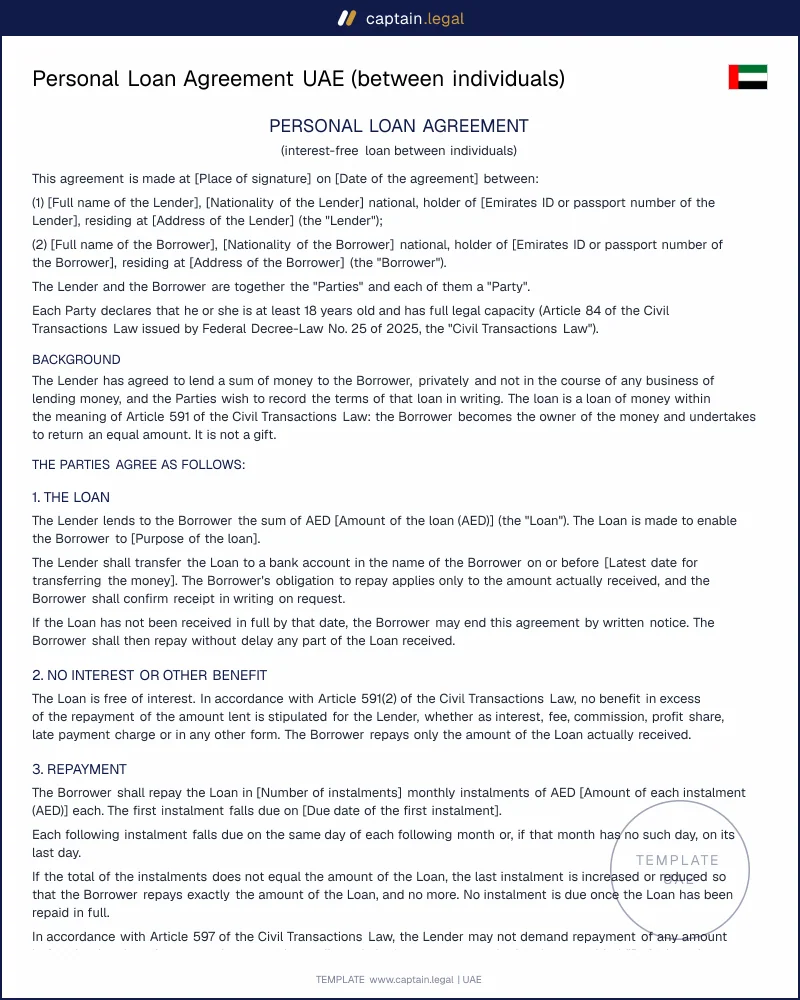
Self-service template for an interest-free loan between individuals under the UAE Civil Transactions Law 2025: monthly, quarterly or single repayment, free early repayment, acceleration on default, optional guarantor or post-dated cheques, witnesses block.
4.5/5— 26 reviewsUAE federal law 2026Instant download
Share

Lending money to a brother, a friend or a colleague is common in the Emirates, and so is the argument that follows when nobody wrote anything down. A personal loan agreement records how much was lent, when it was paid, how it will be repaid and who stands behind the debt. This page explains the rules that shape a loan agreement UAE residents sign between individuals under the federal Civil Transactions Law, starting with the one that surprises most people: a loan between individuals cannot carry interest. Our self-service template builds an interest-free agreement with repayment in instalments or in one payment, optional guarantor or post-dated cheques, and an optional block for two witnesses.

UAE federal law

Updated for 2026

50,000+ clients

trust us

Clear prices

From AED 49.00, VAT incl.

Secure payment

Instant download

Personal Loan Agreement UAE: Interest-Free Loan Between Individuals

Secure payment

Fill in the template

What is a loan agreement in the UAE?

Under Article 591 of the Civil Transactions Law (Federal Decree-Law No. 25 of 2025), a loan is a contract by which the lender transfers ownership of a sum of money to the borrower, who undertakes to return an equal amount at the end of the agreed period. The borrower becomes the owner of the money and may spend it, which is what distinguishes a loan from a deposit. What the law protects is the obligation to return the same amount, nothing more. Article 593 adds that the lender must have full capacity and the borrower must be able to take on the obligation, and majority is reached at 18 Gregorian years.

A written loan agreement in the UAE is not a formality the law imposes. The contract is formed by the parties' agreement, and Article 594 then obliges the lender to hand over the money at the time agreed. Writing matters for a different reason: proof. Months later, a bank transfer with no reference can be presented as a gift, a repayment of an older debt or a contribution to shared expenses. A signed agreement that states the amount, the purpose, the date of payment and the repayment schedule removes that ambiguity. It also differs from a debt acknowledgment, which records a debt that already exists from any source. Where a sum is owed for other reasons, the debt acknowledgment and payment plan template is the better fit.

When do you need this document?

The typical case is a family loan: parents helping a son with the deposit and first rent of a flat, a sister covering school fees, cousins pooling money for a car. The amounts are often large relative to monthly salaries, and the repayment stretches over a year or more. Friends and colleagues form the second group, usually for shorter loans repaid in one payment once a bonus or an end of service gratuity arrives. Expatriates have a particular reason to write things down: if the borrower leaves the country, the lender wants a clear record of what remains due and an agreed way to pay it from abroad.

Some situations call for something else. A loan from a company, or a person who lends money regularly as a business, is outside the scope of this template, since lending as a business is a regulated activity and the agreement here is built for private, one-off loans. A shareholder funding a company should look at the documents in the business category for the UAE. And if the money has already changed hands without any paper, you can still use the template: one question lets the borrower acknowledge that the money was received on a past date.

Key clauses included in our template

The agreement opens with the full identity of each party, including nationality and Emirates ID or passport number, and a short background clause that records the loan as a private loan, not a gift. The money clause then follows one of two paths: either the lender undertakes to transfer the sum by a set date, with the borrower free to end the agreement if it never arrives, or the borrower acknowledges receipt on a past date.

  • No interest, fee or late charge appears anywhere, and a dedicated clause cites Article 591(2) so that the point is visible to both sides.
  • Repayment runs either in monthly or quarterly instalments, with the last one adjusted to the exact balance, or in a single payment by a fixed date.
  • Early repayment is free at any time.
  • Should an instalment stay unpaid 14 days after written notice, or the borrower leave the UAE permanently without an agreed arrangement, the whole balance becomes due, without any increase.

Security is optional. With a guarantor, a third person signs as a joint guarantor and the clause reminds everyone of the six-month rule of Article 1006. With post-dated cheques, the borrower hands over one cheque per due date, the lender undertakes not to present any cheque before its date and to return the unused ones, and a schedule lists them. Closing clauses cover notices, amendments in writing, governing law, the Arabic translation note and the courts of the UAE.

How to fill out this loan agreement

You start with the lender and the borrower: name as written on the Emirates ID or passport, nationality, ID number and address. The next step asks for the amount in figures, the purpose of the loan and the IBAN that will receive repayments. You then say whether the money has already been paid; the form shows either the date of receipt or the latest date for the transfer.

Repayment comes next. Choosing instalments opens a step for the number of instalments, the amount of each and the first due date, with a choice between monthly and quarterly payments. Choosing one payment asks for a single date. The security question offers no security, a guarantor whose identity you then enter, or post-dated cheques with the bank and account they are drawn on. Last come the witnesses and the place and date of signature. The preview updates with every answer. When you click Finish, the agreement is generated in Word and PDF, ready to print in two copies, or three with a guarantor. Every party signs every copy. Keep the bank transfer receipt with it, and any power of attorney for the UAE if someone signs on behalf of a party.

Common mistakes to avoid

The most frequent mistake is copying an online template that adds interest at 5 or 10 percent. Between individuals that clause is void under Article 591(2), and in a dispute it undermines the credibility of the whole document. The second mistake is paying in cash with no receipt. A transfer from the lender's account to the borrower's account, with the agreement signed the same week, is far stronger evidence. Third comes the instalment arithmetic: when the number of instalments multiplied by their amount does not match the sum lent, a mismatch invites argument about what was really agreed, even though the template adjusts the last instalment.

Guarantees produce their own trap. Lenders who accept a guarantor and then wait patiently for a year discover that the guarantor may have been released by the six-month rule, because nobody acted after the first missed payment. Cheques are misused in a different way: lenders sometimes ask for a single undated cheque for the full amount, which this template does not provide for. The personal documents for the UAE include a payment plan document if the schedule needs rewriting later.

Key takeaways

ARTICLE 591(2)

No interest between individuals, by law

Under Article 591(2) of the Civil Transactions Law, a condition giving the lender any benefit beyond repayment, other than security for that repayment, is void while the loan stays valid. Interest, fees and late payment charges therefore have no place in a loan between individuals. The template states the rule in a dedicated clause and asks the borrower to repay only the amount actually received.

SECURITY

Optional security: a guarantor or post-dated cheques

You can add a joint guarantor, identified like the parties, or a schedule of post-dated cheques. The lender undertakes not to present a cheque before its date and to return those no longer needed. For a guarantor, the agreement recalls Article 1006: the guarantor is released if no legal action is taken against the borrower and the guarantor within six months after the amount claimed falls due.

REPAYMENT

Instalments, one payment and free early repayment

Repayment runs in monthly or quarterly instalments, with the last one adjusted to the exact balance, or in one payment by a fixed date. The borrower may repay early at any time without any charge. If an instalment stays unpaid 14 days after written notice, or the borrower leaves the UAE for good without an agreed arrangement, the whole balance becomes due at once, without any increase.

Frequently Asked Questions

Yes. The Civil Transactions Law sets no special form for a loan, so the agreement is valid once the parties agree, and a signed written agreement is strong evidence of it. Notarisation is possible but not required. What can invalidate part of the document is its content: a clause granting interest or another benefit to the lender is void under Article 591(2), while the rest of the contract stays in force. The template avoids that risk by setting no interest at all. Witnesses are optional and simply make it harder to dispute a signature.

Not between individuals. Any stipulated benefit beyond repayment of the principal is void under Article 591(2), other than security for repayment. That covers interest, arrangement fees, profit shares and penalties for late payment. The borrower repays the amount actually received and nothing more. Inflation or currency movements do not change the amount either, since Article 598 requires the return of an equal amount whatever has happened to its value. If you want protection, use a guarantor or post-dated cheques, which the law treats as security rather than as a benefit.

The agreement is delivered as an editable Word document and as a PDF, both built from the answers you gave in the form. The PDF is the version to print and sign, in two originals or three when a guarantor signs. The Word file is useful if a translator needs the text to prepare an Arabic version for a court or an authority. Make sure every page of every copy matches before signing, and keep your copy with the proof of the transfer and the cheque schedule if you used one.

Under Article 429, a claim is not heard after 15 years without an acceptable excuse when the borrower denies the debt. That period runs from each due date, and Article 439 restarts it whenever the borrower acknowledges the debt, expressly or impliedly. The guarantor is a different matter: Article 1006 releases a guarantor if the lender takes no legal action against both the borrower and the guarantor within six months from the day after the amount claimed falls due. Preparing the agreement itself takes a few minutes, since it is generated as soon as you click Finish.

Yes, and many families in the UAE prefer them because each repayment then only requires the lender to deposit the cheque on its date. Cheques are governed by the Commercial Transactions Law (Federal Decree-Law No. 50 of 2022). The template lists them in a schedule, commits the lender not to present any cheque before its date and to return the cheques that are no longer needed, and states that paying a cheque discharges the corresponding amount. The cheques secure repayment and do not add anything to the amount owed, so they do not break the interest-free rule. Landlords in the Emirates rely on the same instrument for rent, as the UAE real estate templates show.

Family loans are the main use of this loan agreement UAE template. Spouses, parents, children and siblings can lend to each other on exactly the same terms, and writing the loan down protects relationships as much as money. For couples, a loan between spouses is a separate matter from the financial arrangements set out in a prenuptial agreement for non-Muslims in the UAE, and the two documents do not replace each other. Name each person exactly as on the Emirates ID.

4.5/5

26 verified reviews · UAE federal law 2026

Personal Loan Agreement UAE: Interest-Free Loan Between Individuals
  • Immediate access to the document
  • PDF + Word download
  • Written to UAE federal law
  • Self-service template, no legal advice
Fill in the template
Secure payment
Updated on 17 November 2026

You might also like

Power of Attorney UAE (draft for notarisation)
Debt Acknowledgment and Payment Plan UAE