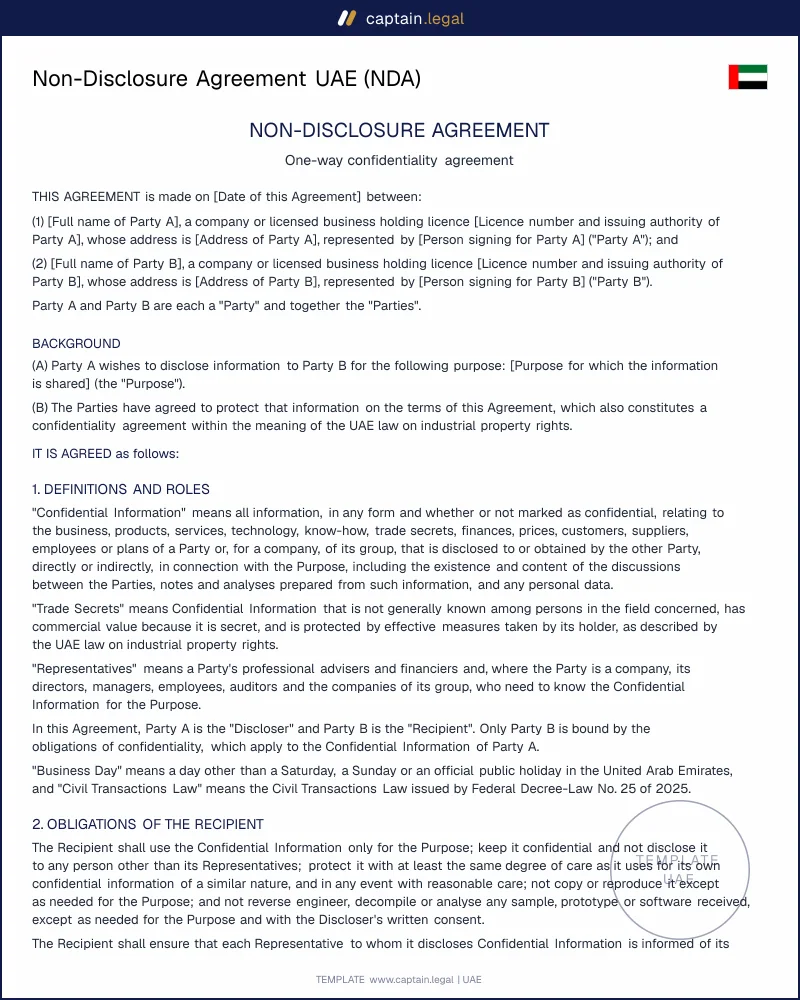
The Civil Transactions Law issued by Federal Decree-Law No. 25 of 2025, in force since 1 June 2026, contains the core rules. Article 121 requires negotiations to be started, conducted and ended in good faith, while making clear that negotiating creates no obligation to conclude the contract. Article 122 imposes a duty to disclose material information that no clause can exclude. The provision that matters most for an NDA is Article 123: any person who uses or discloses without authorisation confidential information obtained in connection with negotiations or a contract is liable under the general rules. A written NDA defines what that information is, how long it stays protected and what compensation is due.
Trade secrets have a second layer of protection under the federal law of 2021 on industrial property rights, published by the Ministry of Economy and Tourism among its federal economic laws. Its Article 61 protects undisclosed information that is secret, has commercial value because it is secret, and is protected by effective measures of its holder. Article 64 lists acts contrary to fair business practices, and one of them is the disclosure of information by a party to a confidentiality agreement. That is why the template defines trade secrets in the same terms.
For compensation, Article 340 of the Civil Transactions Law allows the parties to fix it in advance, but the court may reduce an amount it finds exaggerated, and Article 337 makes compensation depend on a prior notice unless the parties agree otherwise. Personal data shared under an NDA falls under Federal Decree-Law No. 45 of 2021.

 UAE federal law 2026