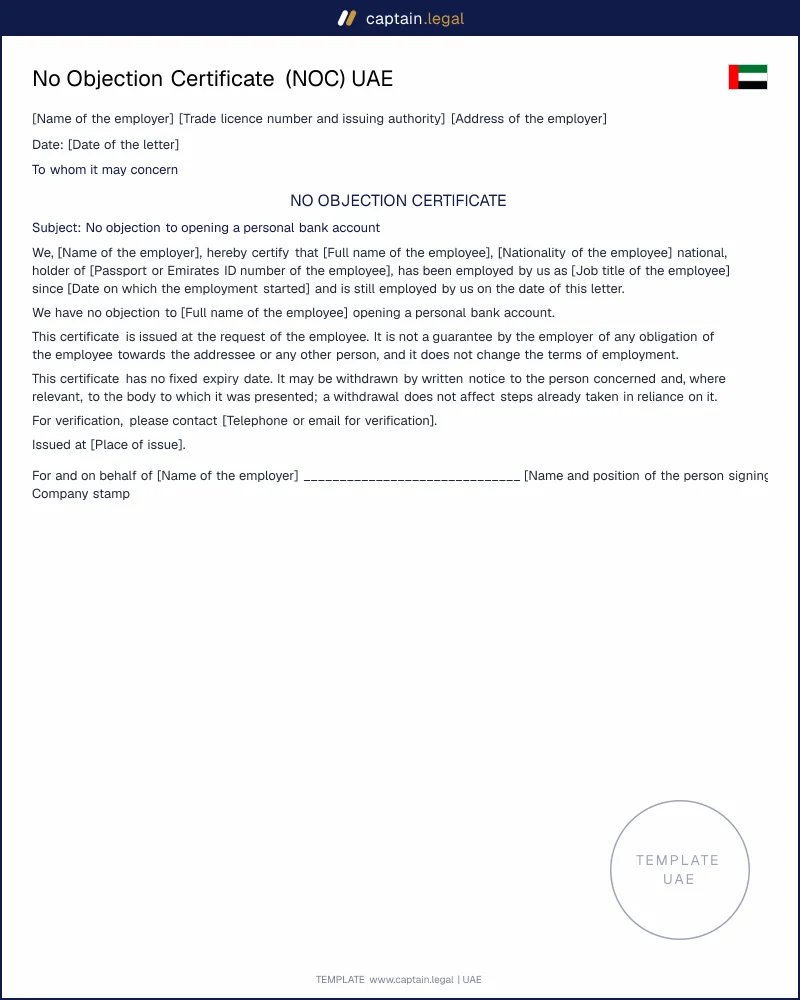
No single federal law governs the NOC letter UAE employers and landlords issue. The requirement, when it exists, comes from the procedure of the body that receives it: a bank's onboarding policy, a traffic department's checklist, a developer's fit-out rules, a licensing authority's address requirements. The letter itself is a written statement whose weight comes from the identity of the signatory, which is why companies print it on letterhead and add the company stamp, and why receiving bodies sometimes call the issuer to verify it.
Employment shows how requirements shift. Under the Labour Relations Decree-Law, Federal Decree-Law No. 33 of 2021, a worker can hold a part-time permit from the Ministry of Human Resources and Emiratisation. The government portal explains in its guide to working for two employers at the same time in the UAE that holders of a family visa need a NOC from their sponsor for a part-time permit, while skilled workers under the part-time contract system can take several jobs without the approval of their original employer, but still need the Ministry's permit. Free zones apply their own employment rules.
Tenancies follow emirate rules. In Dubai, the tenancy law (Law No. 26 of 2007, as amended) requires the landlord's permission and the licences of the competent entities before a tenant makes any change to the property (Article 19) and, unless the parties agree otherwise, does not let the tenant remove its improvements when leaving (Article 23). Utility connections in Dubai are tied to the registered Ejari rather than to a separate letter, while gas providers, developers and owners associations often ask for the owner's written consent before works start.

 UAE federal law 2026