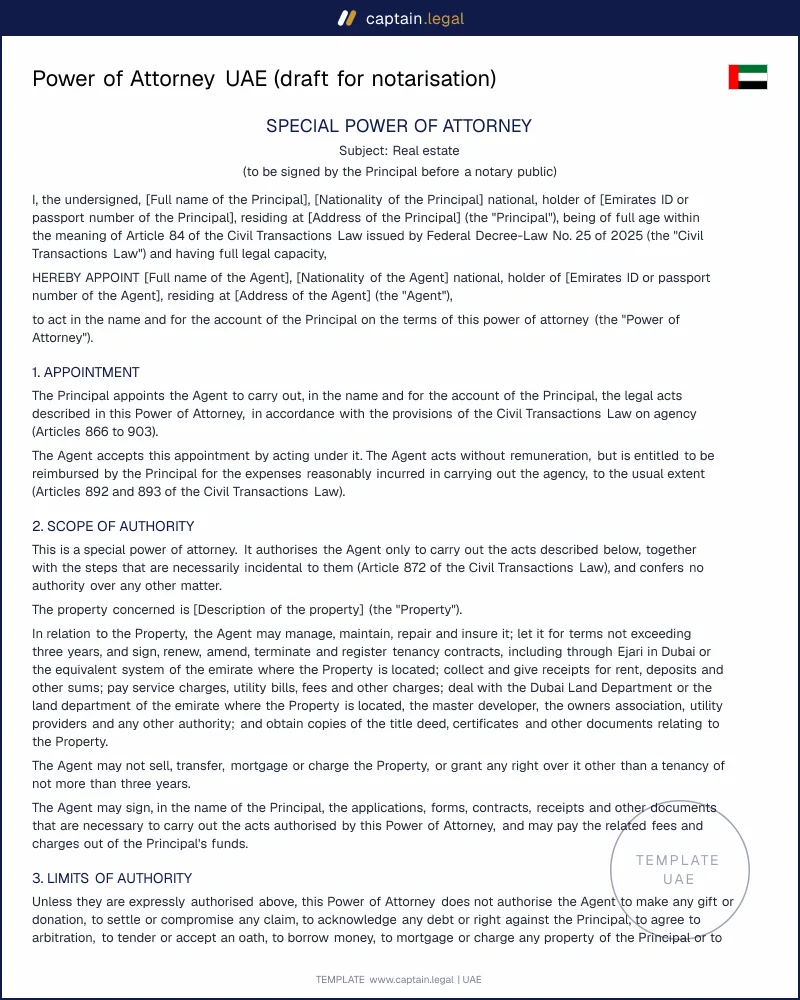
Emirati law treats a power of attorney as a contract of agency, wakala. Under Article 866 of the Civil Transactions Law (Federal Decree-Law No. 25 of 2025), agency is a contract by which the agent undertakes to carry out a legal act in the name and for the account of the principal. The agent signs for you, and the act binds you as if you had signed it yourself. A vague instrument either does too little, because banks and land departments refuse it, or too much, because it hands someone control you never meant to give.
The law distinguishes two shapes. A general power of attorney uses broad wording, and Article 871 reads such wording as covering acts of administration only: managing property, collecting sums due, paying debts, letting for up to three years. A special power of attorney names a type of act or a specific asset. For anything beyond administration, Article 870 requires a specific authorisation: sale, gift, mortgage, settlement, acknowledgment, arbitration and representation before a court all have to be spelled out. This is where most homemade documents fail, and it is the first thing a notary or a registry clerk reads. A simple authorisation letter is a different tool again: fine for collecting a parcel, useless for selling a flat.

 UAE federal law 2026