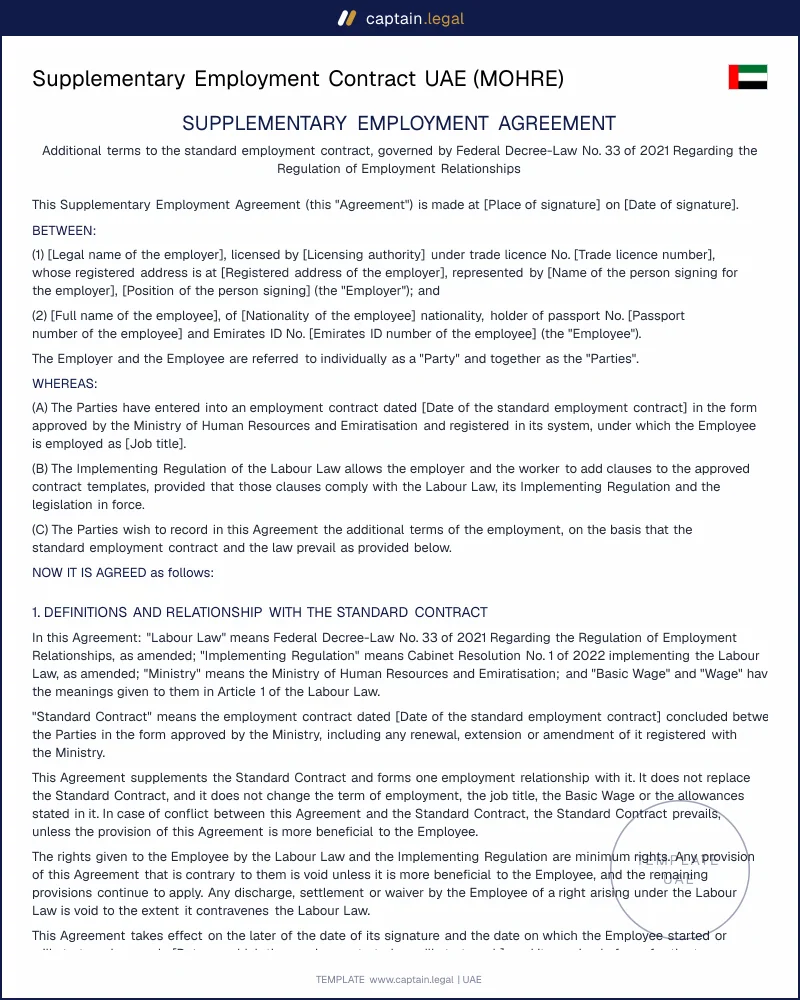
The governing text is Federal Decree-Law No. 33 of 2021 Regarding the Regulation of Employment Relationships, in force since 2 February 2022 and amended several times since. The amendment made by Federal Decree-Law No. 14 of 2022 removed the three-year ceiling on fixed-term contracts, so a contract is now concluded for a fixed term agreed by the parties and renewable. The government portal describes fixed-term contracts and work models in its page on employment contract duration and work models in the private sector. The detailed rules sit in Cabinet Resolution No. 1 of 2022, the Implementing Regulation. It lists the content of the standard contract and allows the employer and the worker to insert new clauses into the approved templates, provided those clauses comply with the Decree-Law and the Regulation. That is the legal basis of every supplementary agreement.
Three limits frame what the addendum may say. First, Article 65 treats the rights in the law as minimum rights: any clause less favourable to the employee is void, and any waiver of a statutory right is void too. Second, Article 66 makes Arabic the language of employment contracts, so the employer must provide an Arabic version signed with the English one, and the Arabic text prevails if the two differ. Third, several entitlements cannot be traded away at all, such as the gratuity under Article 51 (21 days of Basic Wage per year for the first five years, 30 days after that, capped at two years' wage), payment of final dues within 14 days under Article 53, and a notice period between 30 and 90 days under Article 43.
Non-financial free zones apply the same federal Labour Law, sometimes alongside their own employment regulations. Only the DIFC and the ADGM have their own employment laws and courts, which is why the template excludes them. Government entities and domestic workers fall under separate regimes and are excluded as well.

 UAE federal law 2026