Employment & HR

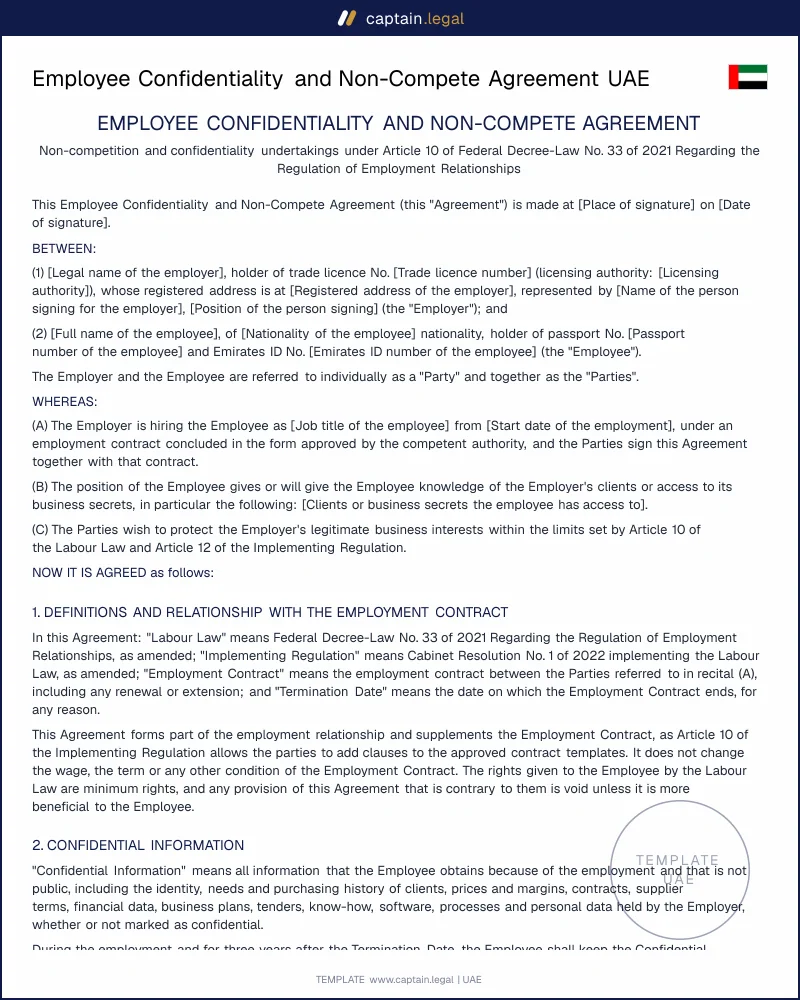
Employee Confidentiality and Non-Compete Agreement UAE

Confidentiality and non-compete undertaking of an employee in the UAE private sector, signed at hiring or during employment: six to twenty-four months, one emirate or the whole UAE, optional non-solicitation and the exemptions of Article 12 of the Implementing Regulation.
4.5/5— 30 reviewsUAE federal law 2026Instant download
Share

A non-compete agreement UAE employers ask key staff to sign is a written undertaking by which an employee agrees not to work for a competitor, within a defined area and for a limited time, after the employment ends. Paired with a confidentiality undertaking, it protects client relationships, pricing and business secrets that an employer spends years building. This template is an Employee Confidentiality and Non-Compete Agreement for private sector employers on the mainland or in a non-financial free zone. It applies the conditions of Article 10 of the Labour Law and its Implementing Regulation: a job with access to clients or secrets, a restriction of two years at most, and limits on place and type of work. It is a self-service template written to reflect UAE federal law as in force on 17 November 2026.

UAE federal law

Updated for 2026

50,000+ clients

trust us

Clear prices

From AED 49.00, VAT incl.

Secure payment

Instant download

Employee Confidentiality and Non-Compete Agreement UAE

Secure payment

Fill in the template

What is a non-compete agreement in the UAE?

Under UAE law, a non-compete is a contractual restriction attached to the employment relationship. The employer may require it only where the work allows the employee to gain knowledge of the employer's clients or access to its business secrets, and only to the extent needed to protect legitimate business interests. The restriction starts when the employment contract ends and cannot run for more than two years. That makes it very different from the duty of loyalty during employment, which the Labour Law already imposes: an employee may not work for others in breach of the law, and must keep the employer's information confidential, whether or not a separate agreement exists.

The standalone agreement exists because the standard MOHRE contract and most free zone contracts leave little room for detailed restrictions. Employers either add the clause to a supplementary employment contract that covers bonus, hybrid work and intellectual property as well, or use a short dedicated document like this one. The second route is common for senior sales staff, account managers and technical leads, and for existing employees who move into a role with client exposure. It also differs from a confidentiality agreement with a supplier or a partner company: those protect information exchanged between businesses, while this one binds an individual employee.

When do you need this document?

The classic case is a hire into a client-facing role. A key account manager who will know every buyer, purchasing volume and negotiated price is exactly the profile the law has in mind, and the restriction is best signed with the employment contract, before the first client meeting. The second case is a promotion. An engineer moving from support into architecture, or a coordinator taking over the largest accounts, gains access to secrets the original contract never contemplated, and signing a non-compete agreement in the UAE at that point records why the restriction is justified.

Employers also use the agreement when reorganising a sales team, or when a departure of one person could take a book of business along. Confidentiality and non-solicitation then matter as much as the non-compete itself, since a former employee who cannot join a competitor may still approach clients or recruit colleagues.

Two edge cases deserve attention. First, a restriction for a role without real access to clients or secrets is unlikely to hold, whatever the paperwork says, so the template asks you to describe that access concretely. Second, an independent consultant is not an employee and is not covered by Article 10; a freelance consultancy agreement with confidentiality and a restriction limited to the life of the contract fits that relationship better.

Key clauses included in our template

The agreement is short, but every clause answers a condition of the law:

  • Recital (B) records the clients or secrets the employee can reach, because that access is the legal condition for any restriction.
  • Confidentiality runs during employment and for two, three or five years afterwards, with trade secrets and personal data protected without limit of time and an express carve-out for reports to authorities.
  • Within the period chosen (six to twenty-four months) and a territory limited to one emirate or the whole UAE, the employee may not work for a competing business in a similar role or in a role that would use the protected knowledge.
  • An optional non-solicitation clause covers clients the employee dealt with in the last twelve months and colleagues.
  • No penalty figure appears anywhere. Compensation depends on the damage the employer proves.

The exceptions of the regulation are written out in a separate clause, so neither side has to look for them, and a final clause provides that a restriction found too wide applies within the limits permitted by law. Employers that need to protect information shared with outside companies should pair this document with a non-disclosure agreement for UAE businesses.

How to fill out this non-compete agreement in the UAE

You start on Captain.Legal by saying whether the agreement is signed at hiring or during the employment, which changes the first recital. The employer's legal name, trade licence number, licensing authority, address and signatory come next, followed by the employee's name, nationality, passport and Emirates ID in the 784 format.

The job step is the one that matters most. You enter the job title and start date, then describe the clients or secrets the employee can access, in concrete terms such as a buyer list, negotiated prices or source code. The next steps set the duration of the restriction, the territory (one of the seven emirates or the whole country) and the competing activity, which should name products or services rather than "any similar business". You then decide whether to add non-solicitation and how long confidentiality lasts after departure. The preview updates at each answer. Once you click Finish, the agreement is generated in Word and PDF, ready for an Arabic version and for signature by the employer's representative, with the company stamp, and by the employee.

Common mistakes to avoid

The most common error in a non-compete agreement UAE businesses copy from abroad is the "anywhere, anything, three years" clause. A restriction covering the whole GCC, any business in the sector and a period beyond two years exceeds the limits of Article 10, and an employer who relies on it in a dispute starts from a weak position. Close behind comes the clause signed by everyone in the company, from drivers to receptionists: without access to clients or secrets, there is no legitimate interest to protect. A third mistake is a fixed penalty of several months' salary. The regulation puts the burden of proof on the employer, and a figure unrelated to the actual loss invites a challenge.

Timing causes the rest. An employer that terminates the contract cannot then enforce the non-compete, so a restriction is no tool for keeping a dismissed employee out of the market. Employers also wait too long after discovering a breach, forgetting the one-year limit for bringing a claim. Finally, a release negotiated with a new employer should be documented properly: a written approval, the amount paid and a no objection certificate from the former employer avoid later arguments about whether the exemption applied.

Key takeaways

ARTICLE 10

Only for jobs with access to clients or secrets

The Labour Law allows a non-compete only where the work gives the employee knowledge of the employer's clients or access to its business secrets. The restriction must be specified in time, place and type of work, limited to what protects the employer's legitimate interests, and it cannot exceed two years from the end of the contract. The template records that access in a recital so the justification is on paper.

EXEMPTIONS

When the restriction falls away by law

The Implementing Regulation lists the cases where the non-compete does not apply: termination during probation, termination by the employer or because of its breach, a written waiver, exempted professions, and payment to the former employer of up to three months' wage with its written approval. The template writes these exceptions out in full, so employer and employee know from the start where the restriction stops.

REMEDIES

No penalty clause, damage proven by the employer

A dispute over a non-compete that is not settled amicably goes to the court, and the employer bears the burden of proving its damage and the amount claimed. The template therefore sets no fixed penalty. A claim for breach is not heard once one year has passed from the discovery of the breach, so an employer who suspects a violation needs to gather evidence quickly and act within that period.

Frequently Asked Questions

It binds the employee if the conditions of Article 10 of the Labour Law are met: the job gives knowledge of clients or access to secrets, the restriction is limited in time, place and type of work, and it does not exceed two years after the contract ends. Courts assess whether the scope is necessary to protect the employer's legitimate interests, and the employer must prove the damage it claims. The restriction falls away in the cases listed by the Implementing Regulation, such as termination during probation or termination by the employer. An Arabic version signed with the English text gives the agreement its full effect.

Both formats are available as soon as you click Finish. The Word file is convenient for adding the company letterhead or preparing a bilingual Arabic and English version for signature, while the PDF is the format most HR teams archive in the employee file. Your answers remain saved, so you can reopen the questionnaire to shorten the period, change the territory or add non-solicitation for another employee, then download a new version. Keep one signed original for each party and give the employee a copy on signature.

The maximum is two years from the end of the employment contract, under Article 10 of the Labour Law. Within that ceiling, the period must match what is necessary to protect the employer's interests, so six or twelve months is easier to justify for most roles than twenty-four. The template offers six, twelve, eighteen or twenty-four months and applies the same period to non-solicitation where that option is chosen. Separately, the employer must bring any claim for breach within one year of discovering it, or the claim will not be heard.

No. The Implementing Regulation exempts the employee from the restriction when the contract is terminated during the probationary period, whichever party ends it. The same applies when the contract is terminated by the employer or ends because of the employer's breach of its obligations. Confidentiality is different: the duty to protect the employer's information continues after any departure, including during probation. An employee leaving during probation must still respect the notice rules of Article 9, which are fourteen days or one month depending on the destination. After probation, the termination letter and end-of-service statement records the notice, the last day and the final settlement.

The regulation allows it. The employee is released if compensation not exceeding three months of the wage under the last contract is paid to the former employer, either by the employee or by the new employer, provided the former employer approves in writing. The parties can also agree at any time, in writing, that the restriction will not apply. In practice, the new employer usually negotiates the amount and asks for a signed release before the start date. Confidentiality obligations survive a buyout and continue to protect the former employer's information.

Not for the employee. This document already contains the confidentiality undertaking, the return of documents and data, and the protection of trade secrets without limit of time, in addition to the confidentiality duty that Article 16 of the Labour Law imposes. A separate agreement is useful for other people: a partner company, a supplier or an investor who receives your information. For shareholders of a limited liability company, restrictions on competing usually belong in a shareholders' agreement for a UAE LLC, which deals with partners rather than employees.

4.5/5

30 verified reviews · UAE federal law 2026

Employee Confidentiality and Non-Compete Agreement UAE
  • Immediate access to the document
  • PDF + Word download
  • Written to UAE federal law
  • Self-service template, no legal advice
Fill in the template
Secure payment
Updated on 17 November 2026

You might also like

Freelance Consultancy Agreement UAE
Supplementary Employment Contract UAE (MOHRE)