Family (non-Muslim residents)

Non-Muslim Will UAE: Civil Will for Registration in Abu Dhabi

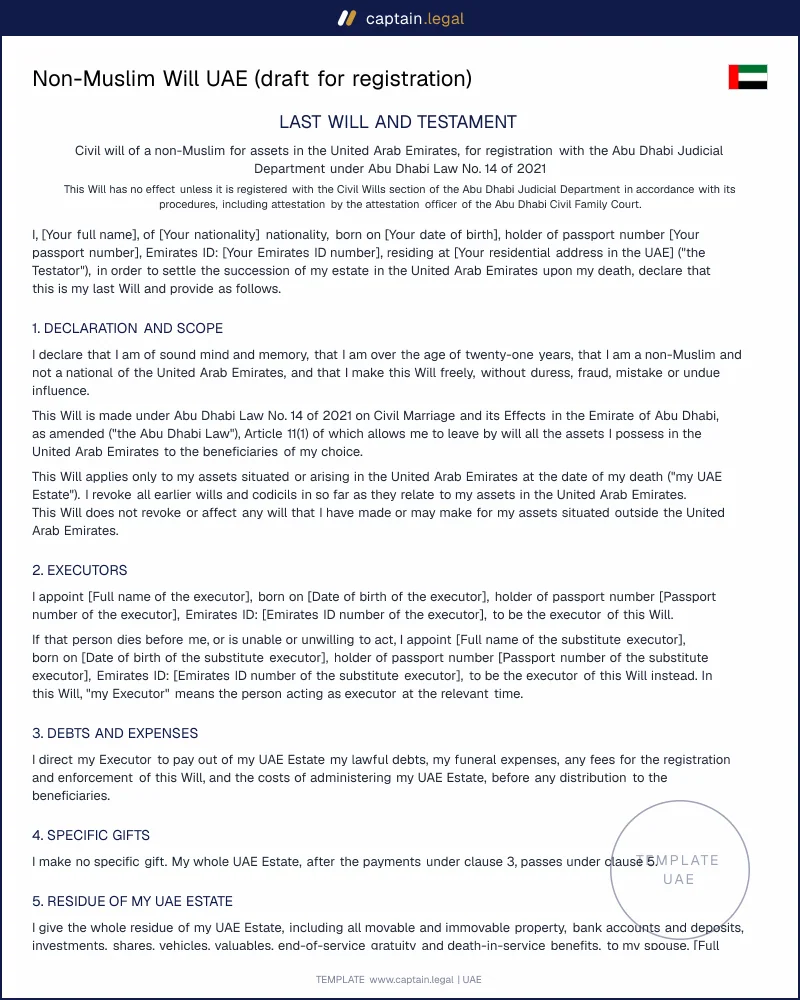
A civil will for a non-Muslim UAE resident who is not a UAE national, covering assets in the UAE: executor, residue, specific gifts and guardians. It has no effect until it is registered with the Abu Dhabi Judicial Department, including attestation by its attestation officer.
4.7/5— 10 reviewsUAE federal law 2026Instant download
Share

A civil will UAE non-Muslim residents register in Abu Dhabi decides who receives their bank accounts, property, vehicles and end-of-service gratuity in the Emirates, who administers the estate and who looks after their minor children. This self-service template is written for a non-Muslim resident who is not a UAE national, covers assets located in the UAE and is prepared for registration with the Civil Wills section of the Abu Dhabi Judicial Department. It reflects Abu Dhabi law as in force on 17 November 2026. The will has no effect until it is registered with the ADJD, including its attestation by the court's attestation officer.

UAE federal law

Updated for 2026

50,000+ clients

trust us

Clear prices

From AED 49.00, VAT incl.

Secure payment

Instant download

Non-Muslim Will UAE: Civil Will for Registration in Abu Dhabi

Secure payment

Fill in the template

What is a non-Muslim will in the UAE?

A non-Muslim will in the UAE is a written declaration in which a non-Muslim sets out how his or her assets in the country will be distributed after death. Under Abu Dhabi's civil family law, a person governed by that law may leave all of his or her assets in the UAE to any beneficiary, without the fixed shares that apply by default. The will names an executor, who collects the assets and pays the debts, may name guardians for the children, and is registered in the civil wills register of the Abu Dhabi Judicial Department. Without registration, the court will not treat it as the testator's will.

This template differs from a will made in your home country, which usually struggles to reach UAE bank accounts or a title deed in Dubai, and from a DIFC will, which follows the common-law rules of the DIFC Courts. It is deliberately limited to the Abu Dhabi civil route. Wills registered with the Dubai Courts, with a notary in another emirate or with the DIFC Wills Service Centre follow other rules and forms, so they are not covered. The template also leaves assets outside the UAE untouched: it revokes earlier wills only in so far as they deal with UAE assets, so a will made in London or Mumbai for property there keeps working. Couples who are about to marry often sign a prenuptial agreement for non-Muslim couples at the same time, since the two documents answer different questions.

When do you need a non-Muslim will in the UAE?

The classic case is a family with young children and assets in the UAE. If a parent dies without a registered will, the bank may freeze the accounts in his or her sole name, the default shares apply, and the question of who looks after the children arises at the worst moment. A registered will answers all three points: it names the beneficiaries, gives the executor the powers to act and appoints a permanent guardian, plus an interim guardian living in the UAE who can step in immediately while relatives fly in.

A second case is the couple without children who want everything to go to the survivor. Under the default rules of Article 11(2), the estate of a person without children goes to the parents or, where a parent has died, partly to the siblings, so the surviving spouse does not receive everything, which is rarely what the couple wanted. A third case is the investor with a villa, shares in a mainland company or a portfolio held through a UAE bank; the will can make specific gifts of a car or an account before the rest is shared, and partners in a company often pair it with a shareholders' agreement for a UAE LLC that deals with the transfer of shares on death. One edge case deserves attention: a parent who is divorced may name guardians, but the other parent's rights survive and the court decides in the children's interests.

Key clauses included in our template

Our non-Muslim will UAE template follows the structure of the court's own model. The will opens with a declaration of capacity and freedom, the legal basis under Article 11(1) and a scope limited to UAE assets, then appoints an executor and a substitute executor with their passport and Emirates ID numbers.

  • Three ways to share the residue are offered: to your spouse with your children as substitutes, to your children in equal shares, or to named persons in the percentages you choose.
  • A thirty-day survivorship rule applies to every gift, and grandchildren take the place of a child who dies first.
  • If every gift fails, a last-resort beneficiary receives the estate, so nothing falls back to the default rules.
  • An express direction excludes the estate rules of the Civil Transactions Law, as Article 11(3) allows for a registered will.
  • Guardianship lists a permanent guardian, an interim guardian in the UAE and a substitute for each.

Beneficiaries under 21 receive their share through the executor, who may use the income for their education, and a letter of wishes clause lets you leave informal instructions later.

How to fill out this will

You start with your identity: full name, nationality, date of birth, passport number, Emirates ID, address in the UAE and country of domicile, which the will states in its final declaration. Then come the executor and the substitute executor, each with a date of birth, passport and Emirates ID number, or "not held" for someone who lives abroad. The next step is the main choice: who receives the residue of your UAE estate. Choose your spouse with the children as substitutes, your children alone, or named beneficiaries with percentages; a married person without children who wants to leave everything to the spouse uses the third option and enters the spouse at 100 per cent. The same step asks for a last-resort beneficiary.

Guardianship has its own step. If you answer yes, you enter the children's names, dates of birth, nationalities and passport numbers, then the permanent guardian, the interim guardian and their substitutes. The last two steps let you add specific gifts and the date on which you sign. When you click Finish, the will is generated in Word and PDF. Practical documents for other personal matters, such as private loans, are grouped on the UAE personal documents page.

Common mistakes to avoid

The most expensive mistake is treating a signed copy of a non-Muslim will in the UAE as a valid will. Until the ADJD has registered it, it is a draft, and the heirs keep the right to ask for the Civil Transactions Law rules under Article 11(3). A second mistake is the home-country will that "covers everything": it rarely meets the UAE registration rules, and a new UAE will that revokes it entirely can destroy the plan for assets abroad. The template avoids that by revoking earlier wills only for UAE assets. A third mistake is naming a guardian who lives on another continent and no one in the UAE; children can wait days in a stressful situation, which is why the interim guardian matters.

Executors cause the other problems. People name a single executor who later moves away or dies first, so the template requires a substitute. Others forget that end-of-service gratuity, death-in-service benefits and insurance proceeds may follow their own nomination forms; check those forms, since the will applies only where no valid nomination exists. Finally, update the will after a marriage, a divorce or the birth of a child. A later will registered the same way, or the court's revocation form, replaces the old one.

Key takeaways

REGISTRATION

No effect until the ADJD registers it

The will is prepared for the Civil Wills section of the Abu Dhabi Judicial Department and only takes effect once registered there, including attestation by the court's attestation officer. Registration also matters for your heirs: under Article 11(3) of Abu Dhabi Law No. 14 of 2021, they may ask for the Civil Transactions Law estate rules unless a registered will provides otherwise.

BENEFICIARIES

Free choice of heirs for your UAE assets

Article 11(1) lets you leave all your assets in the UAE to anyone you choose. The template offers your spouse with the children as substitutes, your children in equal shares, or named persons in percentages, plus specific gifts, a thirty-day survival rule and a last-resort beneficiary. Without a will, half goes to the spouse and half to the children, with parents and siblings next in line.

GUARDIANS

Permanent and interim guardians for children

Following the court's own model, you can appoint a permanent guardian for your minor children and an interim guardian living in the UAE who looks after them straight away, with a substitute for each. Assets left to a beneficiary under 21 are held by your executor. The other parent's rights remain, and the court always decides in the children's interests. Assets abroad stay under your other wills.

Frequently Asked Questions

No. It becomes effective once it is registered with the Civil Wills section of the Abu Dhabi Judicial Department, which includes its attestation by the court's attestation officer. A registered will lets you leave all your UAE assets to the beneficiaries you choose under Article 11(1) of Abu Dhabi Law No. 14 of 2021, and it prevents the heirs from asking for the Civil Transactions Law rules under Article 11(3). The court still applies the law: a guardianship appointment, for example, does not override the rights of a surviving parent, and any dispute about the children is decided in their best interests.

The ADJD's wills guidance says that anyone who is not a UAE citizen may register a will with the Abu Dhabi Civil Wills Office, whatever his or her religion, and the Abu Dhabi law covers assets in the country, not only in Abu Dhabi. This template is written for UAE residents and covers UAE assets, including property and accounts in Dubai. Whether a particular asset, such as a Dubai title deed, is transferred on the strength of the Abu Dhabi will depends on the procedures of the authority concerned. Owners and tenants of Dubai homes will find their contracts on the UAE real estate documents page.

The ADJD sets the appointment and the registration procedure, and the timing depends on the service you choose and the court's calendar. The court's attestation officer attests the will and completes its registration number. You can change your mind at any time: a later will registered the same way replaces this one for UAE assets, and the court has a civil will revocation form if you simply want to cancel it. Review the will after a marriage, a divorce, a birth or a significant purchase, as the choices you made may no longer fit.

Nothing changes for them. This will applies only to assets situated or arising in the UAE at the date of death and revokes earlier wills only in so far as they relate to UAE assets. A will made in your home country for property there continues to apply, and the two documents work side by side. Check that the home-country will does not itself revoke "all previous wills" without limitation, since signing it after the UAE will could cancel the UAE will too. The usual solution is to limit each will expressly to its own assets.

The interim guardian is the person who looks after your minor children in the UAE straight after your death, until the permanent guardian can take custody. Most parents choose a close friend or relative who lives in the same emirate, knows the children and can act at short notice. The template asks for a substitute in case that person has moved or cannot act. A guardianship appointment does not remove the rights of the children's other parent if he or she survives you. Separated parents organise their lifetime arrangements in a parenting plan for non-Muslim parents.

Both formats are generated when you click Finish. The Word file is useful if an Arabic version is needed, since translation works from an editable file, or if you want to adjust a name or a gift before registration. The PDF is the clean copy to submit to the ADJD for registration. You can return to the form at any time, change an answer such as the residue option or the guardians, and download an updated version.

4.7/5

10 verified reviews · UAE federal law 2026

Non-Muslim Will UAE: Civil Will for Registration in Abu Dhabi
  • Immediate access to the document
  • PDF + Word download
  • Written to UAE federal law
  • Self-service template, no legal advice
Fill in the template
Secure payment
Updated on 17 November 2026

You might also like

Parenting Plan UAE (non-Muslim parents after divorce)
Prenuptial Agreement UAE (non-Muslims)