Real Estate & Rental

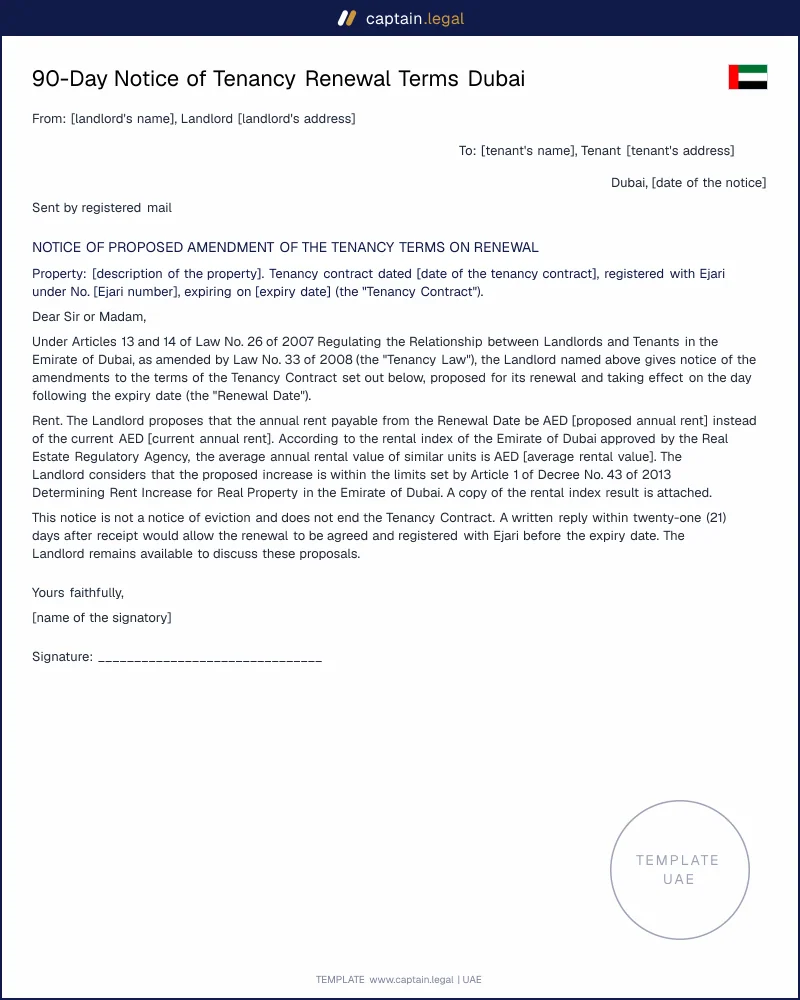
90 Day Notice Dubai Tenancy: Renewal Terms, Rent Increase or Non-Renewal Letter

Notice from a Dubai landlord or tenant proposing a new rent (within the rental index cap) or new terms for the renewal of a tenancy, at least 90 days before expiry, or a tenant's notice of non-renewal. Not an eviction notice.
4.8/5— 22 reviewsUAE federal law 2026Instant download
Share

The 90-day notice Dubai tenancy rules revolve around one sentence of the tenancy law: a party who wants to change the rent or any other term on renewal must tell the other side at least ninety days before the lease expires. This self-service template produces that written notice for a landlord proposing a rent increase or new terms, for a tenant asking for a reduction or other changes, and for a tenant announcing that it will not renew. It works for homes and business premises let under Dubai tenancy law, outside the DIFC, and it is never an eviction notice.

UAE federal law

Updated for 2026

50,000+ clients

trust us

Clear prices

From AED 49.00, VAT incl.

Secure payment

Instant download

90 Day Notice Dubai Tenancy: Renewal Terms, Rent Increase or Non-Renewal Letter

Secure payment

Fill in the template

What is a 90-day notice Dubai tenancy parties send before renewal?

It is a short formal letter, sent before the lease ends, that puts the proposed change on record. Without it, a Dubai tenancy that runs to its expiry date and continues with the tenant in occupation is renewed on the same terms, so a landlord who only mentions a new rent by phone has no written proposal to rely on. The notice identifies the property, the tenancy contract and its Ejari number, states exactly what should change from the renewal date, and is delivered in a way that can be proved later. In practice, it opens the renewal negotiation on paper.

The letter differs from two documents people often confuse with it. An eviction notice ends a tenancy against the tenant's will and follows a separate set of grounds and a twelve-month notice period, served through a Notary Public or by registered mail; this template does not cover it and says so. An addendum, on the other hand, records terms both parties have already agreed and is signed by both. The notice is the step before agreement. Once the parties settle the new rent or terms, the result is usually written into a renewed contract or a residential tenancy contract addendum and registered with Ejari. Other lease documents sit with the Dubai property templates.

When do you need this document?

Landlords use it most often three or four months before expiry, after checking the rental index for the building. If the current rent is well below the average for similar units, the landlord can propose an increase within the band and must do so in writing, in time. Some landlords also use it to change other terms: fewer cheques, a parking space no longer included, a new maintenance arrangement. When the owner lives abroad and a representative signs, the representative should hold a power of attorney for property matters in the UAE.

Tenants have their own reasons. When the index shows that similar flats now rent for less, a tenant can ask for a reduction, since Article 13 allows the rent to be reconsidered either way. A tenant may also ask for practical changes, such as paying in four cheques instead of two. The third use is the non-renewal letter: a tenant moving to a new home or office tells the landlord that the lease will end on its expiry date and asks for the inspection, the deposit refund and the Ejari cancellation. A tenant who needs to leave before expiry needs a different document, the early termination agreement for a Dubai tenancy, because the notice cannot shorten the term.

Key clauses included in our template

Every version opens with the sender and recipient blocks, the date, the delivery method and a reference line naming the property, the tenancy contract, its Ejari number and its expiry date. The salutation stays neutral so the letter works for individuals and companies alike.

  • A landlord's rent proposal states the current rent, the new rent and the average value shown by the rental index, and attaches the index result.
  • Changes to other terms are listed one by one, and the letter confirms that everything not mentioned stays the same.
  • If the tenant asks for a reduction, the letter gives the proposed rent and the factual reasons, with the reference to Article 13.
  • For a non-renewal, the tenant fixes the end date, undertakes to hand back the keys and asks for a joint inspection, the deposit refund under Article 20 and cooperation on the Ejari cancellation.

Two closing sentences matter. The landlord's version states that it is not a notice of eviction and does not end the tenancy, and both amendment versions invite a written reply within twenty-one days so that the renewal can be registered before expiry. An acknowledgement of receipt block appears when the letter is delivered by hand.

How to fill out this 90-day notice

You begin by choosing the purpose of the notice from six options: three for the landlord and three for the tenant. That single answer decides who writes to whom, the title of the letter and which paragraphs appear. Next you describe the property and enter the date of the tenancy contract, its Ejari number and its expiry date, then the names and addresses of both parties, taken from the contract.

The middle screens depend on your purpose. A landlord proposing an increase enters the current rent, the new rent and the index average; a tenant asking for a reduction enters the proposed rent and the reasons; either party can list other changes. You then choose the delivery method and the date, and name the person signing. The preview changes with each answer. When you click Finish, the notice is generated in Word and PDF, ready to sign and send.

Common mistakes to avoid

Timing is the classic failure. A landlord who sends the proposal sixty days before expiry has missed the period of Article 14, and the tenant can rely on that delay to refuse the new terms for the coming renewal. Count back from the expiry date and allow for delivery time, because what matters is when the other party receives the notice. Proof is the second weakness: a notice sent only by WhatsApp is hard to rely on, while registered mail or delivery against a signed acknowledgement leaves a record.

Landlords also overreach on the amount. Proposing twenty percent when the index allows five invites a refusal and, failing agreement, a fair rent fixed by the competent body. Check the index the week you send the notice and attach the result. Tenants make the opposite error with non-renewal: they assume the 90-day notice Dubai tenancy rule binds them by law and ignore a longer period in their contract. Finally, a landlord who wants the property back cannot use this letter, because ending a tenancy on expiry follows Article 25 and its twelve-month notice.

Key takeaways

ARTICLE 14

Ninety days to propose new renewal terms

Under Articles 13 and 14 of Dubai Law No. 26 of 2007, as replaced by Law No. 33 of 2008, a landlord or tenant who wants to change the rent or any other term on renewal must notify the other party at least ninety days before the lease expires, unless the contract says otherwise. A late proposal cannot rely on Article 14 for the coming renewal, so the letter is dated and delivered with proof of receipt.

RENT INDEX

Rent increases stay within Decree No. 43

A landlord's proposal quotes the current rent, the new rent and the average value of similar units in the official rental index, and attaches the index result. Decree No. 43 of 2013 allows no increase when the rent is up to ten percent below that average, then five to twenty percent of the current rent as the gap widens, so the figure is checked against the index before the notice leaves.

NOT AN EVICTION

A renewal proposal, never an eviction notice

The letter proposes terms; it does not end the lease. A landlord who wants the property back on expiry must follow Article 25, with one of its listed grounds and twelve months' notice through a Notary Public or by registered mail, which this template does not cover. A tenant may use it to announce that it will not renew and to ask for the inspection, the deposit refund and the Ejari cancellation.

Frequently Asked Questions

The notice is a unilateral statement, not a contract, so it binds no one to accept the new terms. What it does is put the proposal on record within the period Article 14 of the tenancy law requires, which allows the renewal negotiation to start lawfully. If the parties agree, the new terms go into a renewed contract registered with Ejari. If they do not, the proposed terms do not apply on their own, and Article 13 allows the competent body to fix a fair rent. The template applies to Dubai tenancies under Law No. 26 of 2007, not to the DIFC or Abu Dhabi.

Both formats are produced when you click Finish. Most senders print the PDF, sign it and send it by registered mail or hand it over against the acknowledgement of receipt printed at the bottom. The Word version is useful if you want to add the landlord's logo, a reference number or a second recipient before signing. Keep a copy of the signed letter, the proof of delivery and, for a rent increase, the rental index result attached to the notice.

For a change of rent or terms, Article 14 sets at least ninety days before the expiry date, unless the tenancy contract provides another period. Count from the date the other party receives the letter, not the date you print it. For a tenant who will not renew, the tenancy contract sets the period; ninety days is common practice. A landlord's eviction on expiry is a different procedure with twelve months' notice and is outside this template.

No. The notice proposes new terms; it does not end the lease. Under Article 25, as replaced by Law No. 33 of 2008, a landlord may seek eviction on expiry only to demolish and rebuild, to carry out restoration that cannot be done with the tenant inside, to use the property personally or for a first-degree relative, or to sell, and the reasons must be notified twelve months in advance through a Notary Public or by registered mail. For business premises, the commercial lease addendum for Dubai shows how renewal terms are usually agreed instead.

Silence is not acceptance. If the expiry date passes without agreement, the proposed terms do not apply on their own: failing agreement, Article 13 allows the competent body to fix a fair rent, and a tenant who stays on without any objection from the landlord is renewed under Article 6 on the same terms. That is why the letter asks for a written reply within twenty-one days, leaving time to negotiate. Company tenants sometimes need internal approval; the business templates for the UAE cover the corporate side.

Not for a proposal to amend terms. Article 2 accepts a written notice delivered by registered mail, by hand or by technological means approved by law, as well as through a Notary Public. The notarial route is the one Article 25 imposes for eviction notices on expiry, which this letter is not. Registered mail or delivery against a signed acknowledgement gives solid proof at lower cost, and e-mail works best when the address appears in the tenancy contract.

4.8/5

22 verified reviews · UAE federal law 2026

90 Day Notice Dubai Tenancy: Renewal Terms, Rent Increase or Non-Renewal Letter
  • Immediate access to the document
  • PDF + Word download
  • Written to UAE federal law
  • Self-service template, no legal advice
Fill in the template
Secure payment
Updated on 17 November 2026

You might also like

Commercial Lease Addendum Dubai (Ejari)
Tenancy Early Termination Agreement Dubai