Personal & Everyday

Debt Acknowledgment and Payment Plan UAE: Self-Service Template

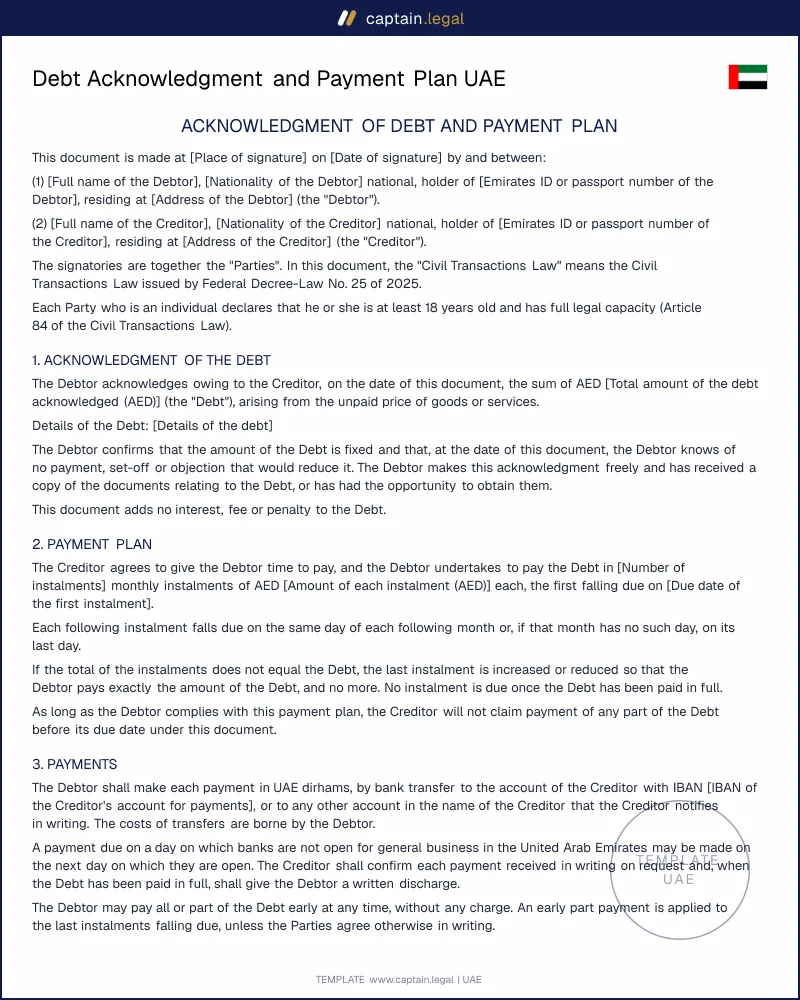
Self-service template under the UAE Civil Transactions Law 2025 for a debtor, individual or company, who acknowledges an existing debt and agrees a payment plan: instalments or one payment, free early payment, optional acceleration and guarantor, no interest added.
4.5/5— 18 reviewsUAE federal law 2026Instant download
Share

When money is owed and both sides agree on the figure, the cheapest protection is a signed page that says so. A debt acknowledgment records that a debtor, an individual or a company, owes a fixed sum to a creditor and accepts a schedule to pay it. This page explains what a debt acknowledgment UAE creditors and debtors sign actually does under the federal Civil Transactions Law, how it affects the time limit for a claim, and how our self-service template builds the document: amount and origin of the debt, a payment plan in instalments or in one payment, an optional acceleration clause and an optional guarantor. The template adds no interest or penalty and is not a demand letter.

UAE federal law

Updated for 2026

50,000+ clients

trust us

Clear prices

From AED 49.00, VAT incl.

Secure payment

Instant download

Debt Acknowledgment and Payment Plan UAE: Self-Service Template

Secure payment

Fill in the template

What is a debt acknowledgment in the UAE?

Arabic legal language calls it iqrar bi dayn: the debtor's written admission that a specific debt exists. It does not create the debt. The obligation already comes from somewhere else, an unpaid invoice, a loan between friends, rent that fell behind, the balance of a sale. What the acknowledgment adds is certainty. Once the debtor has signed a document stating the amount, the source and the date, a later argument over whether the money is owed at all becomes much harder to sustain.

Most acknowledgments signed in the Emirates also contain a payment plan, because the debtor usually signs in exchange for time. The creditor agrees not to claim the whole sum at once, and the debtor commits to instalments or to a single payment by a set date. That is why our template is a two-sided document: the debtor acknowledges, the creditor accepts the schedule, and both sign. A debt acknowledgment in the UAE is different from a loan agreement, which sets the terms of new money lent. If the money has not been lent yet, the personal loan agreement template for the UAE is the right starting point. It also differs from a settlement of court proceedings, which this document does not replace.

When do you need this document?

Trade debts are the most common trigger for a debt acknowledgment UAE businesses sign. A contractor finishes a fit-out, three invoices sit unpaid, and the client agrees on the figure but needs six months. The supplier gets a signed acknowledgment and a schedule; the client avoids a dispute and keeps the relationship. Service providers whose contracts were thin on payment terms use it the same way, and a solid services agreement template for the UAE avoids the problem on the next job.

Private debts form the second group. A friend lent money without paperwork and wants it recorded before memories diverge. A tenant who fell behind on rent agrees a plan with the landlord to clear the arrears while staying in the flat, a situation the real estate documents for the UAE also cover from the tenancy side. Family members who covered school fees or medical bills for a relative sometimes want the same clarity.

Two edge cases matter. If proceedings have already started before a court or a rental dispute body, this template does not settle or withdraw them, and the parties deal with those proceedings separately. And if the debtor is a company, the person who signs must have authority to bind it, typically the manager named on the trade licence.

Key clauses included in our template

The parties come first, with a different block for an individual (name, nationality, Emirates ID or passport, address) and for a company (name, licence number and issuing authority, registered address, signatory). An optional guarantor appears as a third party.

  • The acknowledgment states the amount in figures, the category of debt and a free description precise enough to identify invoices, a contract or a date.
  • Payment runs monthly or quarterly with the last instalment adjusted to the exact balance, or in one sum by a fixed date, and early payment is free.
  • If an instalment is missed, you choose between acceleration of the whole balance after 14 days' written notice and a softer rule where only the missed instalment is due.
  • A guarantor signs jointly and severally, with the reminder of the six-month rule in Article 1006.

The closing clauses explain that the document records an existing debt without replacing it, so any security the creditor already holds stays in place. They set out the effect on time limits under Articles 439, 441 and 433(2), the notices clause, the option to have the document attested by a notary, the Arabic translation note and the courts of the UAE. More documents of this kind sit in the personal documents category for the UAE.

How to fill out this debt acknowledgment

Filling in this UAE debt acknowledgment starts with who owes the money: an individual or a company. The form then asks for the matching details, and repeats the same choice for the creditor. Next comes the amount still owed on the day of signature, net of payments already made, and the IBAN that will receive payments. The origin step offers four categories (unpaid price of goods or services, a loan of money, unpaid rent, another cause) and a text box for the details.

The payment plan follows. Instalments open a step for their number, amount and first due date, with a choice of frequency and of what happens if one is missed; one payment asks for a single date. Last come the optional guarantor and the place and date of signature. The preview changes with each answer. When you click Finish, the document is generated in Word and PDF. Print one original for each signatory and have every original signed by everyone.

Common mistakes to avoid

The first mistake in a debt acknowledgment in the UAE is a vague description of the debt. "Money owed for work done" invites a dispute about which work and which invoices. Name the invoice numbers, the contract date or the transfer, so that the acknowledged sum can be traced. The second is the wrong amount: creditors sometimes acknowledge the original invoice total and forget a part payment received last month, which hands the debtor an argument. Third, an instalment arithmetic that does not match the debt makes it unclear what was agreed.

Companies make a mistake of their own. A document signed by an employee without authority may not bind the company, so check the signatory against the trade licence or a written authorisation, and add the company stamp. Creditors with a guarantor often wait too long: the guarantor may be released after six months if no legal action is taken. Finally, a creditor should not add a late payment percentage to a family loan, because Article 591(2) voids it. A debtor who will be abroad when the time comes to sign can authorise someone through a power of attorney for the UAE.

Key takeaways

ARTICLE 439

An acknowledgment restarts the clock on the claim

Under Article 439 of the Civil Transactions Law, the debtor's acknowledgment interrupts the period after which a claim can no longer be heard, and Article 441 starts a new one. For debts with short periods, such as rent or goods sold to a non-trader, Article 433(2) brings the period to 15 years once the debt is acknowledged in writing. Each later part payment counts as an acknowledgment too.

PAYMENT PLAN

Instalments, one payment and a missed payment rule

The debtor pays in monthly or quarterly instalments, the last one adjusted to the exact balance, or in one sum by a fixed date, and may pay early at any time without any charge. You choose what a missed instalment triggers: the whole balance after 14 days' written notice, or only that instalment while the plan continues. The creditor also signs, to accept the time given to pay.

NO PROCEEDINGS

A record of the debt, not a demand letter

The document records an existing debt and the time given to pay it, adds no interest or penalty, and keeps any security the creditor already holds. It is not a demand letter and does not settle or withdraw proceedings already started. An optional guarantor signs jointly and severally, with a reminder of the six-month rule of Article 1006, and the parties may have it attested by a notary.

Frequently Asked Questions

Yes. No special form is required for a written acknowledgment between private parties, and a document signed by the debtor is evidence of the debt in its own right. Notarisation remains an option that strengthens the document: in Dubai, an instrument processed by a notary public has the value of an official document. The template takes effect when the parties sign it, adds no interest and does not claim more than the debt stated. Its strength depends on accuracy, so the amount and the description of the debt must match the invoices or transfers behind it.

It interrupts it. Under Article 439 of the Civil Transactions Law, an acknowledgment by the debtor interrupts the period after which a claim can no longer be heard, and Article 441 starts a new period of the same length. For debts subject to the short periods of Articles 430 to 432, such as rent or goods supplied to a non-trader, Article 433(2) extends the period to 15 years once the debt is acknowledged in writing. Each later part payment also counts as an acknowledgment. Commercial debts between traders can be subject to other time limits.

The document is generated as soon as you click Finish, so it can be printed and signed the same day. The timing that matters is the payment plan: the first instalment date you choose, and the 14 days that follow a written notice before the whole balance becomes due if you selected acceleration. Leave enough time between signature and the first due date for the debtor to organise the transfer. Notarisation, if you choose it, adds the time of the notary's appointment and of the Arabic translation.

You receive a Word file and a PDF. The PDF is the version to print and sign, one original per signatory, and the Word file is useful if a translator prepares an Arabic version for a notary or an authority. A company signatory adds the company stamp next to the signature. Both formats carry exactly the clauses shown in the preview, including the guarantee and the payment schedule you selected.

Yes, as debtor or as creditor. The template asks for the company name as shown on the trade licence, the licence number and issuing authority, the registered address and the name and position of the person who signs. That person must have authority to bind the company, for example as a manager named on the licence or under a board resolution. A debt between two companies may fall under the Commercial Transactions Law, and the business documents for the UAE include contracts that set payment terms from the start.

The template adds none. In a loan governed by the Civil Transactions Law, a condition giving the lender interest or any other benefit is void under Article 591(2), and other debts do not carry contractual interest unless an agreement provides for it. Adding a new interest charge in the acknowledgment would also make the debtor less likely to sign. The document therefore records the amount owed, the dates and the consequences of a missed payment, and leaves the law to apply to any late payment as it stands.

4.5/5

18 verified reviews · UAE federal law 2026

Debt Acknowledgment and Payment Plan UAE: Self-Service Template
  • Immediate access to the document
  • PDF + Word download
  • Written to UAE federal law
  • Self-service template, no legal advice
Fill in the template
Secure payment
Updated on 17 November 2026

You might also like

Personal Loan Agreement UAE (between individuals)
No Objection Certificate (NOC) UAE